Summary label: DEEP-DIVE TIMELINE REPORT | PART 1 OF 4
How PNS 49:2026 emerged as an updated reinforcing-steel standard for an earthquake-prone country—and why approval did not immediately make it mandatory

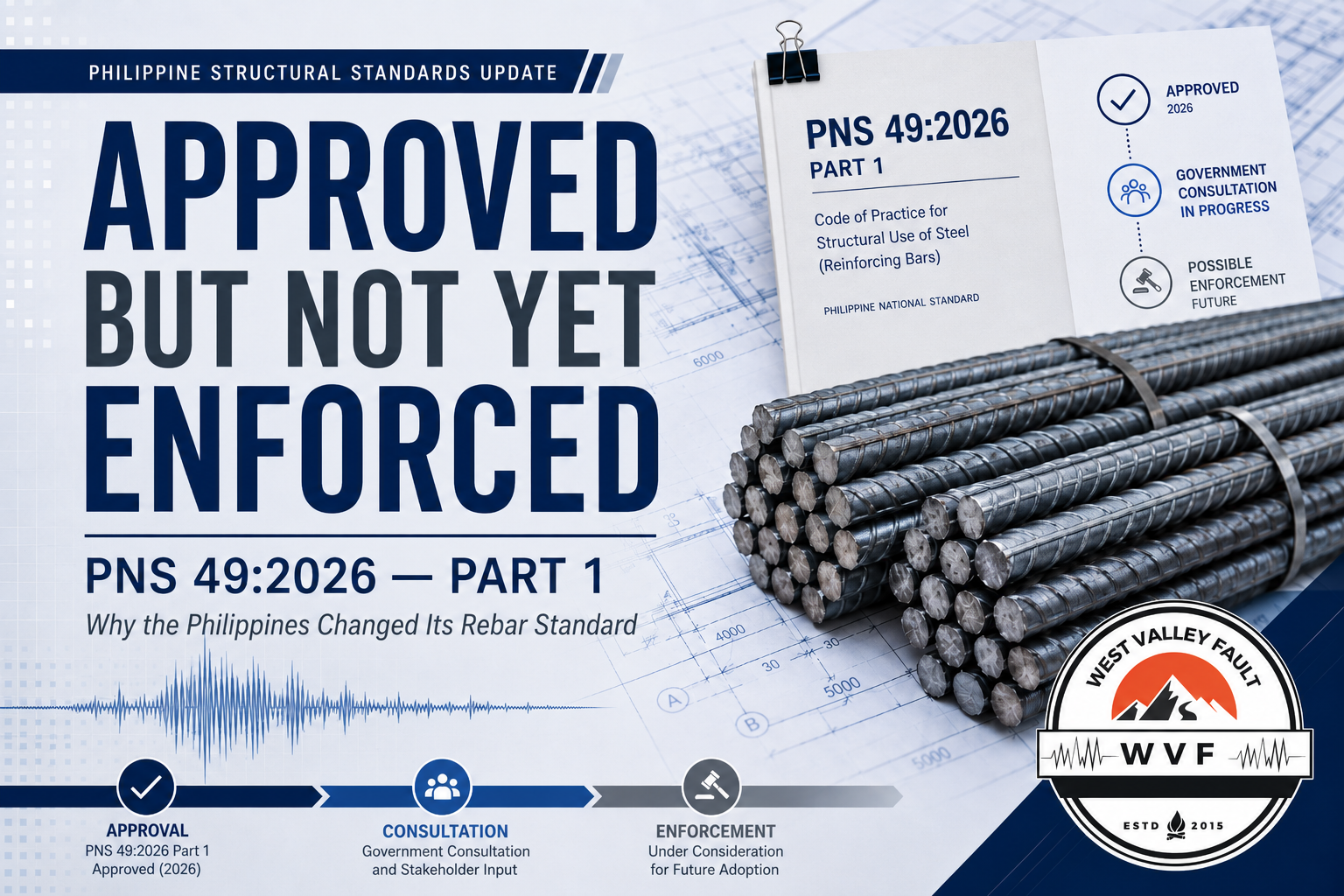
Approved but Not Yet Enforced
A four-part WestValleyFault™ Deep-Dive Timeline Series
Part 1 — Why the Philippines Changed Its Rebar Standard
Why reinforcing-steel standards matter, what PNS 49:2026 was intended to change, and why its May 2026 approval did not immediately make the new requirements mandatory.
Part 2 — The Campaign to Make PNS 49:2026 Mandatory
PISI’s June 8 appeal, the wider June industry campaign, concerns over smaller construction projects and induction-furnace steel, and DTI’s announcement that an implementing directive was coming.
Part 3 — The Fight Over the April 2027 Deadline
The July 23 public consultation, the proposed transition to April 30, 2027, PISI’s objection to that timetable, and the reported provisions that became central to the dispute.
Part 4 — What Enforcement of PNS 49:2026 Would Actually Mean
The wider implementation challenge, the limits of what stronger steel standards can accomplish on their own, and what the new requirements could mean for manufacturers, builders, regulators, and the public.
You are reading Part 1 of 4.
About this report
This article is part of a source-based reconstruction of the development of PNS 49:2026 and the debate surrounding its implementation. Technical provisions and stakeholder claims are presented according to their attribution in the news reports reviewed.
WestValleyFault.com does not independently audit steel manufacturers, certify products, evaluate steelmaking technologies, or determine the appropriate regulatory timetable.
30-Second Takeaway
The Philippines reportedly approved PNS 49:2026 in May 2026 to update the standard governing reinforcing steel used in concrete construction.
The revision was described in the news coverage as an effort to align reinforcing bars more closely with current structural and seismic-design expectations. Industry representatives said it would restrict certain lower-grade and regular non-seismic bars from structural use and push the market toward higher-grade products.
But approval did not make the new requirements immediately mandatory.
That distinction—between having an updated standard and actually enforcing it—would become the starting point for the implementation debate that followed.
Continue the Full PNS 49:2026 Timeline

The approval of a stronger steel standard was only the beginning.
Subscribe to continue reading how PNS 49:2026 moved from technical approval to an industry campaign, a government consultation, and a growing debate over earthquake safety and enforcement.
As a welcome gift, you’ll also receive our FREE Earthquake Quick Start Guide.
Executive Summary
Reinforcing steel is one of the materials that helps concrete buildings resist the forces generated during an earthquake.
Concrete performs well under compression but is much weaker when forces pull it apart. Steel bars embedded inside concrete help carry these tensile forces and allow structural elements to deform under stress.
For earthquake-resistant construction, strength alone is not enough. Reinforcing steel must also behave in a predictable and sufficiently ductile manner so that structural components can bend and absorb energy rather than fail abruptly.
This is why steel standards matter.
According to the news reports reviewed, the Bureau of Philippine Standards approved PNS 49:2026 in May 2026 as an updated standard for deformed reinforcing bars used in concrete construction.
The reports described the revision as an effort to better align reinforcing-steel requirements with the National Structural Code of the Philippines and current seismic-design expectations.
Industry representatives said the updated standard would restrict certain lower-grade and regular non-seismic reinforcing bars from structural applications and move the market toward products intended to meet higher seismic-performance requirements.
These descriptions are presented according to their attribution in the news coverage. The reviewed reports did not reproduce the complete technical text of PNS 49:2026, and this report does not independently reconstruct provisions that were not clearly described.
The most important issue at this stage was not the technical detail of every requirement. It was the status of the standard itself.
PNS 49:2026 had reportedly been approved, but the updated requirements were not yet mandatory throughout the market. A further Department of Trade and Industry issuance was still needed before the new standard became the compulsory benchmark for covered products.
That created the gap that would drive the next phase of the story.
Part 1 explains why reinforcing-steel standards matter and establishes the May 2026 starting point. Part 2 follows the campaign that began when the Philippine Iron and Steel Institute called on DTI to make PNS 49:2026 mandatory without delay.
Subscribe to continue reading
Subscribe to get access to the rest of this post and other subscriber-only content.