
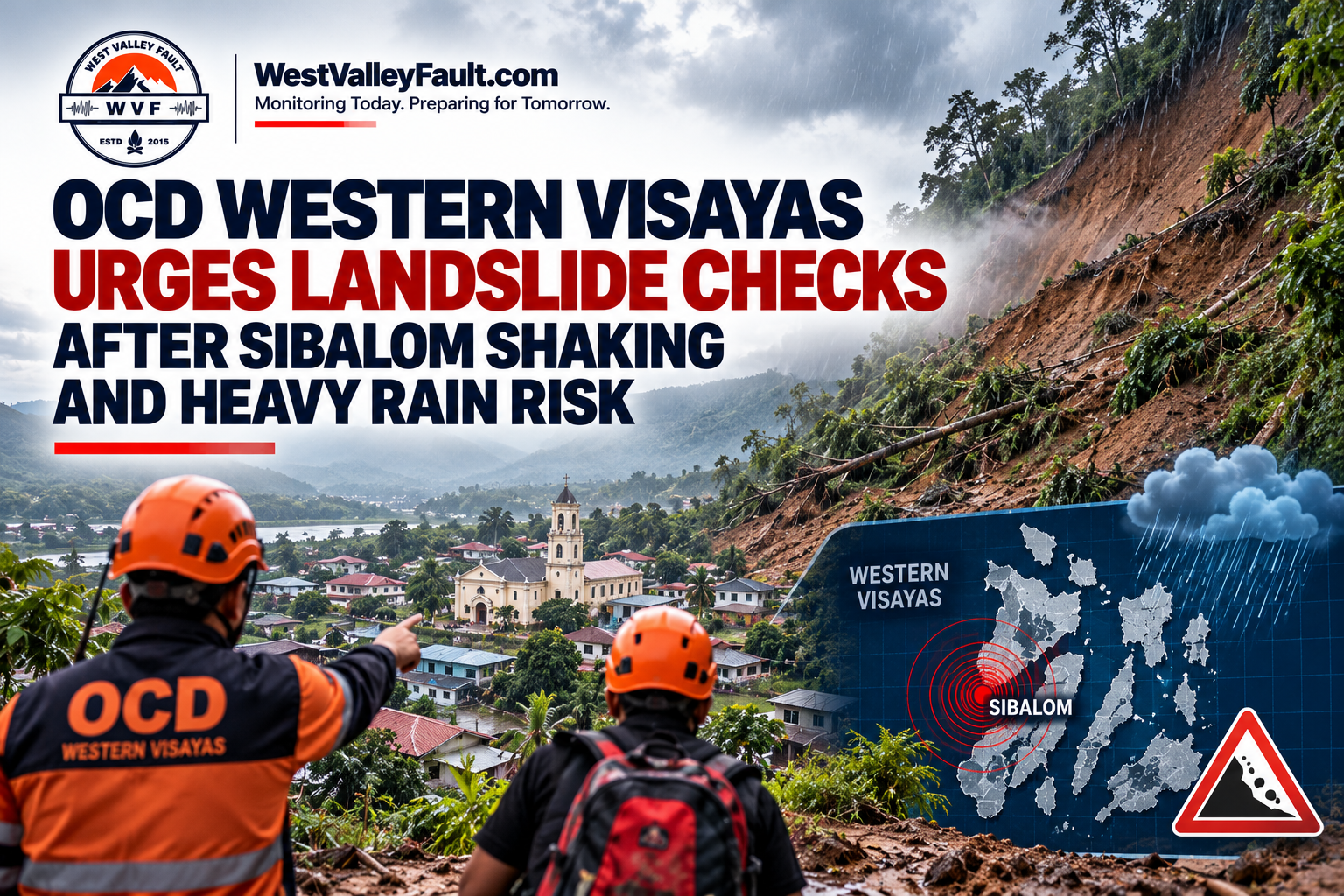
ILOILO CITY — The Office of Civil Defense (OCD) Western Visayas has urged local disaster councils to identify landslide-prone communities and prepare for possible preventive evacuations after recent earthquake shaking in Sibalom, Antique, raised concerns about ground already saturated by rain.
The warning was reported by the Philippine Information Agency on October 23, 2026, as regional agencies prepared for the possible effects of Super Typhoon Rosal (Champi). OCD VI Regional Director Raul Fernandez stressed that seismic shaking and saturated slopes are hazards that local governments need to evaluate together, rather than separately.
Regional council under Blue alert
According to PIA, the Regional Disaster Risk Reduction and Management Council (RDRRMC) VI Operations Center maintained Blue alert status as of 5 p.m. on October 22, following an October 21 pre-disaster risk assessment (PDRA) scenario-building meeting. The status supports regional monitoring and coordination; it is not evidence of a particular municipal evacuation or response-team deployment.
The Mines and Geosciences Bureau (MGB) VI reported 1,497 barangays across 58 municipalities highly susceptible to rain-induced landslides and flooding under a forecast-based assessment using October 20 rainfall data. The PIA report identified 860 barangays in Iloilo and 405 in Capiz in that screening. These numbers represent susceptibility in the cited hazard-and-rainfall assessment, not confirmed landslide incidents or households evacuated.

OCD warns of shaking and saturated ground
Fernandez pointed to the recent minor earthquake in Sibalom, Antique, while directing local councils to identify locations where prior shaking could coincide with rain-saturated slopes. He urged local governments to consider preventive evacuation where conditions warrant it. The report does not claim the Sibalom earthquake caused any particular landslide.
Local DRRMCs were also encouraged to conduct localized PDRA, keep Incident Management Team members on standby for possible activation, and prepare welfare supplies for potential response. Standby instructions must not be confused with verified team activation or completed evacuation.
Why these hazards need to be considered together
Earthquake shaking can reduce slope stability or disturb already vulnerable ground. Heavy or prolonged rainfall can increase water content and pore-water pressure in soil and rock. Where both conditions affect a susceptible slope, authorities may need more conservative monitoring and protective decisions. However, neither shaking nor saturation alone establishes that a particular slope will fail.
The regional announcement is not a site-specific engineering assessment, nor a forecast of a particular landslide location or time. Residents in identified hazard zones should follow alerts and evacuation directions from their LGU and official disaster authorities.
What remains to be verified
The October 23 PIA account establishes preparedness directives and regional monitoring status. It does not establish which local councils completed new slope assessments, whether any specific preventive evacuation was ordered in response to the Sibalom shaking, or which Incident Management Teams, if any, were activated.
For related preparedness guidance, WVF’s first 72 hours guide discusses household needs after a damaging event, while its guide to checking property hazards with PHIVOLCS tools explains why official hazard information and location-specific assessments matter. Neither is a substitute for current local landslide alerts.
Stay Informed. Stay Prepared.
Get continuing earthquake intelligence, preparedness updates, Special Reports, and the WestValleyFault.com Weekly Earthquake & Preparedness Intelligence Report delivered to your inbox.

As a welcome gift, you’ll also receive the FREE WVF Earthquake Preparedness Quick Start Guide with practical first steps every household can take before a major earthquake.
Enter your email below to join the WVF email list. Unsubscribe anytime.
Recommended Further Reading
- The First 72 Hours After the Big One: A Metro Manila Family Survival Guide
- How Close Is Your Home to the West Valley Fault?




Leave a Reply