
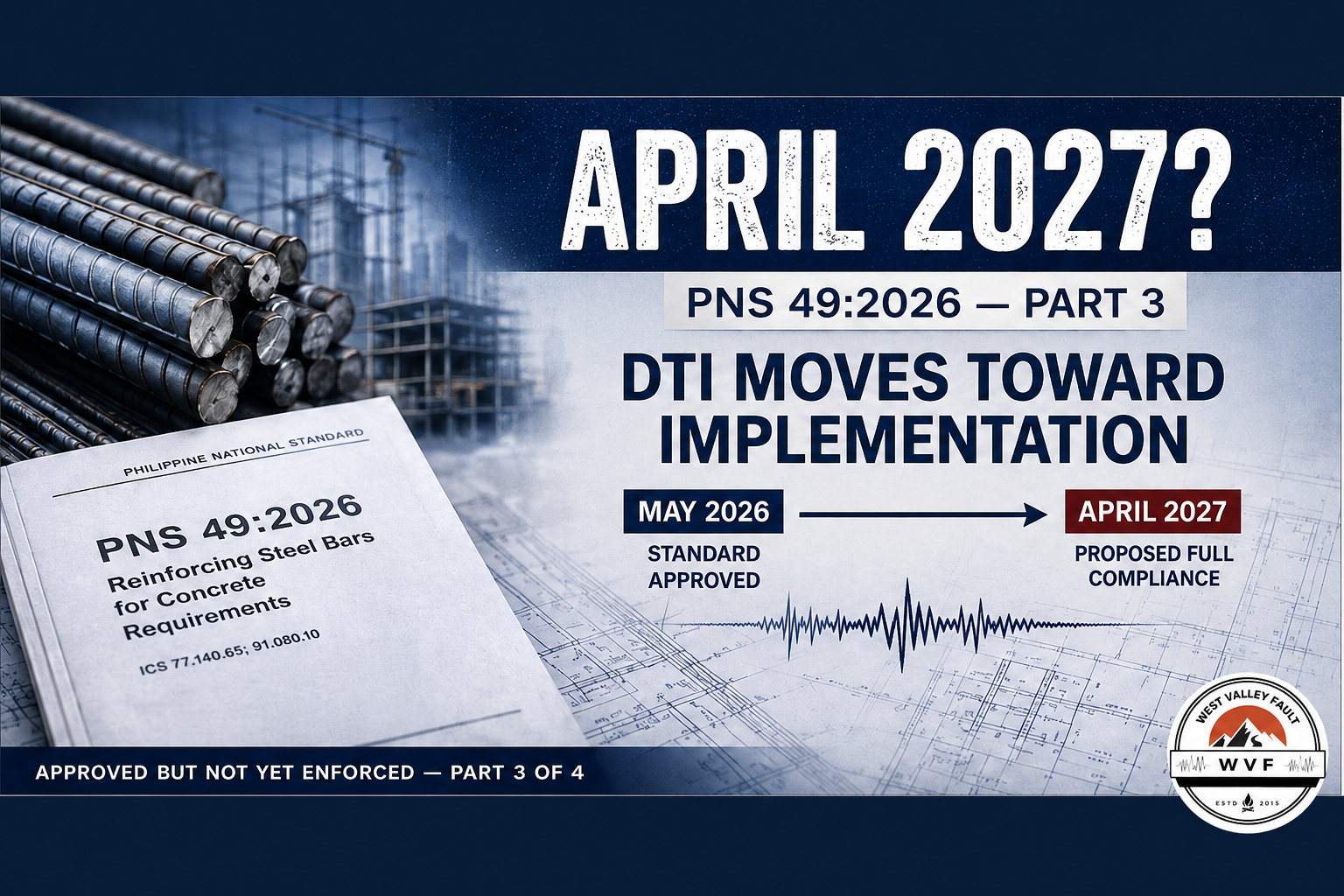
Summary label: DEEP-DIVE TIMELINE REPORT | PART 3 OF 4
How the government’s July consultation introduced an April 2027 compliance date—and shifted the PNS 49:2026 debate from approval to timing

Approved but Not Yet Enforced
A four-part WestValleyFault™ Deep-Dive Timeline Series
Part 1 — Why the Philippines Changed Its Rebar Standard
Why reinforcing-steel standards matter, what PNS 49:2026 was intended to change, and why its May 2026 approval did not immediately make the new requirements mandatory.
Part 2 — The Campaign to Make PNS 49:2026 Mandatory
PISI’s June 8 appeal, the wider June industry campaign, concerns over smaller construction projects and induction-furnace steel, and DTI’s announcement that an implementing directive was coming.
Part 3 — The Fight Over the April 2027 Deadline
The July 23 public consultation, the proposed transition to April 30, 2027, PISI’s objection to that timetable, and the reported provisions that became central to the dispute.
Part 4 — What Enforcement of PNS 49:2026 Would Actually Mean
The wider implementation challenge, the limits of what stronger steel standards can accomplish on their own, and what the new requirements could mean for manufacturers, builders, regulators, and the public.
You are reading Part 3 of 4.
About this report
This article is part of a source-based reconstruction of the development of PNS 49:2026 and the debate surrounding its implementation. Technical provisions and stakeholder claims are presented according to their attribution in the news reports reviewed.
WestValleyFault.com does not independently audit steel manufacturers, certify products, evaluate steelmaking technologies, or determine the appropriate regulatory timetable.
Previously in the Series
PNS 49:2026 was reportedly approved in May 2026, but the updated reinforcing-steel requirements did not immediately become mandatory.
That gap became the focus of an industry campaign.
On June 8, the Philippine Iron and Steel Institute asked DTI for immediate nationwide implementation. By late June, steel-industry organizations were publicly arguing that older or regular non-seismic reinforcing bars could continue circulating while the new standard remained voluntary.
The campaign also raised questions about smaller construction projects, hardware-store sales, cost, available supply, and induction-furnace steel.
By the end of June, industry groups had made their position clear.
What remained unclear was how—and when—DTI intended to act.

Chapter 5
July 20–22: DTI Announces That an Implementing Order Is Coming
By the second half of July 2026, the campaign surrounding PNS 49:2026 had reached a turning point.
For more than a month, steel-industry organizations had urged the Department of Trade and Industry to make the updated reinforcing-steel standard mandatory.
What remained missing was a clear government timetable.
That began to change on July 20, when Trade Secretary Ma. Cristina Roque reportedly confirmed that DTI was preparing an implementing directive for the updated standard.
According to the news reports reviewed, the department expected to issue the directive in August following consultation and government review.
The announcement provided the clearest indication yet that PNS 49:2026 was moving from technical approval toward formal implementation.
It also changed the central question.
The debate was no longer simply:
Will DTI make PNS 49:2026 mandatory?
It was becoming:
When will compliance begin, and how much time will the market receive before the new requirements take full effect?
DTI Signals That the Standard Is Moving Forward
The July announcement showed that the government had entered the implementation stage.
DTI was no longer simply considering an approved standard. It was preparing the regulatory instrument that would determine how the updated requirements would be applied.
That mattered because an implementing order would have to address practical questions beyond the technical standard itself.
These included:
- When mandatory compliance would begin.
- Which products or grades would be affected.
- How existing inventories would be treated.
- What certification and testing requirements would apply.
- How manufacturers, importers, distributors, and retailers would adjust.
- How government agencies would monitor compliance.
The reviewed reports did not yet provide DTI’s final position on those questions.
But the announcement established something important: the government intended to act.

July 22: Public Consultation Announced
On July 22, reports confirmed that DTI would conduct a public consultation the following day on the draft memorandum circular covering the updated standard for deformed steel bars.
Stakeholders were invited to submit comments and recommendations before the department finalized the issuance.
The consultation represented the next formal stage of implementation.
For manufacturers and industry groups, it was an opportunity to raise concerns about compliance, production, certification, inventories, and timing.
For DTI, it provided a mechanism for gathering stakeholder input before the final rules were issued.
But it also created the setting in which the most important disagreement of the next phase would emerge.
Until then, the steel industry had been asking when the government would act.
After the consultation, the question would become whether DTI was acting fast enough.

Chapter 6
July 23: The Proposed April 2027 Deadline Emerges
The July 23 public consultation brought the implementation timetable into public view.
According to reports published immediately afterward, the draft memorandum circular allowed public comments until September 21, 2026, while full mandatory compliance with the updated requirements would begin on April 30, 2027.
That meant the transition from consultation to full compliance would extend for roughly nine months.
The timetable changed the debate almost immediately.
Steel-industry groups had spent June arguing that PNS 49:2026 should be implemented without delay.
The proposed schedule suggested something very different: even if the implementing directive was issued in the coming months, manufacturers, sellers, and other affected parties could still have additional time before full compliance became mandatory.
For PISI, that was the central problem.
Issuance and Compliance Were Different Milestones
The distinction between issuing a regulation and requiring full compliance became critical.
DTI had indicated that an implementing directive could be issued as early as August.
But if the draft timetable remained unchanged, full mandatory compliance would still not arrive until April 30, 2027.
In other words:
The rule could be issued months before everyone covered by it was required to comply.
Transition periods are common when new technical requirements affect manufacturing, certification, inventories, distribution, and enforcement.
They can give companies time to adjust production, obtain approvals, manage existing stocks, and prepare documentation.
Government agencies may also need time to establish testing, inspection, and enforcement procedures.
But the reviewed news coverage did not explain why DTI considered nine months appropriate.
This gap matters.
The reports clearly documented the proposed dates, but they provided much more detail about PISI’s objections than about the government’s technical reasoning for the timetable.
The report therefore cannot independently conclude that the proposed transition was either necessary or excessive.
It can only reconstruct how the timetable became the next point of conflict.
What Could Happen During the Transition?
From the industry groups’ perspective, the practical concern was straightforward.
If the new requirements would not become fully mandatory until April 2027, products permitted under the previous rules could potentially remain available during the transition.
That possibility had already been at the center of the June campaign.
PISI and allied organizations argued that the purpose of PNS 49:2026 was to move the market away from steel products they considered inadequate for current seismic-design expectations.
A long transition, in their view, would postpone that shift.
However, the existence of a transition did not mean that every product sold during the period was automatically unsafe or illegal.
Products could remain compliant with the regulations then in force until the updated requirements became mandatory.
The dispute was therefore not simply about legal versus illegal steel.
It was about how quickly the legal minimum should change.
For homeowners and buyers: Steel standards are only one part of structural safety. If you are assessing an existing home—especially before buying, renovating, or planning structural work—use our Structural Integrity Checklist for Metro Manila Homeowners to identify visible warning signs and questions that may warrant professional evaluation.

The Timeline Becomes the Story
Until July 23, most of the public discussion had focused on the content and purpose of the new standard.
After the consultation, the dates themselves became the story.
May 2026: PNS 49:2026 reportedly approved.
June 2026: Industry organizations call for immediate implementation.
July 23, 2026: Public consultation held.
September 21, 2026: Proposed end of public-comment period.
April 30, 2027: Proposed date for full mandatory compliance.
For the first time, the public could see the possible distance between technical approval and full enforcement.
Industry supporters of immediate implementation considered that distance too long.
Their response came quickly.

Chapter 7
July 23–27: PISI Rejects the Length of the Transition
PISI reportedly sent another letter to DTI on July 23, the same day as the consultation.
This time, the issue was no longer whether PNS 49:2026 should become mandatory.
The dispute was over when.
According to the reports reviewed, PISI opposed the proposed timetable and called for a much faster transition.
The organization reportedly argued that:
- The public-comment period should be shortened.
- Full compliance should not be delayed until April 2027.
- Implementation should be immediate or completed within approximately three months.
- Grade 33 and regular non-seismic reinforcing bars should be removed from structural use sooner.
- Continuing to allow older grades during a long transition could prolong what the organization considered a safety gap.
The campaign had entered a new phase.
In June, PISI had asked DTI to act.
By late July, DTI was acting—but not on the timetable PISI wanted.
The Capacity Argument
To support its demand for faster implementation, PISI reportedly cited figures for national steel-production capacity and domestic market demand.
The organization said Philippine producers had approximately eight million metric tons of annual production capacity, compared with domestic demand of about four million metric tons.
PISI used these figures to argue that the country already had enough production capacity to supply steel meeting the updated requirements.
Its conclusion was that supply should not require a lengthy transition.
These figures remain stakeholder claims.
The reviewed reports did not provide a complete breakdown of:
How much existing inventory remained in circulation.
Production capacity and immediately available compliant supply are not necessarily identical.
For that reason, the figures are important to understanding PISI’s position but should not be treated as an independent WestValleyFault.com finding that the entire market could transition immediately.
The Cost Argument Returns
The earlier estimate that higher-grade reinforcing steel would cost approximately ₱2 to ₱3 more per kilogram also supported the industry’s case for faster implementation.
Industry representatives had argued that the difference was relatively small compared with the total cost of construction and the potential safety consequences associated with structural failure.
Again, this was an industry estimate rather than a national economic assessment.
The reports did not provide a comprehensive analysis of how the transition might affect different manufacturers, construction sectors, or regions.
But the estimate played a clear role in the campaign.
Combined with the capacity figures, it allowed PISI to make a broader argument:
Compliant steel was available, production capacity was sufficient, and the price difference was manageable—so why wait until April 2027?
That was the industry’s position.
DTI’s response to that argument was less fully developed in the reviewed coverage.
Grade 33 and Regular Reinforcing Bars
Reports published from July 24 through July 27 also placed greater attention on the types of reinforcing bars that industry representatives said would be affected by PNS 49:2026.
PISI reportedly argued that Grade 33 reinforcing bars and regular non-seismic bars should no longer be permitted for structural use once the updated requirements took effect.
This became important because it connected the abstract implementation timetable with products already circulating in the market.
From PISI’s perspective, delaying full compliance meant those products could potentially remain available for several more months.
The reports, however, did not reproduce the full technical text of PNS 49:2026.
Descriptions of exactly which grades would be prohibited, restricted, reclassified, or permitted therefore remain attributed to the organizations and representatives quoted in the coverage.
Part 4 will examine those reported changes more closely.
A Debate with Unequal Representation
By late July, the public record contained a detailed industry case against the proposed transition.
PISI had presented:
- A safety argument.
- A production-capacity argument.
- A cost argument.
- A supply argument.
- A proposed alternative timetable.
The available news reports provided less detail about arguments supporting a longer transition.
There was limited reporting from manufacturers that could require additional adjustment time, distributors holding existing inventory, testing laboratories, affected retailers, or other stakeholders that might face practical compliance challenges.
DTI’s procedural position was clearer than its technical justification.
The department had conducted consultation, was preparing an implementing issuance, and had proposed a compliance timetable.
But the reviewed coverage did not provide an equally extensive government explanation defending the April 2027 date.
This imbalance must remain visible.
The news record clearly documents the disagreement.
It does not provide enough evidence for WestValleyFault.com to decide independently which timetable is correct.

Following PNS 49:2026? Get the complete professional brief.
Free PNS 49:2026 Professional Brief
Get a concise downloadable briefing on what the new rebar standard changes, where implementation stands, and what it means for builders, engineers, property professionals and other stakeholders in the Philippines. Enter your email below and we’ll send you the brief.
From Approval to a Deadline Dispute
By July 27, the story had changed considerably from where it began in May.
The sequence was now clear:
PNS 49:2026 had been approved.
Industry organizations demanded immediate implementation.
DTI began preparing the implementing rules.
A public consultation produced a proposed timetable.
And PISI rejected that timetable as too slow.
The debate had therefore moved through three distinct stages:
What should the standard require?
Then:
When will government make it mandatory?
And finally:
How long should the transition last?
The next question goes beyond dates.
If PNS 49:2026 eventually becomes fully mandatory, what exactly do the reviewed reports say will change—and what would implementation actually require across manufacturers, distributors, construction projects, regulators, and existing buildings?
That is where the final part of the series begins.
What Comes Next
Part 4: What Enforcement of PNS 49:2026 Would Actually Mean
The first three parts of this series reconstruct how PNS 49:2026 moved from approval to an implementation dispute.
The final installment turns to the practical meaning of enforcement.
Part 4 will examine:
- What the news reports say PNS 49:2026 would change.
- The reported treatment of Grade 33 and regular non-seismic reinforcing bars.
- Why mandatory rules still depend on testing, certification, distribution, inspection, and enforcement.
- What the new standard could mean for builders and consumers.
- What stronger steel requirements cannot solve on their own.
- Why PNS 49:2026 does not automatically determine whether an existing building is earthquake-safe.
The final question is no longer just when the new standard takes effect.
It is what happens when the requirements written on paper have to be applied throughout the real construction market.
Previous: Part 2 — The Campaign to Make PNS 49:2026 Mandatory
Next: Part 4 — What Enforcement of PNS 49:2026 Would Actually Mean
Sources and Methodology
Scope of the Report
This series reconstructs the development of PNS 49:2026 and the debate surrounding its implementation from the news reports reviewed.
Technical provisions, cost estimates, market-share figures, production claims, safety concerns, and stakeholder positions are presented according to their attribution in those reports.
Several reports cover the same letters, media briefings, and industry statements. These were compared to reconstruct the chronology and identify claims repeated across the coverage.
The available reporting gives substantial representation to PISI and allied steel-industry organizations. The views of manufacturers criticized by those groups, induction-furnace operators, independent metallurgical specialists, retailers, contractors, and other affected stakeholders are less fully represented in the reviewed coverage.
WestValleyFault.com does not independently:
- Audit steel manufacturers or distributors.
- Test or certify reinforcing-steel products.
- Determine whether a particular steelmaking process should be prohibited.
- Verify industry cost, capacity, or market-share estimates.
- Attribute a particular earthquake collapse to a specific type of reinforcing steel without an official finding.
- Make independent engineering, metallurgical, or regulatory conclusions.
This article is part of a Deep-Dive Timeline Series. Its purpose is to reconstruct and explain the development of the implementation campaign—not to determine whether the positions advanced by industry organizations are technically or economically correct.
For the full series methodology and editorial scope, see Part 1: Why the Philippines Changed Its Rebar Standard.
Sources Used for Part 3
BusinessMirror — July 20, 2026
DTI readies seismic steel standards directive
https://businessmirror.com.ph/2026/07/20/dti-readies-seismic-steel-standards-directive/
The Philippine Star — July 22, 2026
DTI to issue new steel safety standards in August
https://www.philstar.com/business/2026/07/22/2543683/dti-issue-new-steel-safety-standards-august
Daily Tribune — July 24, 2026
PISI seeks immediate seismic steel implementation
https://tribune.net.ph/2026/07/24/pisi-seeks-immediate-seismic-steel-implementation
BusinessWorld — July 26, 2026
Steel lobby pushing for shorter timeline to comply with quake-resistance standards
https://bworldonline.com/economy/2026/07/26/765935/steel-lobby-pushing-for-shorter-timeline-to-comply-with-quake-resistance-standards/
Manila Bulletin — July 27, 2026
DTI urged to fast-track earth-safe steel rules as quake risks surge
https://mb.com.ph/2026/07/27/dti-urged-to-fast-track-earth-safe-steel-rules-as-quake-risks-surge
The Philippine Star — July 27, 2026
Faster transition to stricter steel rebar standards urged
https://www.philstar.com/business/2026/07/27/2544866/faster-transition-stricter-steel-rebar-standards-urged
Recommended Further Reading
- Part 1 — Why the Philippines Changed Its Rebar Standard
- Part 2 — The Campaign to Make PNS 49:2026 Mandatory
- Part 4 — What Enforcement of PNS 49:2026 Would Actually Mean
- Is Your Home Fault-Line Ready? A Structural Integrity Checklist for Metro Manila Homeowners
Turn Earthquake Awareness into a Family Plan
Standards and building regulations are one part of earthquake preparedness. Your household also needs a practical plan for what happens when a major earthquake actually occurs.
The West Valley Fault™ Big One Emergency Planner helps you organize your family’s emergency contacts, evacuation arrangements, communication procedures, essential supplies, medical information, and recovery priorities in one structured place.

✔ Family emergency plans
✔ Emergency contact pages
✔ Go-bag planning
✔ Home preparedness checklists
✔ Document inventory
✔ Designed specifically for Filipino households
A practical planning system for households preparing for a major earthquake.




Leave a Reply