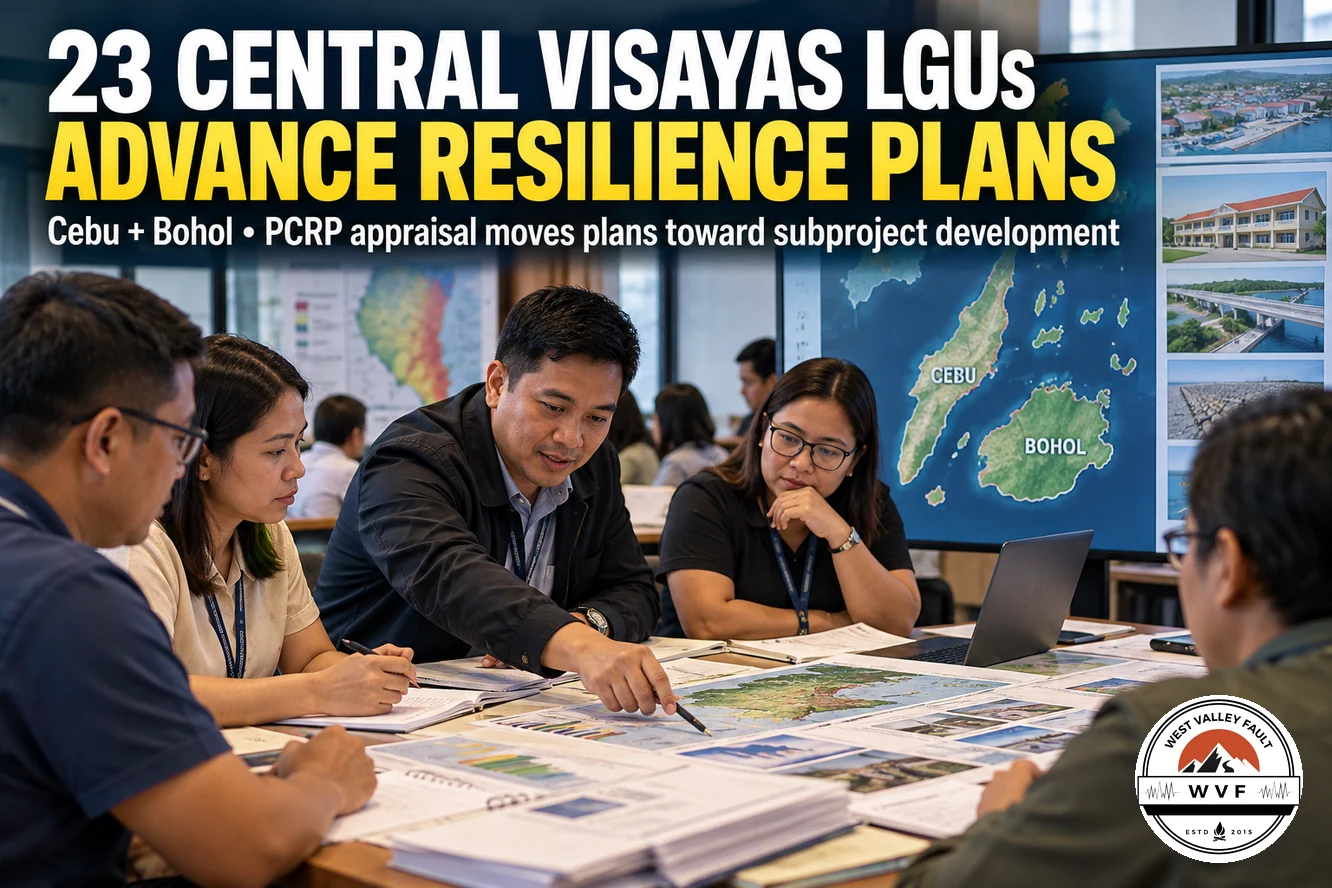
CEBU — Twenty-three local government units in Central Visayas have moved their community resilience plans through an interagency appraisal under the World Bank-backed Panahon ng Pagkilos: Philippine Community Resilience Project (PCRP), bringing participating municipalities closer to the stage where priority interventions can be developed into subproject proposals.
The Department of Social Welfare and Development Field Office VII said the appraisal was conducted on October 6, 2026 and covered 21 municipalities in Cebu and two in Bohol. DSWD published the update on October 7.
The development follows similar PCRP rollouts elsewhere in the country, including community-led resilience planning in Ilocos Sur and World Bank-backed resilience funding preparations in Northern Mindanao.
Four municipal plans received “fully met” ratings
DSWD said the Municipal Resilience Plans of Santander, Sibonga and Alegria in Cebu, and President Carlos P. Garcia in Bohol received “fully met” ratings during the appraisal. The remaining participating LGUs are expected to revise their plans based on comments and recommendations from the Regional Program Management Office and Regional Inter-Agency Committee.
A “fully met” rating does not mean that proposed projects have already been approved, funded or awarded. The appraisal is a quality-assurance step intended to check whether each plan reflects community risk and vulnerability assessments and whether proposed programs, projects and activities are supported by evidence and aligned with identified risks.
The 23 LGUs under appraisal
The Cebu municipalities are Pinamungajan, San Francisco, Medellin, Pilar, Tudela, Asturias, San Remigio, Boljoon, Bantayan, Dalaguete, Badian, Poro, Alegria, Oslob, Samboan, Malabuyoc, Santander, Tabogon, Ginatilan, Barili and Sibonga.
In Bohol, the plans of Getafe and President Carlos P. Garcia were included in the appraisal.
What happens after the appraisal
Once revisions are completed, the updated plans become the final Municipal Resilience Plans. DSWD said these plans will become the basis for identifying and developing subprojects, marking the transition from participatory risk and vulnerability assessment and resilience planning to Community Resilience Sub-Project Development.
Priority interventions identified in the plans can then be developed into subproject proposals, after which the Municipal Resilience Team prioritizes programs, projects and activities that may receive PCRP support. Selection at that stage is separate from the current appraisal.
WVF tracks verified funding, procurement and implementation developments from programs like this through the Philippine Earthquake Resilience Projects Monitor.
Why this matters for disaster and earthquake resilience
The PCRP is designed around community-led assessments of climate and natural-hazard risks. The World Bank says the nationwide project will support community resilience planning and implementation grants, particularly for resilient community infrastructure and sustainable livelihoods. The Bank identifies earthquakes among the natural hazards facing the Philippines.
For Central Visayas, this planning-to-project pipeline matters because community risk assessments can eventually lead to investments—such as evacuation facilities, resilient infrastructure, and school-safety improvements—when those needs are identified and selected. During the October 6 appraisal, a Department of Education engineer said the interagency process can also help update the agency’s pipeline of projects involving classrooms and other education facilities.
That does not mean the 23 municipal plans contain earthquake-specific projects. DSWD did not identify which proposed interventions, if any, directly address seismic hazards. WVF will treat any future earthquake-related infrastructure or school-safety proposal as a separate development that requires its own project-level verification.
For broader context on how resilience planning can translate into physical safety investments, see WVF’s coverage of DPWH’s public-school retrofitting program and why building performance remains central to earthquake risk.
A ₱56.7-billion nationwide program
DSWD Field Office VII reports a ₱56.7-billion total project cost for the nationwide PCRP. The World Bank says the project has a total cost of US$874.35 million, of which US$700 million is financed through an International Bank for Reconstruction and Development loan and the Philippine government provides the remaining US$174.35 million.
The project targets about 500 municipalities nationwide. In Central Visayas, DSWD said 27 LGUs under Batch 1 have started implementing the project, while another 15 are expected to join in the fourth quarter of 2026 following capacity assessments.
Stay Informed. Stay Prepared.
Get continuing earthquake intelligence, preparedness updates, Special Reports, and the WestValleyFault.com Weekly Earthquake & Preparedness Intelligence Report delivered to your inbox.

As a welcome gift, you’ll also receive the FREE WVF Earthquake Preparedness Quick Start Guide with practical first steps every household can take before a major earthquake.
Enter your email below to join the WVF email list. Unsubscribe anytime.
Recommended Further Reading
- World Bank-Backed Resilience Project Offers ₱50–70-Million Grants to Northern Mindanao Municipalities
- Seven Ilocos Sur Municipalities Begin Community-Led Disaster-Resilience Planning
- DOST and PCCI Establish Visayas Partnership for Disaster Technology and Business Continuity
- DPWH Opens ‘Big One’ Retrofitting Bids for 21 Public School Buildings in Manila and Taguig
Sources
- DSWD Field Office VII — PCRP Municipal Resilience Plans of 23 LGUs
- World Bank — Philippines Community Resilience Project (Pagkilos)




Leave a Reply