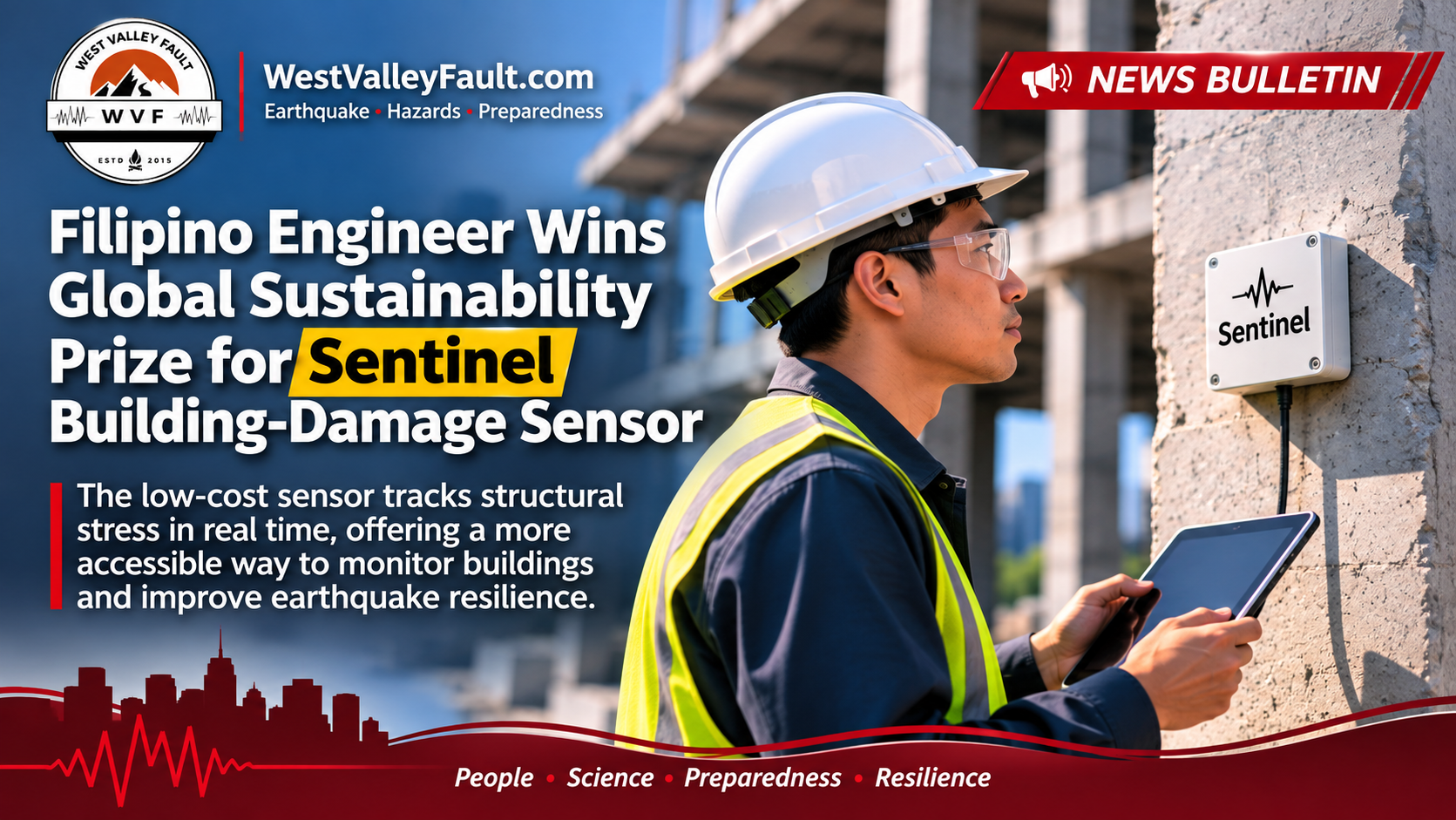
PHILIPPINES — Filipino structural engineer Aldrei Ong has won the 2026 James Dyson Award Global Sustainability Prize for Sentinel, a building-monitoring sensor designed to help identify potentially dangerous hidden damage in concrete structures. The award was announced November 4, 2026, and carries a £30,000 prize.
A concrete component turned into a sensor
Sentinel adapts a concrete spacer block, the component used to position reinforcing steel during construction, into a self-sensing element. Its conductive concrete changes electrical resistance when it is stressed or cracked. Embedded electrodes and an electronic module track those changes and can send information wirelessly to a dashboard for engineering review.
The technology is intended to help engineers identify signs of possible internal structural damage that ordinary visual inspections may miss. It does not predict earthquakes, prevent damage, or independently certify that a building is safe to occupy.
Philippine research and early field testing
Ong is a De La Salle University graduate who developed Sentinel through research on self-sensing concrete. According to Dyson’s November 4 announcement, he prepared and tested more than 125 concrete samples over more than a year. Sensor units have been embedded in a building in the Philippines for real-world monitoring, but the exact site and independently assessed performance have not been publicly established in the reviewed announcement.
Ong plans further validation, redesigned electronics and versions that could be installed in existing buildings. The announcement does not establish regulatory certification, commercial rollout, or long-term reliability across different building types.

Why this matters for earthquake resilience
After strong shaking, some cracks or internal damage may not be visible from outside a structure. Continuous monitoring could potentially help engineers prioritize detailed inspections, particularly in dense urban areas where large numbers of buildings may need assessment. WVF’s home structural-integrity checklist explains when visible warning signs warrant professional attention, while The Big One Is Not the Biggest Threat—Our Buildings Are examines the wider problem of building vulnerability. However, sensor readings require interpretation by qualified structural engineers and cannot replace formal post-earthquake inspection and safety decisions.
What still needs verification
Independent accuracy and false-alarm results, environmental effects, installation costs, performance in older buildings, local regulatory acceptance and sustained field-test results remain open questions. These are distinct from the professional structural evaluation and retrofit planning discussed in WVF’s report on the Makati City Hall retrofit-design consultancy. The award recognizes the invention’s promise, not proven universal earthquake-safety protection.
Stay Informed. Stay Prepared.
Get continuing earthquake intelligence, preparedness updates, Special Reports, and the WestValleyFault.com Weekly Earthquake & Preparedness Intelligence Report delivered to your inbox.

As a welcome gift, you’ll also receive the FREE WVF Earthquake Preparedness Quick Start Guide with practical first steps every household can take before a major earthquake.
Enter your email below to join the WVF email list. Unsubscribe anytime.
Recommended Further Reading
- Is Your Home Fault-Line Ready? A Structural Integrity Checklist
- The Big One Is Not the Biggest Threat—Our Buildings Are
- Negros Oriental and Siquijor Begin Seismic-Vulnerability Inventory of Public Buildings
- Makati City Hall Structural Retrofit-Design Consultancy
- More Than 2,300 DPWH Engineers Trained in Seismic Retrofitting
Sources
Dyson official 2026 global winners announcement, November 4, 2026; Dyson interview with Aldrei Ong, November 4, 2026; James Dyson Award Philippine competition site.




Leave a Reply