
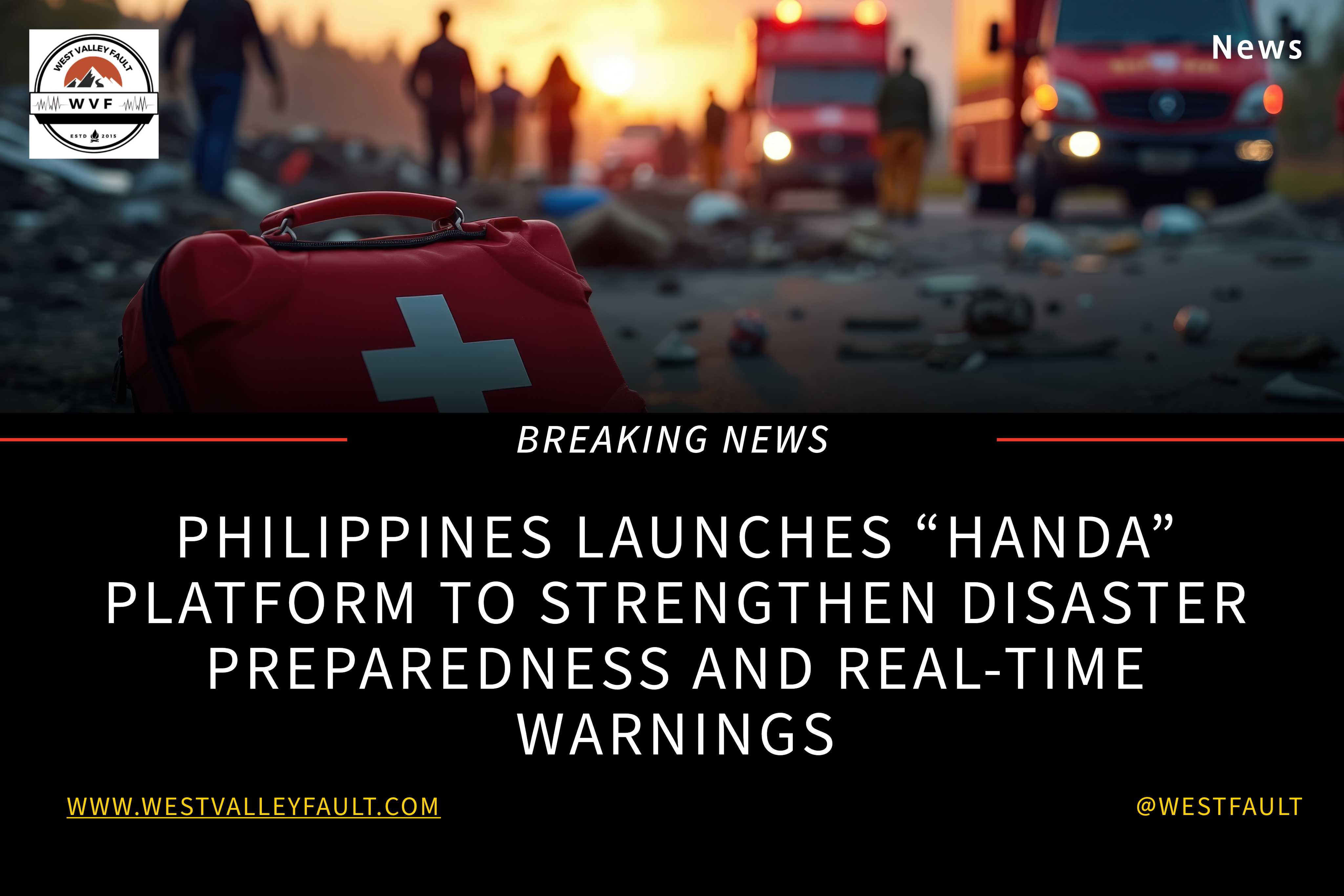
The Philippine government has introduced a new digital platform aimed at improving how the country prepares for and responds to disasters. Spearheaded by the Department of Science and Technology (DOST), the system called HANDA integrates critical disaster data and early warning tools into one centralized hub accessible to both authorities and the public.
The platform was officially launched as part of the government’s push to modernize the country’s disaster monitoring and response capabilities under the leadership of Ferdinand Marcos Jr.. Designed to streamline emergency information, HANDA consolidates multiple hazard monitoring systems into a unified digital interface.
FREE: ‘The Big One’ Emergency Family Planner (Download)
A Centralized Hub for Disaster Information
Developed by the Philippine Institute of Volcanology and Seismology (PHIVOLCS), HANDA brings together geological and hydro-meteorological data to help communities stay informed during emergencies. The platform’s name, which means “ready” in Filipino, reflects its goal of helping citizens and authorities respond quickly when disasters occur.
“Today, we come together with one big purpose — to help protect our communities during times of disaster,” said PHIVOLCS Director Teresito C. Bacolcol during the platform’s launch.

Officials explained that the system makes vital hazard information easier to access by integrating updates from several government agencies into a single platform.
Real-Time Monitoring and AI-Powered Tools
HANDA was built under the Geospatial Analytics and Technology Solutions (GATES) program and utilizes the capabilities of GeoRiskPH, a multi-agency initiative designed to provide geospatial hazard data for disaster risk reduction.

Through interactive dashboards, the platform provides users with real-time monitoring and visualizations of hazards, including the location of critical infrastructure and facilities. It also incorporates location-based alerts and artificial intelligence tools to assist in hazard analysis and emergency planning.
The system integrates official advisories from key government agencies such as the Philippine Atmospheric, Geophysical and Astronomical Services Administration (PAGASA) and the Mines and Geosciences Bureau, allowing users to see consolidated warnings and hazard information in one place.
Addressing the Philippines’ High Earthquake Activity
According to DOST Secretary Renato Solidum Jr., the platform is especially important given the Philippines’ geographic location along the Pacific Ring of Fire.
In an interview with the Daily Tribune, Solidum noted that the country records an average of around 30 earthquakes daily, partly due to the growing network of monitoring stations that detect seismic activity.

“Earthquakes are normal occurrences in the Philippines,” Solidum said.
The system enables authorities to conduct rapid hazard assessments and quickly deliver updated warnings to agencies such as the Office of Civil Defense, which coordinates emergency response and disaster management efforts nationwide.
Supporting Safer Communities
By combining early warning data, hazard mapping, and emergency advisories into a single digital platform, HANDA is expected to support better decision-making at every level—from national agencies and local governments to individual households.
Officials said the platform’s ultimate goal is to strengthen disaster preparedness across the country, ensuring communities have access to reliable and timely information when disasters strike.
Source: DailyTribune
Based on today’s article, we recommend the following items to help add to your family’s preparedness score:
- NOAA Emergency Weather Radio A1 7400mWh Portable Power Bank
- JDS c-88quake Earthquake Alarm
- BLAVOR Solar Power Bank 20,000mAh
- MARBERO Portable Power Station
Note: We only recommend items we believe adds real value to your safety plan. If you purchase through these links, we may earn a small commission at no extra cost to you.










Leave a Reply