

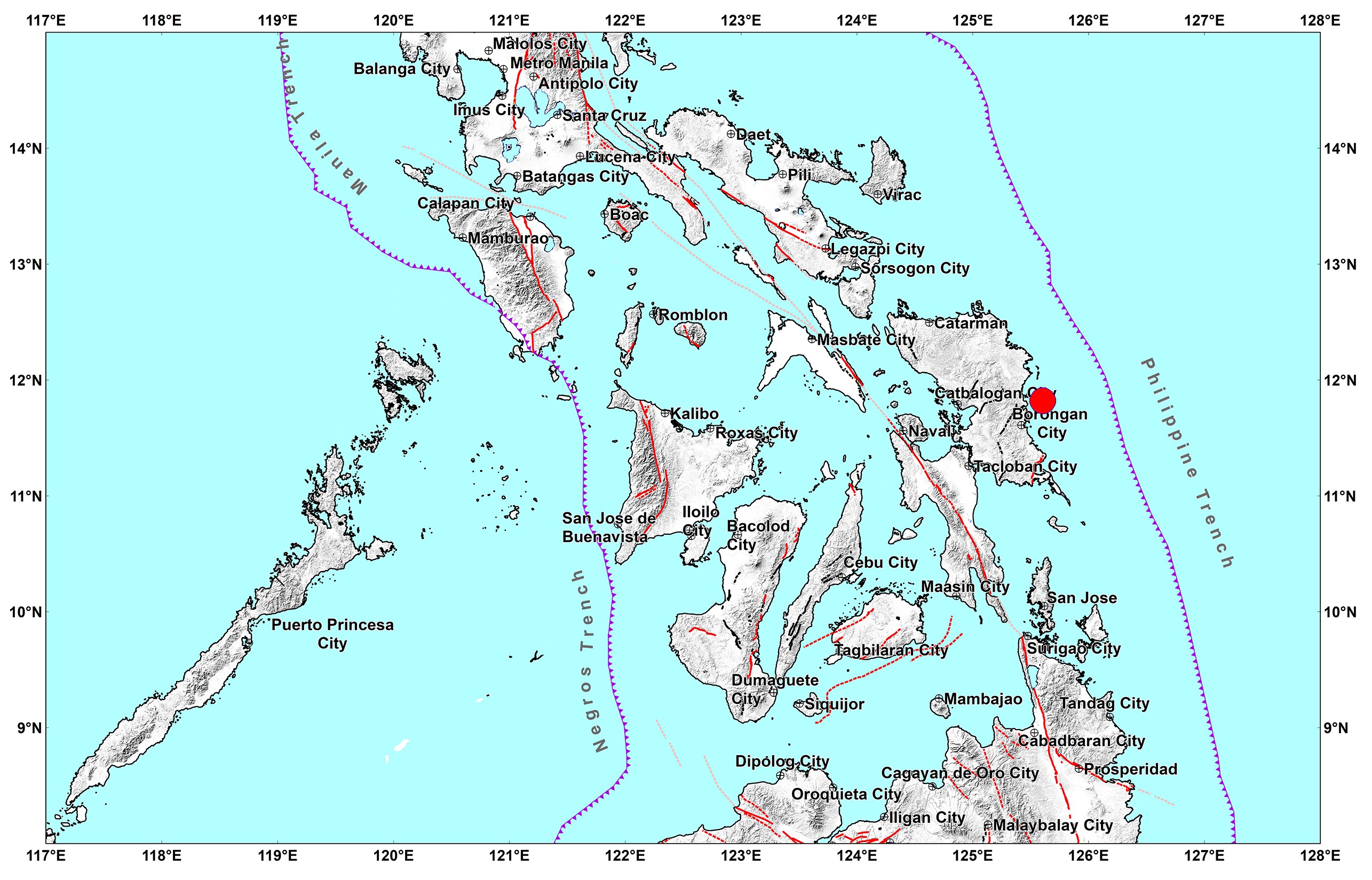
The Philippine Institute of Volcanology and Seismology (Phivolcs) just reported a magnitude 5.3 earthquake that hit Bicol region yesterday evening at 9:57 p.m.

Scan the QR code to get this post on the go.
The quake which was of tectonic origin struck some 15 kilometers southeast of Sto. Domingo, Albay and had a depth of 9 kilometers.
The Manila Times posted this video on x.com:
These intensities were recorded in the following areas:
Intensity V – Santo Domingo and City of Legazpi, ALBAY; Bulusan, SORSOGON
Intensity IV – City of Tabaco, City of Ligao, and Malilipot, ALBAY; City of Sorsogon, Donsol, and Irosin, SORSOGON
Intensity III – Malinao, ALBAY; Juban and Prieto Diaz, SORSOGON; Monreal, MASBATE; CITY OF NAGA
Intensity II – Bulan, SORSOGON; City of Masbate, Dimasalang, and San Fernando, MASBATE; Goa, CAMARINES SUR; Allen, Biri, Bobon, Capul, Catarman, Lavezares, Lope de Vega, Mondragon, Pambujan, Rosario, San Isidro, San Jose, San Roque, and Victoria, NORTHERN SAMAR
No damage was reported but Phivolcs warned of possible aftershocks.
AI-Assisted Content Disclosure:
The information below was generated with the assistance of artificial intelligence and is provided for general informational and educational purposes only. While every effort has been made to ensure accuracy and clarity, AI-generated content may contain errors, omissions, or interpretations that do not reflect the latest scientific findings or official guidance.
This content should not be considered a definitive or authoritative source for earthquake-related information. Readers are encouraged to verify important details with official agencies such as PHIVOLCS, the Office of Civil Defense (OCD), and other relevant government or scientific institutions before making decisions or taking action.
Always rely on official advisories during emergencies and disaster situations.
What Does Magnitude 5.3 Mean?
A magnitude 5.3 earthquake is considered moderate. It releases significantly more energy than a magnitude 4 quake and is strong enough to be felt by almost everyone in the affected area.
In simple terms:
- Strength: Moderate earthquake
- Possible effects: Shaking of buildings, rattling windows, falling objects, and minor damage to older or poorly constructed structures.
- What people experience: Difficult to stand still, parked cars may rock noticeably, and many people will instinctively move outdoors or take cover.
- Near the epicenter: Small cracks in walls or roads may occur, but well-engineered buildings are generally expected to remain structurally sound.
Because the magnitude scale is logarithmic, a magnitude 5.3 earthquake releases about 32 times more energy than a magnitude 4.3 earthquake and about 3 times more energy than a magnitude 4.8 earthquake.

The actual impact, however, depends on factors such as:
- Depth of the earthquake
- Distance from the epicenter
- Local soil conditions
- Quality of building construction
So, while a 5.3 magnitude quake is not usually catastrophic, it is strong enough to cause alarm and localized damage, especially in areas with vulnerable infrastructure or soft ground.
Why Did This Earthquake Happen?
A tectonic magnitude 5.3 earthquake near Santo Domingo, Albay was most likely caused by the sudden movement of rocks along an active fault due to the buildup and release of stress in the Earth’s crust.
Because PHIVOLCS classified it as tectonic, the shaking is not directly caused by volcanic activity, even though the area is near Mayon Volcano. Instead, it is more likely related to the movement of regional fault systems and the ongoing interaction of tectonic plates beneath the Philippines.
Could Aftershocks Occur?
In most cases such as this, aftershocks are possible, so residents are advised to stay alert and follow official updates from authorities.
Could This Trigger Other Earthquakes?
Yes, it is possible, but not guaranteed.
A magnitude 5.3 tectonic earthquake can alter stress along nearby faults, sometimes leading to aftershocks or, less commonly, triggering earthquakes on adjacent faults that are already close to failure.
For the Santo Domingo, Albay event:
- Most likely: A series of smaller aftershocks in the same area over the coming hours to days.
- Less likely: A larger earthquake on a nearby fault.
- Very unlikely: It will trigger a major earthquake hundreds of kilometers away.
Earthquake scientists cannot reliably predict whether one earthquake will trigger another significant event. The best approach is to monitor updates from Philippine Institute of Volcanology and Seismology and remain prepared for possible aftershocks.
Key takeaway: A magnitude 5.3 quake can increase stress on nearby faults, but there is no evidence that it will necessarily lead to a larger earthquake or widespread seismic activity.
Safety Advice
- Stay away from damaged buildings
- Expect aftershocks
- Follow local emergency authorities.
Source: ManilaBulletin, Phivolcs, x.com















Leave a Reply