
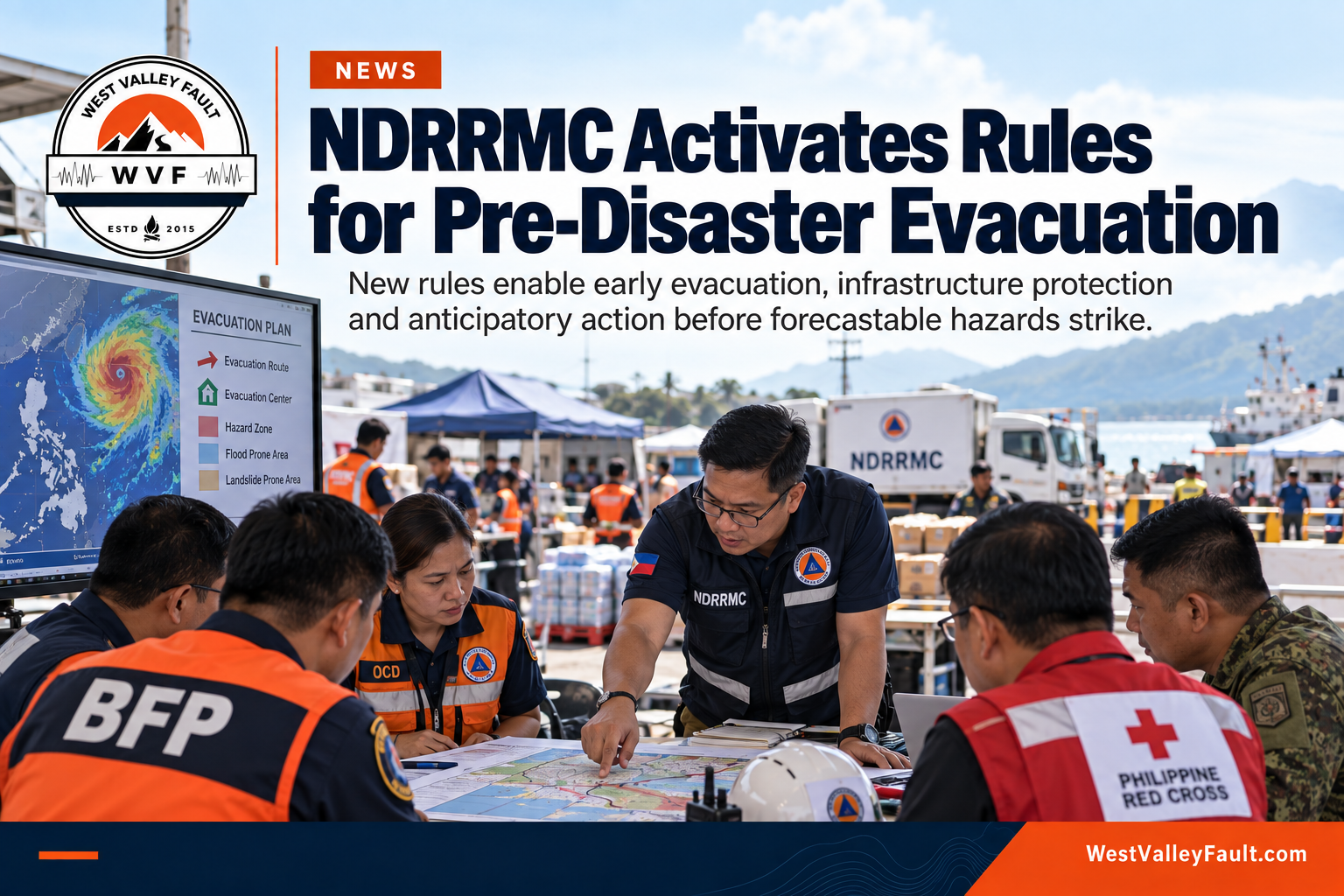
MANILA — The National Disaster Risk Reduction and Management Council has released the implementing rules and regulations of Republic Act No. 12287, putting into operation a nationwide framework for anticipatory action before forecastable disasters.
The rules cover pre-emptive evacuation, infrastructure protection, coordinated public advisories, and the strategic prepositioning of personnel, supplies and operational assets before an imminent hazard reaches its most damaging stage.
The IRR was signed on September 14, 2026 by Defense Secretary Gilberto Teodoro Jr., who chairs the NDRRMC. Republic Act No. 12287 itself was signed into law on September 12, 2025.
Pre-disaster action now has an operational framework
Under the law and its implementing rules, a State of Imminent Disaster may be declared where scientific forecasts and a pre-disaster risk assessment indicate a highly probable hazard with projected catastrophic impacts.
The framework allows authorities to issue and coordinate public advisories, mobilize inter-agency response teams, carry out pre-emptive or forced evacuation when necessary, deploy accredited volunteers, and preposition food, non-food items and other critical resources.
The IRR also sets guidelines for infrastructure protection, evacuation protocols, camp coordination and management, protection of internally displaced persons, and participation by civil society, the private sector and volunteer groups.

LGUs may use part of disaster funds for anticipatory action
National government agencies are directed to integrate anticipatory action into their regular programs, projects and activities and fund these measures through regular agency budgets.
For local governments, the IRR allows anticipatory action measures to be programmed under local DRRM plans and permits the use of a limited share of the Local Disaster Risk Reduction and Management Fund for those measures. The PCO release states that LGUs may allocate not more than 10 percent of the 70 percent portion of the LDRRMF for anticipatory action.
The Office of Civil Defense is tasked with monitoring areas placed under a State of Imminent Disaster. Concerned agencies must also report on local declarations, use of anticipatory-action funds, and estimated economic and social costs after the declaration is lifted.
Why it matters for earthquake preparedness
The new rules strengthen the legal and operational basis for acting before a forecastable disaster reaches full impact. For local DRRM offices, that can affect evacuation planning, protection of critical infrastructure, emergency communications, volunteer mobilization and the prepositioning of response assets.
WVF has recently tracked related investments in local warning systems, including Caloocan City’s ₱20-million early-warning system expansion, as well as broader efforts to strengthen disaster-resilient infrastructure.
The law is not an earthquake-prediction mechanism
Republic Act No. 12287 covers hydrometeorological, geological and climatic hazards that can be modeled and forecast within an allowable or sufficient lead time. The law uses a three-day lead time that may be extended to five days for anticipatory interventions.
That should not be interpreted as authority to predict the exact timing of damaging earthquakes. DOST-PHIVOLCS states that there is currently no reliable technology, instrument or scientific knowledge that can specify the exact time, date and location of a strong earthquake. For earthquake preparedness, the most relevant applications of the framework would therefore depend on hazards or cascading effects for which official forecasts and defined thresholds are available.
Stay Informed. Stay Prepared.
Get continuing earthquake intelligence, preparedness updates, Special Reports, and the WestValleyFault.com Weekly Earthquake & Preparedness Intelligence Report delivered to your inbox.

As a welcome gift, you’ll also receive the FREE WVF Earthquake Preparedness Quick Start Guide with practical first steps every household can take before a major earthquake.
Enter your email below to join the WVF email list. Unsubscribe anytime.
Recommended Further Reading
- Caloocan Seeks ₱20-M Expansion of Citywide Early-Warning System
- Philippines Joins CDRI: Boosting Disaster-Resilient Infrastructure
- The Big One Is Not the Biggest Threat—Our Buildings Are
Sources
- Presidential Communications Office — “NDRRMC issues implementing rules on Declaration of State of Imminent Disaster,” September 29, 2026
- Philippine Information Agency — “NDRRMC releases rules for new law allowing early disaster declarations,” October 1, 2026
- Republic Act No. 12287 — Declaration of State of Imminent Disaster Act
- DOST-PHIVOLCS — Earthquake scenarios and the limits of earthquake prediction




Leave a Reply