
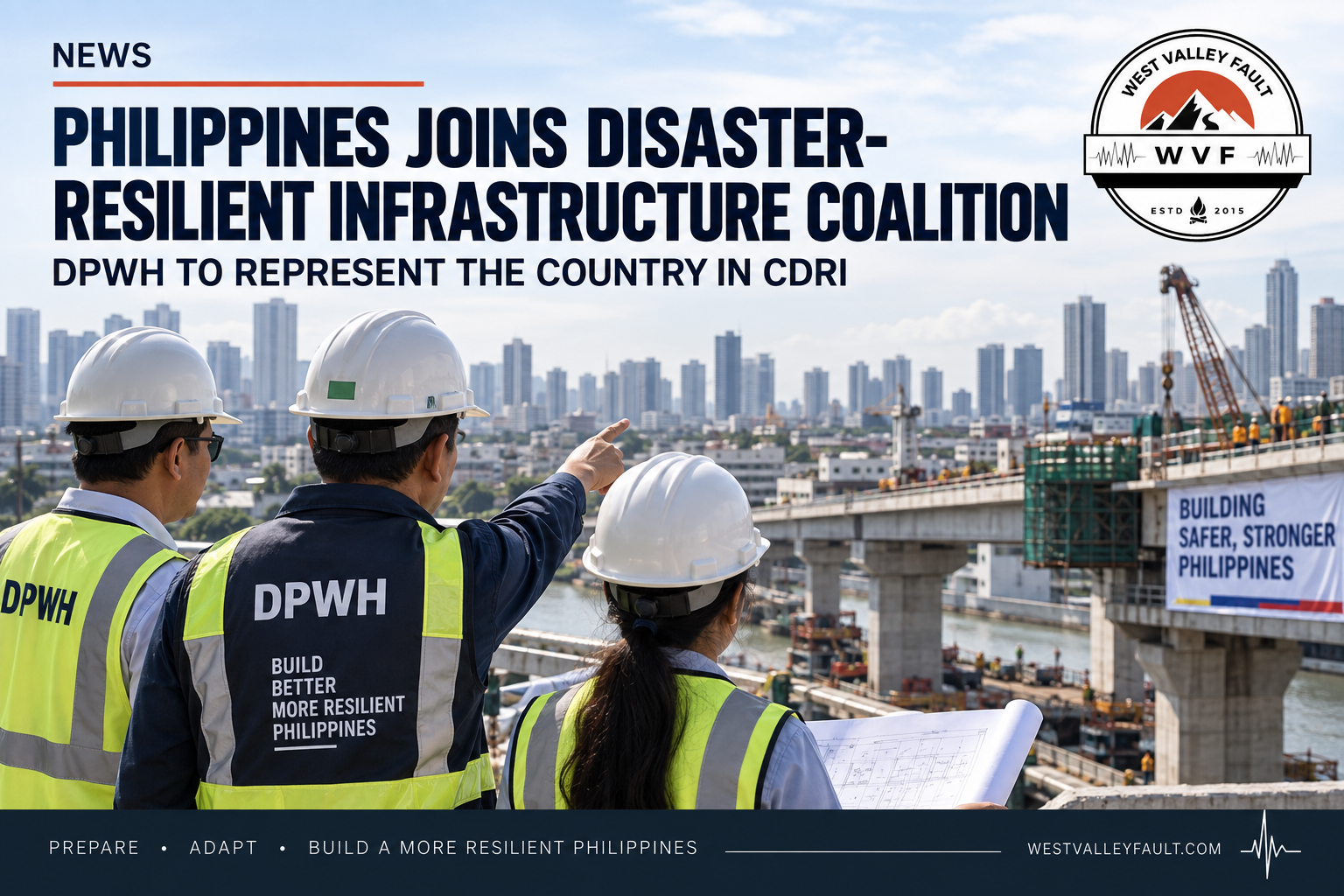
The Philippines has joined the Coalition for Disaster Resilient Infrastructure (CDRI), with the Department of Public Works and Highways designated to represent the country. The more important question for communities is what eventually changes on the ground.
The Philippines was formally welcomed as CDRI’s 71st member on September 12, 2026, during a meeting between Philippine officials and coalition representatives in New Delhi. The Presidential Communications Office said the country is the second Southeast Asian member after Vietnam.
CDRI is a voluntary and non-binding global partnership focused on strengthening infrastructure against disasters and climate-related risks. Its members include governments, international organizations, financial institutions, private-sector organizations and academic institutions.
The Department of Public Works and Highways has been designated to represent the Philippines in the coalition, placing the agency at the center of the country’s participation in CDRI’s technical and policy work.
What membership could provide
According to the Presidential Communications Office, CDRI membership can give the Philippines access to shared experience, technical expertise and best practices for building more resilient roads, bridges, ports and other infrastructure. The government also said membership may help open access to financing opportunities for projects aimed at improving infrastructure resilience.
That does not mean a new Philippine infrastructure project, retrofit program or funding package has already been approved through CDRI. Membership creates access to a network and potential support mechanisms; implementation still depends on specific programs, assessments, financing decisions and government action.
The Climate Change Commission added an important implementation lens on September 16, saying CDRI participation could strengthen how the Philippines applies climate projections, hazard information and risk assessments before infrastructure is located, designed, financed, built and maintained.
That emphasis closely follows the country’s broader push toward stronger infrastructure and adaptation systems after the recent ASEAN disaster-resilience conference in Manila, where the focus increasingly shifted from regional commitments to actual implementation.
Why DPWH’s role matters for earthquake resilience
DPWH’s role is particularly relevant because the department is already involved in a major seismic-resilience effort.
On August 14, 2,312 DPWH engineers from central, regional and district offices participated in nationwide training on seismic retrofitting of public buildings under the Philippines Seismic Risk Reduction and Resilience Project.
The same World Bank-supported project includes detailed design and construction supervision for the seismic retrofitting of 172 public schools and health facilities through 2028. The training covered building vulnerability, hazard assessment, retrofitting techniques, construction quality, procurement, supervision and post-construction monitoring.
Those programs are separate from CDRI membership. There has been no announcement that the seismic-retrofitting project has become a CDRI initiative, and the government has not announced a new earthquake-specific CDRI program.
But the sequence is significant from a preparedness perspective: engineering capacity is being expanded, public-building resilience work is underway, and the Philippines has now entered an international coalition centered on resilient infrastructure.
This also reinforces a point WVF has raised previously: earthquake risk is not only about the hazard itself, but also about whether buildings and critical infrastructure can withstand severe shaking and remain usable afterward.
The next question is implementation
For the Philippines, the practical value of CDRI membership will become clearer through what follows.
Key developments to watch include whether Philippine agencies receive new technical assistance, whether hazard and risk information visibly influences infrastructure planning and design, whether resilient-infrastructure projects gain financing support, and whether standards, assessments and investment decisions reflect disaster risk before construction begins.
For earthquake preparedness, the most relevant question is whether that approach reaches the infrastructure people depend on most: schools, hospitals, government buildings, roads, bridges, communications systems and other critical facilities.
Joining CDRI is therefore best understood as an institutional step—not an end result. The longer-running story is whether membership contributes to measurable changes in how infrastructure is assessed, designed, strengthened and funded.
Stay Prepared with WVF
Join the WestValleyFault.com email list for the Weekly Earthquake Intelligence Report, Special Reports and practical preparedness guidance. As a welcome gift, you’ll receive the FREE Earthquake Quick Start Guide.

Free PDF. No spam. Unsubscribe anytime.
Recommended Further Reading
- After ASEAN Disaster Resilience Conference, Philippines Faces Test of Strengthening Disaster-Ready Infrastructure
- More Than 2,300 DPWH Engineers Trained in Seismic Retrofitting of Public Buildings
- Quezon City Requires Evacuation Plans for Government Buildings in 24 Earthquake-Hotspot Barangays
- The Big One Is Not the Biggest Threat—Our Buildings Are
Sources
- Presidential Communications Office — Philippines becomes CDRI’s 71st member
- Climate Change Commission — CDRI entry and predictive governance for resilient infrastructure
- Coalition for Disaster Resilient Infrastructure — Philippines membership announcement
- Oriental Consultants Global — DPWH seismic-retrofitting seminar and PSRRRP implementation




Leave a Reply