
The West Valley Fault remains one of the most important factors influencing real estate decisions across Metro Manila and nearby provinces in 2026. Stretching roughly 100 kilometers through highly urbanized areas, the fault passes through parts of Quezon City, Marikina, Pasig, Makati, Taguig, Muntinlupa, Rizal, Laguna, Bulacan, and Cavite. While the anticipated magnitude 7.2 earthquake known as “The Big One” has not yet occurred, awareness of seismic risk has become deeply embedded in the property market.
For homeowners, investors, and developers, the question is no longer whether earthquake risk matters. The question in 2026 is how much that risk affects property values and buyer behavior.
The Relationship Between Risk and Property Prices
Real estate prices are influenced by many factors, including location, accessibility, infrastructure, school districts, commercial development, and future growth potential. However, hazard exposure has increasingly become another major consideration.
Studies in real estate valuation have shown that environmental risks can affect land values when buyers are aware of those risks. Research specifically examining properties near the West Valley Fault found that earthquake risk can influence market perceptions and pricing, particularly when proximity to the fault is known and understood by buyers.
In simple terms, buyers generally expect a discount when purchasing property that carries greater perceived risk.
This does not necessarily mean properties near the fault become unsellable. Instead, the market often adjusts through pricing, negotiation leverage, and longer selling periods.
What Has Changed Since the Fault Maps Became Public?
A major turning point occurred when detailed Valley Fault System maps were publicly released by PHIVOLCS. Before widespread publication of fault-line data, many homeowners and even some developers were unaware that certain properties sat directly above or near active fault traces.
Today, prospective buyers have access to tools such as the PHIVOLCS FaultFinder and HazardHunterPH that allow them to check active-fault proximity and other location-specific hazards before making a purchase. For a practical walkthrough, see How Close Is Your Home to the West Valley Fault? A Step-by-Step PHIVOLCS Hazard Check.
This increased transparency has fundamentally changed the market.
A buyer in 2026 can often determine within minutes whether a property lies near a fault line. As a result, risk information that once remained hidden is now incorporated into purchasing decisions.
Properties Directly on the Fault Experience the Greatest Impact
Not all properties near the West Valley Fault are affected equally.
Properties that sit directly on top of the identified fault trace face the greatest challenges. Ground rupture is among the most destructive earthquake hazards because it can physically tear through structures and infrastructure during a major seismic event.
For these properties, several factors tend to reduce market demand:
- Difficulty obtaining financing in some situations
- Increased buyer hesitation
- Greater disclosure concerns
- Reduced pool of interested purchasers
- Higher emphasis on engineering and geotechnical studies
Many buyers simply eliminate these properties from consideration altogether.
As a result, properties located directly on the fault often experience the strongest downward pressure on market value compared with similar lots located farther away.
See The Complete List of Barangays Traversing the West Valley Fault
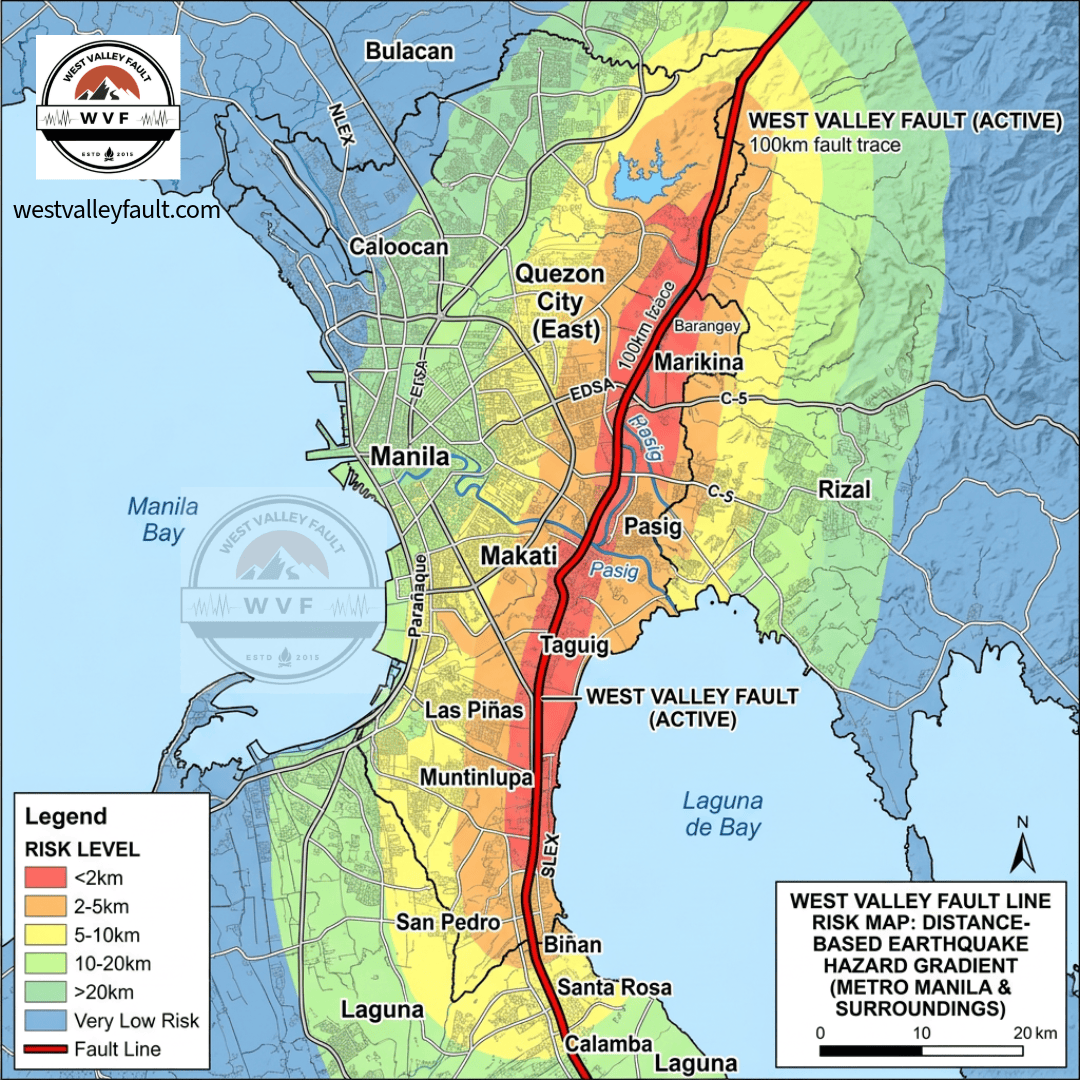
The Market Penalty Declines With Distance
One of the most misunderstood aspects of fault-line risk is that the effect on property values is not uniform.
The closer a property is to the actual fault trace, the greater the perceived risk. As distance increases, the market penalty generally decreases.
International studies referenced in fault-related valuation research have found measurable discounts associated with proximity to active fault systems. Similar findings have been observed in other earthquake-prone regions such as California and Japan.
In Metro Manila, however, the situation is more complex.
Many areas close to the fault are also among the most desirable locations in the country. Portions of Pasig, Taguig, Makati, and Quezon City continue to attract strong demand because of employment centers, transportation access, schools, and commercial districts.
In these cases, location advantages may partially offset concerns about seismic risk.

Why Some High-Value Areas Continue to Thrive
An interesting trend in 2026 is that proximity to the West Valley Fault has not prevented major residential and commercial developments from succeeding.
The reason is simple: buyers evaluate multiple risks simultaneously.
A condominium near Ortigas, BGC, or Makati may face earthquake-related concerns, but it may also offer:
- Shorter commute times
- Higher rental demand
- Better infrastructure
- Greater capital appreciation potential
- Access to business districts
As a result, many buyers conclude that the benefits outweigh the risks.
Discussions among investors frequently reveal that construction quality and compliance with modern building codes often play a larger role in decision-making than mere proximity to the fault itself.
This explains why some developments near fault-affected zones continue to command premium prices despite widespread awareness of seismic hazards.
Check the Earthquake Risks Around a Property Before You Decide

Before evaluating a property, check its complete hazard profile.
Use WVF’s Free Earthquake Risk Checklist to review active-fault proximity, ground shaking, liquefaction, tsunami and landslide hazards, building safety, and community preparedness before buying, renting, relocating, or investing.
Enter your email below and we’ll send you the free PDF checklist, together with WVF preparedness updates. Unsubscribe anytime.
Small disclaimer: This checklist is an educational screening tool—not an official hazard assessment or guarantee of safety.
The Growing Importance of Structural Resilience
One of the biggest changes in the 2026 market is the growing emphasis on building resilience.
Buyers increasingly ask questions such as:
- Was the structure designed under modern seismic standards?
- Were geotechnical studies conducted?
- Is the building engineered for major ground shaking?
- What is the liquefaction risk of the site?
- Has the developer demonstrated strong construction quality?
For many purchasers, these questions matter more than simply measuring distance from the fault.
A well-engineered building located near a fault may be viewed more favorably than an older structure farther away but constructed under outdated standards.
This trend is particularly noticeable in the condominium sector, where engineering certifications and structural design have become significant selling points.
Access PHIVOLCS’ Hazard Hunter App and Other Useful Platforms on our Resources Page
How Sellers Are Adapting
Property sellers in fault-affected areas have adjusted their strategies in recent years.
Many now proactively provide:
- Hazard assessment reports
- PHIVOLCS proximity checks
- Engineering certifications
- Soil investigation results
- Structural upgrades and retrofitting records
Providing this information helps reduce buyer uncertainty and can minimize the valuation discount associated with fault proximity.
Transparency has increasingly become a competitive advantage.

What Investors Should Consider in 2026
For investors evaluating properties near the West Valley Fault, the decision should not be based solely on whether a property is inside a fault-affected city.
Instead, consider:
Exact Distance From the Fault
A property several kilometers away faces a very different risk profile from one sitting directly on the mapped fault trace.
Ground Conditions
Liquefaction, soft soils, and slope stability can sometimes pose greater concerns than fault proximity alone.
Building Quality
Modern engineering standards can significantly improve earthquake resilience.
Market Demand
Some locations maintain strong demand regardless of seismic concerns because of their strategic importance.
Long-Term Liquidity
Consider how easily the property could be resold if risk awareness increases further in the future.
For homebuyers and property investors, earthquake risk extends beyond a property’s distance from an active fault. Building quality, construction standards, and long-term structural resilience can have an even greater influence on safety. We explore these issues in greater detail in our Special Report, The Big One Is Not the Biggest Threat—Our Buildings Are.
The Future of Fault-Affected Real Estate
As hazard awareness grows and mapping technologies improve, earthquake risk is likely to become an even more important factor in property valuation.
However, the evidence suggests that the market does not react in a simplistic way.
Properties directly on the West Valley Fault face the greatest challenges and often experience downward pressure on value. Yet many properties located near—but not directly on—the fault continue to command strong prices because buyers balance seismic risk against location, convenience, and economic opportunity.
In 2026, the most valuable real estate is no longer judged solely by location. Increasingly, it is judged by resilience.
For buyers, sellers, and investors alike, understanding the relationship between fault proximity and property value may be just as important as understanding the property itself.
Recommended Further Reading
- Unveiling the Mysteries: Geological Origins of the West Valley Fault in the Philippines
- Discover the Safest Places in the Philippines: Earthquake-Free Zones
- Preparing for the Big One: Essential Earthquake Survival Kit for Filipinos
- The Big One Philippines: What Experts Say About the Next Metro Manila Earthquake.
Sources:
PHIVOLCS FaultFinder – Active Fault Proximity Search Tool
PHIVOLCS Maps Portal
PHIVOLCS Valley Fault System Maps (Inquirer Report)
Valley Fault System Atlas (PHIVOLCS)
Galeon & Albano, “The Effect of Proximity to Fault Line as a Land Value Determinant in Metro Manila”
Philippine News Agency – Property Valuation and West Valley Fault Buffer Zones
Community Discussion on Real Estate Investing Near the West Valley Fault
Earthquake Preparedness and West Valley Fault Overview




Leave a Reply