
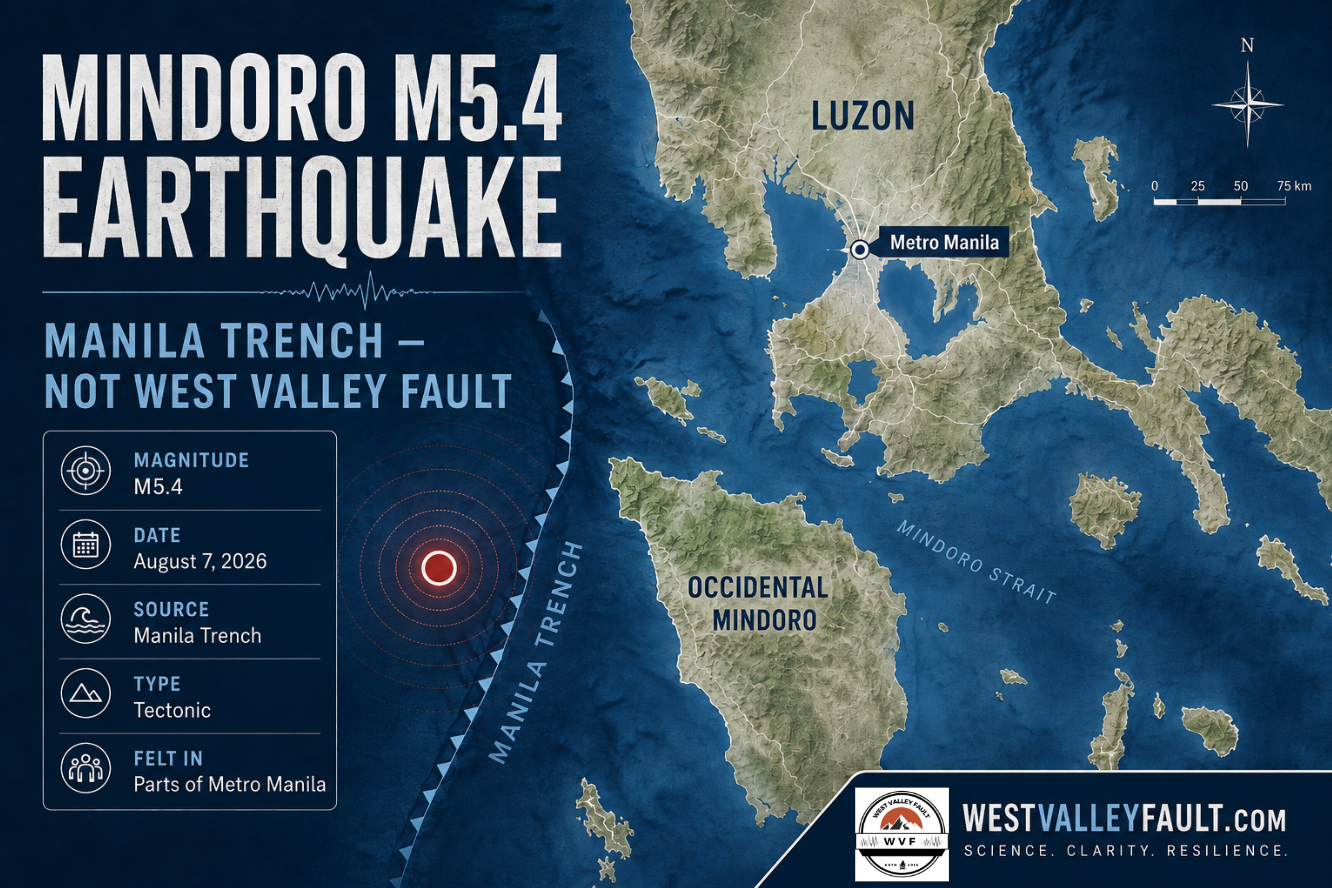
The August 7 earthquake was felt across parts of Metro Manila, highlighting that the capital’s earthquake risk extends beyond the West Valley Fault.
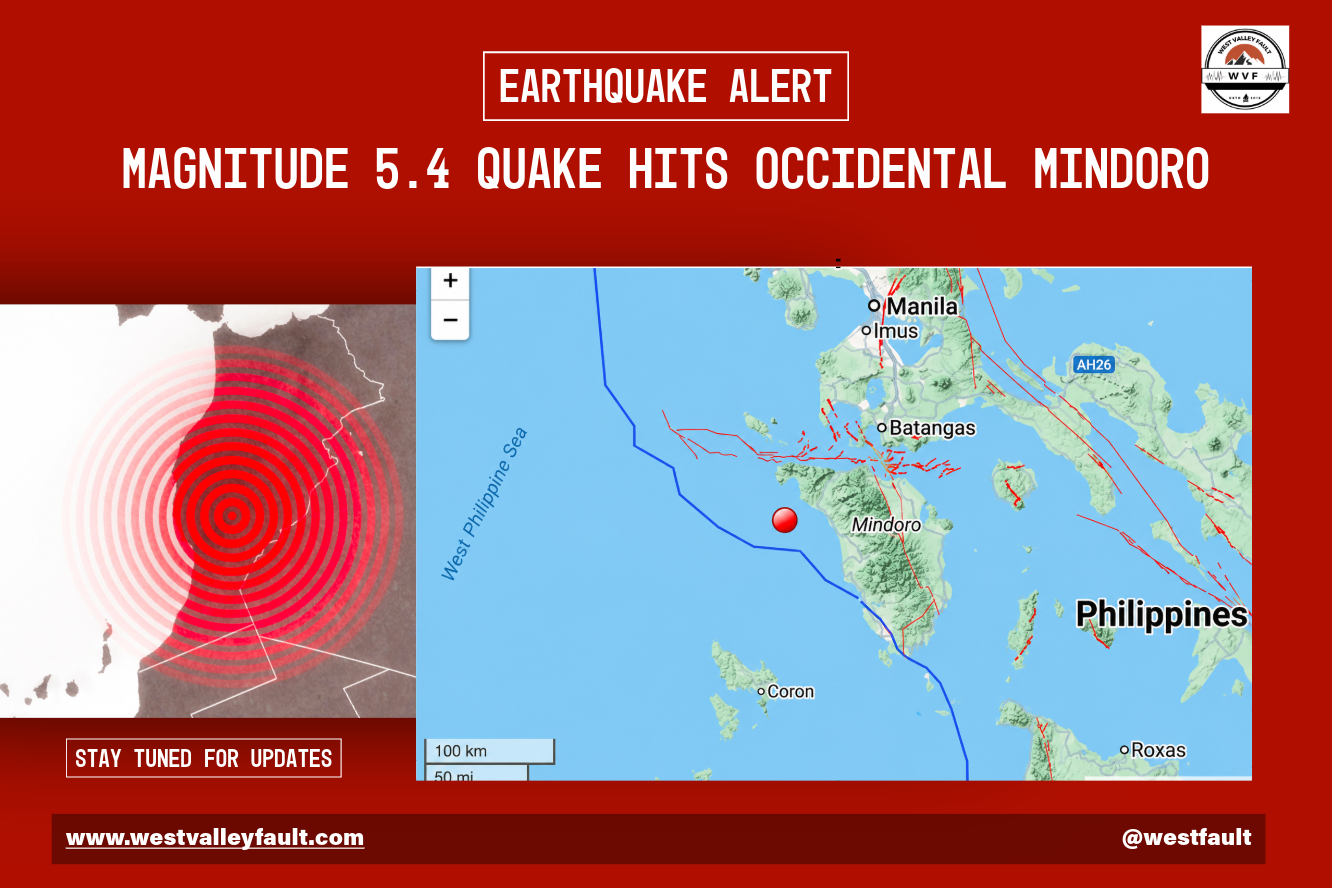
A magnitude 5.4 earthquake that struck Occidental Mindoro on Friday, August 7, was generated by movement associated with the Manila Trench, according to the Philippine Institute of Volcanology and Seismology (PHIVOLCS).
The earthquake occurred at around 10:39 a.m. and was felt not only in Mindoro but across parts of Southern Luzon and Metro Manila. PHIVOLCS classified the earthquake as tectonic in origin. (ABS-CBN News)
For residents of Metro Manila, however, the source of the earthquake is an important distinction.

This Was Not a West Valley Fault Earthquake
Because shaking was experienced in Metro Manila, it can be tempting to associate the event with the West Valley Fault—the fault most commonly discussed in connection with the capital’s earthquake risk.
PHIVOLCS, however, attributed the August 7 earthquake to movement associated with the Manila Trench, an offshore tectonic system west of Luzon.
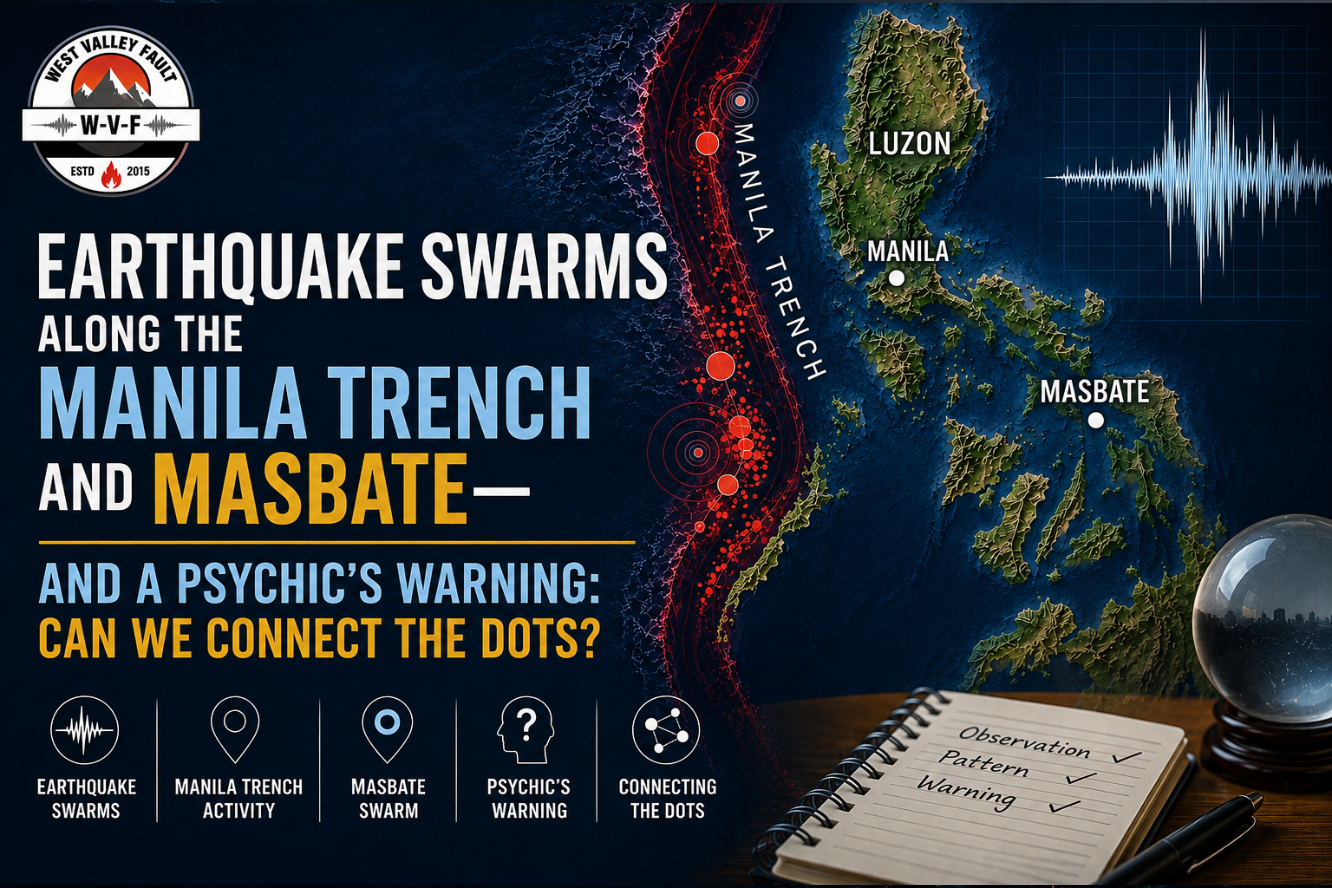
The Manila Trench had already drawn attention earlier this year following a series of offshore earthquakes monitored west of Luzon.
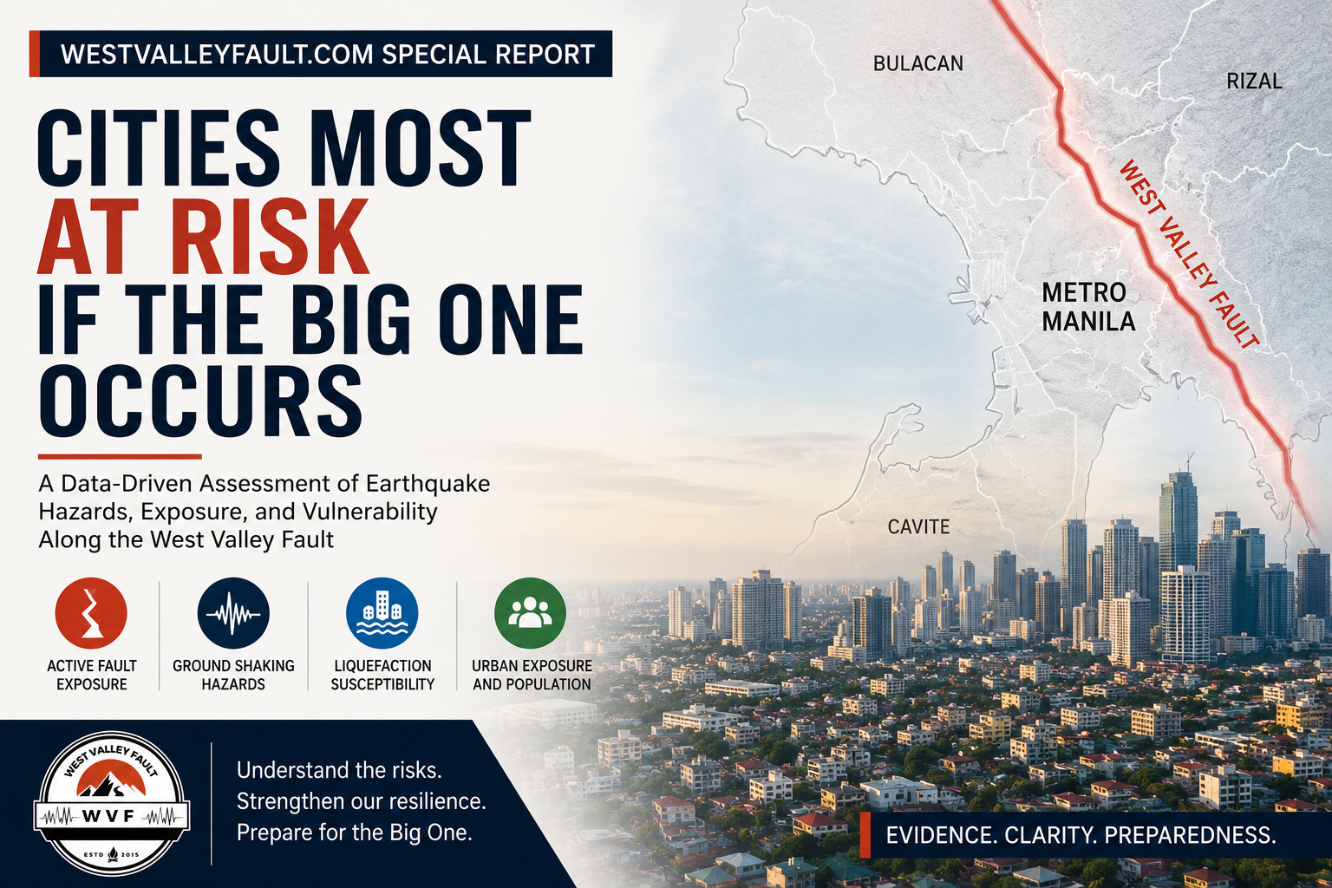
The West Valley Fault is a different earthquake source. It forms part of the Valley Fault System running through portions of Bulacan, Rizal, Metro Manila, Cavite and Laguna. PHIVOLCS uses a magnitude 7.2 West Valley Fault earthquake as one of its major disaster-planning scenarios for Greater Metro Manila. (PHIVOLCS)
The fact that an earthquake is felt in Metro Manila therefore does not mean that the West Valley Fault itself moved.
Earthquake waves can travel considerable distances from their source, and earthquakes originating offshore or in surrounding provinces can produce noticeable shaking across the capital.

Why the Manila Trench Matters
The Manila Trench is a major offshore subduction zone running along the western side of Luzon.
Unlike the West Valley Fault, which is an active fault system on land, the Manila Trench marks an area where one tectonic plate is being forced beneath another.
PHIVOLCS has repeatedly identified the Manila Trench as one of the major earthquake sources that communities in western Luzon and surrounding regions need to consider in disaster preparedness.
In June 2026, PHIVOLCS Director Teresito Bacolcol identified the Manila Trench among the country’s six active trenches capable of generating very large earthquakes. (Philippine News Agency)
The Department of Science and Technology has also emphasized that a major Manila Trench earthquake represents a separate earthquake scenario for areas near Metro Manila from the magnitude 7.2 West Valley Fault scenario. (DOST)
That does not mean Friday’s magnitude 5.4 earthquake signals that such a larger event is about to occur.
Earthquakes cannot presently be predicted by specifying an exact date, time and location, and a moderate earthquake should not automatically be interpreted as a precursor to a much larger one.
What the event does demonstrate is that Metro Manila’s earthquake exposure does not come from a single fault.
Philippine earthquake history also demonstrates that damaging earthquakes can originate from very different faults and tectonic environments.
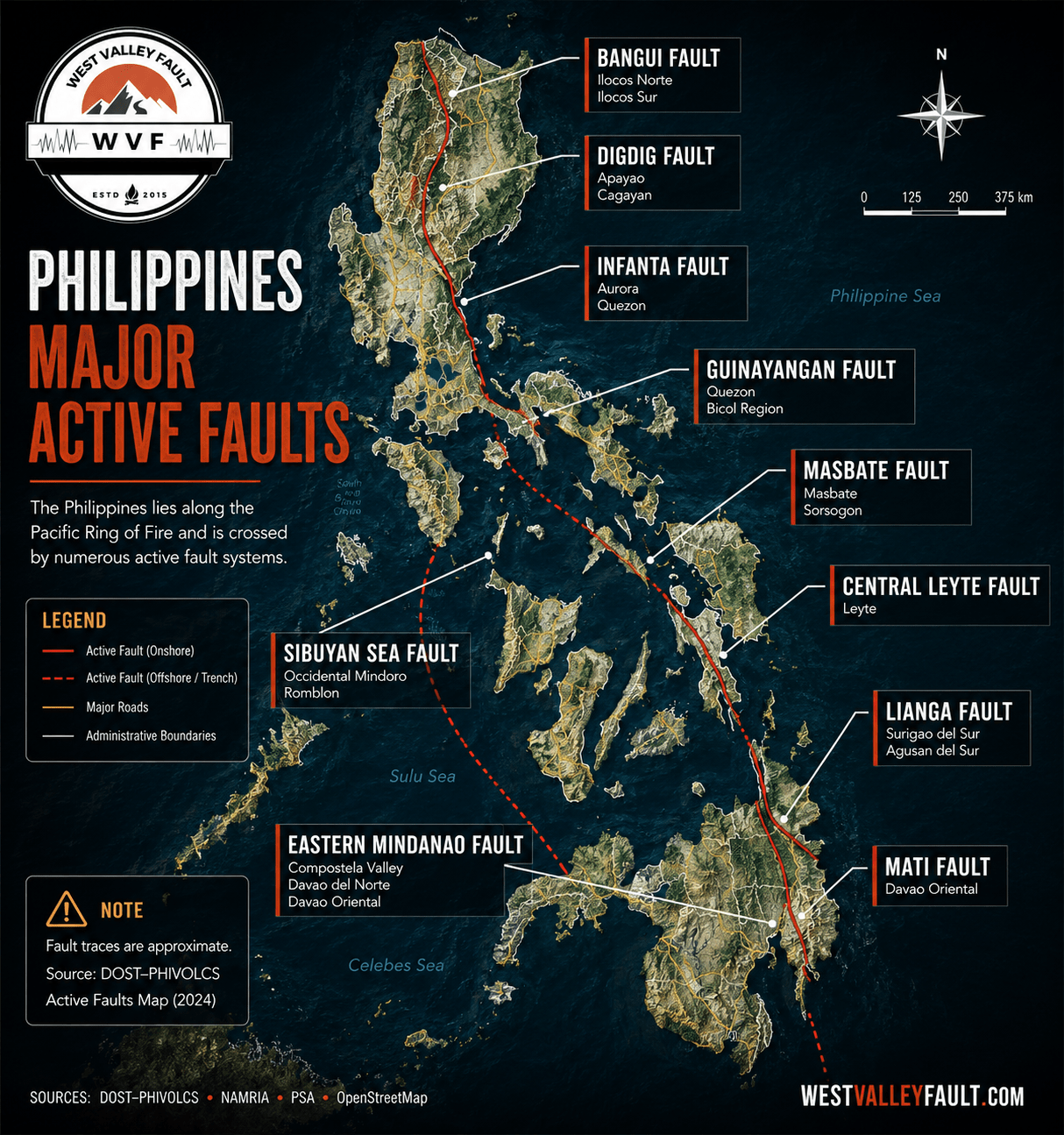
Metro Manila Has More Than One Earthquake Source
Discussion of earthquake preparedness in the capital often revolves around the West Valley Fault because of its proximity to heavily populated communities and PHIVOLCS’ magnitude 7.2 earthquake scenario or “The Big One“.
But the West Valley Fault is not the only seismic source capable of affecting the metropolitan area.
Past earthquakes originating around Mindoro and the Manila Trench have also been felt in Metro Manila. In March 2022, for example, a magnitude 6.4 earthquake northwest of Lubang, Occidental Mindoro was attributed by PHIVOLCS to movement along the Manila Trench. Shaking from that earthquake reached several Metro Manila cities. (Philippine News Agency)
This is an important preparedness lesson.
Earthquake risk should not be understood simply as distance from the West Valley Fault.
People living away from the fault trace may avoid the direct hazard of surface fault rupture, but they can still experience strong ground shaking from earthquakes originating elsewhere.
Local ground conditions, building design, construction quality and the characteristics of each earthquake can all influence how severely an area is affected.

What Coastal Communities Should Also Remember
The Manila Trench carries another hazard that distinguishes it from the West Valley Fault: its offshore location means sufficiently large earthquakes can potentially generate tsunamis.
PHIVOLCS therefore advises coastal communities to recognize the natural warning signs of a possible local tsunami, particularly:
- strong or prolonged ground shaking;
- a sudden rise or fall in sea level; and
- an unusual roaring sound from the sea.
When these natural warning signs occur, people in exposed coastal areas should move to higher ground or farther inland without waiting for an official warning. (Philippine News Agency)
There was no indication in the available reports that Friday’s magnitude 5.4 event generated a destructive tsunami.

The Bigger Preparedness Lesson
The August 7 Mindoro earthquake was moderate compared with the major earthquake scenarios studied for the Philippines, but its reach provides a useful reminder.
Metro Manila sits within a region influenced by several earthquake-generating systems.
The West Valley Fault remains one of the most consequential earthquake threats because it passes directly through the Greater Metro Manila Area and is capable of producing a major land-based earthquake.
But preparedness cannot stop at the West Valley Fault.
The Manila Trench, other active faults and regional tectonic structures can also produce earthquakes capable of shaking the capital.
Friday’s earthquake should therefore be understood for what PHIVOLCS says it was: a tectonic earthquake associated with the Manila Trench—not evidence that the West Valley Fault moved.
And that distinction reinforces a broader principle that WestValleyFault.com continues to emphasize:
Earthquake preparedness should be based on the hazards that can affect where you live—not simply on whether your home sits beside a mapped fault.
Read more on that here: Cities Most at Risk If the Big One Strikes the Philippines
Preparedness Shouldn’t Depend on Which Fault Moves

The next damaging earthquake affecting your community may come from the West Valley Fault, an offshore trench, or another active seismic source.
What matters is whether your household is ready when the shaking begins.
Build your family’s earthquake plan before an emergency.
Recommended Further Reading
- 152 Earthquakes Along the Manila Trench: What PHIVOLCS Says—and What It Doesn’t
- “The Big One” Isn’t an Official Scientific Term
- Historical Earthquakes in the Philippines
- Cities Most at Risk If the Big One Strikes the Philippines
- Preparing for the Big One: Essential Earthquake Survival Kit for Filipinos
Not Ready for a Full Emergency Plan Yet?

Start with the free WestValleyFault™ Earthquake Preparedness Quick Start Guide.
The free West Valley Fault Earthquake Quick Start Guide walks you through the essential first steps for preparing your family, home and emergency supplies for a major earthquake.
Sources:
- ABS-CBN News — original August 7, 2026 report: Manila Trench movement caused Mindoro quake felt in Metro Manila
- DOST-PHIVOLCS — earthquake scenarios, including the M7.2 West Valley Fault scenario: Earthquake Scenarios Mahalaga sa Tamang Paghahanda at Pagtugon sa Malalakas na Lindol
- Philippine News Agency — PHIVOLCS on the Philippines’ six active trenches, including the Manila Trench: Phivolcs: Magnitude 8.2 quake possible along 6 active trenches
- DOST — discussion of the West Valley Fault versus Manila Trench earthquake scenarios near Metro Manila: DOST’s Solidum reiterates preparedness is key amidst earthquake
- Philippine News Agency — March 2022 M6.4 Occidental Mindoro earthquake generated by the Manila Trench: Magnitude 6.4 Occidental Mindoro quake generates 240 aftershocks








Leave a Reply