
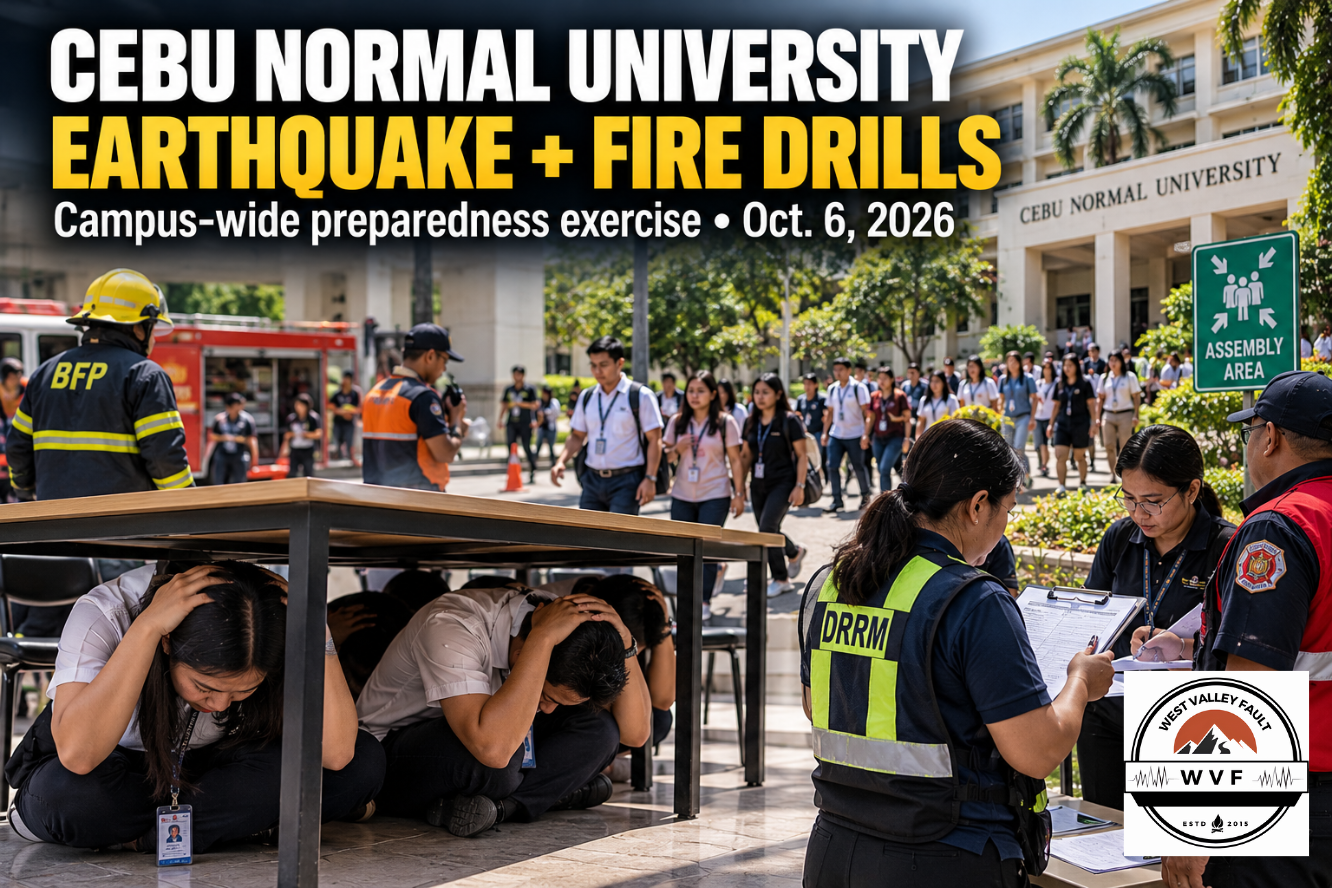
CEBU CITY — Cebu Normal University conducted university-wide earthquake and fire drills on October 6, 2026, bringing students, faculty members and administrative personnel through emergency procedures designed to strengthen campus readiness.
The university reported on October 7 that the activity was organized by the CNU Disaster Risk Reduction and Management Unit in partnership with the Bureau of Fire Protection Region VII. The safety campaign was held at the College of Teacher Education Ground Floor Building and covered both fire and earthquake response.
The exercise focused on the use of emergency exits and evacuation maps, emergency coordination, personnel accounting and earthquake-safety practices. These are the same operational elements that determine whether a campus can move people quickly, confirm who is safe and coordinate response during a real emergency.
The drill tested more than evacuation routes
CNU President Dr. Laurence Garcia described drills as opportunities to build familiarity with proper emergency response and to create “muscle memory” before an actual disaster. He also emphasized that fire drills should test systems and reveal areas that need improvement.
For earthquake preparedness, that systems approach matters. A successful evacuation depends not only on knowing where to go, but also on communication, orderly movement, clear accountability and the ability to verify whether students and employees have reached designated safe areas.
WVF has previously highlighted similar operational testing in Davao City’s first nighttime earthquake drill and Calapan Port’s earthquake-response procedures.
Why campus drills matter
Schools and universities concentrate large numbers of people in classrooms, laboratories, offices and common areas. Practicing evacuation and personnel accounting can expose weaknesses in routes, communications and coordination before those gaps become critical during an earthquake.
For students and families, preparedness also starts with understanding the hazards surrounding a school and how its emergency procedures are designed to work. WVF’s guide What Hazards Surround Your Child’s School? explains the broader risk context, while The Vital Role of Schools and Educational Institutions in Earthquake Safety looks at institutional preparedness.
What CNU did not report
The university did not disclose the number of participants, the time required to complete the evacuation, specific deficiencies observed during the exercise or corrective measures ordered afterward.
Those details are important because drills are most useful when performance is measured and lessons are carried into the next exercise. Without them, the October 6 activity can be confirmed as a university-wide preparedness drill, but its operational performance cannot yet be independently assessed.
Stay Informed. Stay Prepared.
Get continuing earthquake intelligence, preparedness updates, Special Reports, and the WestValleyFault.com Weekly Earthquake & Preparedness Intelligence Report delivered to your inbox.

As a welcome gift, you’ll also receive the FREE WVF Earthquake Preparedness Quick Start Guide with practical first steps every household can take before a major earthquake.
Enter your email below to join the WVF email list. Unsubscribe anytime.
Recommended Further Reading
- Davao City Pilots First Nighttime Earthquake Drill at Mall, Hospital and Colleges
- Calapan Port Tests Earthquake Procedures After Mindoro Tremor
- What Hazards Surround Your Child’s School?
- The Vital Role of Schools and Educational Institutions in Earthquake Safety




Leave a Reply