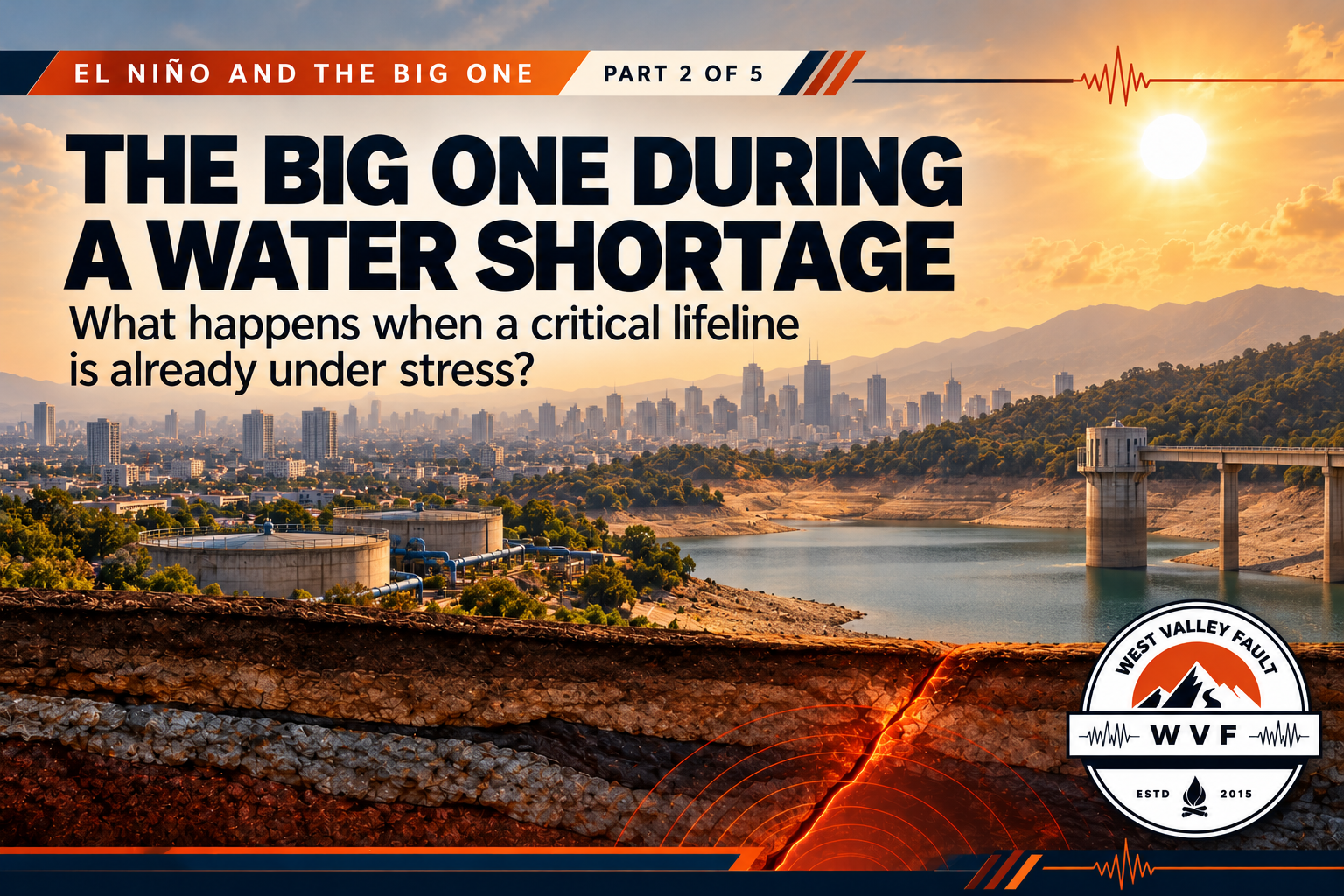
SPECIAL SERIES: EL NIÑO AND THE BIG ONE — PART 2 OF 5
How El Niño could change the conditions in which the Philippines faces its next major earthquake.
Read Part 1: Can El Niño Cause Earthquakes? What the Science Actually Says.
Part 1 of this series established an important distinction: El Niño does not make the West Valley Fault more likely to rupture.
But earthquake risk is not determined by the fault alone. It is also shaped by the condition of the communities, infrastructure and emergency systems that would have to cope with the consequences.
That raises a more practical question as the Philippines prepares for a very strong El Niño:
What if a major earthquake strikes Metro Manila while its water system is already under stress?

This is not a claim that Metro Manila is currently running out of water. As of October 13, PAGASA reported Angat Dam at 208.71 meters, just 1.29 meters below its normal high-water level and well above its rule curve. The government has likewise said there is currently no reported shortage of drinking water.
Authorities are nevertheless preparing for possible El Niño impacts. According to the Presidential Communications Office’s October 1 announcement, the National Water Resources Board reduced Metro Manila’s allocation from a reported typical 52–53 cubic meters per second to 44 cubic meters per second for October. This refers to the stated allocation baseline, not necessarily a matching reduction in water delivered to consumers; providers also have other sources. Malacañang urged conservation without panic buying or excessive stockpiling.
That makes this a preparedness question rather than a crisis claim: if an earthquake happens while the margin of available water is already tighter than usual, what changes?
Water Is One of the First Lifelines an Earthquake Can Disrupt
For most households, emergency-water planning begins with drinking water. After a major earthquake, however, water becomes much more than something to drink.
It is needed for cooking, personal hygiene, sanitation, medical care, cleaning wounds, evacuation centers and maintaining basic operations in hospitals and other critical facilities. It is also essential for firefighting.
At the same time, an earthquake can damage exactly the infrastructure needed to deliver that water. Strong shaking can break distribution mains and service pipes, interrupt pumping because of power failure, reduce pressure in parts of the network and block roads needed by repair crews or tanker trucks.
Water availability is not the same as water accessibility.
A reservoir can contain water while a damaged pipe, failed pump or isolated distribution zone leaves thousands of people unable to receive it.

The Philippines Has Already Seen This Happen
The consequences are not merely theoretical. PHIVOLCS documentation of the 1990 Luzon earthquake shows how severely an earthquake can disrupt ordinary water access.
In surveyed communities affected by the magnitude 7.8 earthquake, water shortages were widespread. PHIVOLCS documented springs that dried up, broken water pipes, contaminated wells and water-supply systems that stopped operating. Water became a problem for 66% of surveyed city households, compared with 32% in towns where residents often had access to alternative wells, springs or streams.
Communities improvised. Some shared surviving wells or private water tanks. Others repaired old pumps, developed new sources or walked considerable distances to obtain water. In some urban centers, residents depended on periodic deliveries from fire departments and water agencies. In Baguio City, water supply was completely disrupted and emergency water initially arrived through fire trucks after road access was restored.
For more historical background, read WVF’s Great Luzon Earthquake of 1990 assessment. The historical water-supply figures above come from the cited PHIVOLCS documentation.
The lesson is straightforward: a major earthquake can turn ordinary water access into an emergency almost immediately.

El Niño Changes the Starting Point
Now consider the same earthquake under two different conditions.
In the first scenario, reservoirs are healthy, normal allocations are in place, water utilities are operating without unusual constraints and emergency resources are fully available.
In the second, the earthquake occurs after months of unusually dry conditions. Water allocations may already have been reduced. Households and businesses may already be conserving. Some local systems may have less reserve capacity. Tankers, pumps or government resources may already be supporting drought-affected communities elsewhere.
The earthquake itself has not become stronger. The pipes have not suddenly become more fragile because of El Niño. But the system may be starting from a smaller margin of safety.
El Niño does not have to cause additional earthquake damage to make the aftermath more difficult. It may simply mean that less spare capacity is available when the earthquake creates a sudden surge in demand.
Metro Manila Depends on an Interconnected Water Lifeline
Metro Manila’s water security depends heavily on the Umiray–Angat–Ipo–La Mesa system, which conveys almost 90% of the water used by nearly 20 million people across Metro Manila and neighboring areas.
But water does not travel directly from a reservoir into a household faucet. Between source and consumer are tunnels and aqueducts, treatment facilities, transmission lines, pumping systems, storage facilities, distribution pipes and building-level plumbing. Each link matters.
A reservoir could remain operational while damage farther downstream interrupts supply to particular areas. This is why the broader Angat–Metro Manila system deserves its own examination later in this series.
For Part 2, the point is simpler: Metro Manila’s emergency water security depends on an entire chain of infrastructure continuing to function—or being restored quickly—after strong shaking.
High-Rise Residents Face an Additional Problem
Metro Manila’s increasingly vertical population creates another vulnerability. Many condominium and high-rise buildings depend on electrical pumps to move water from ground-level or basement storage to upper floors.
If electricity fails after an earthquake, municipal water may still be entering the property while residents on higher floors cannot easily receive it. A building may have stored water, but that supply is finite. Damaged internal pipes may drain tanks. Booster systems may stop functioning. Elevators may be unavailable, leaving residents to carry water manually up many flights of stairs. Households that rely on phones, routers, lights or small appliances during an outage can review WVF’s earthquake power-outage guide and the broader Emergency Preparedness Essentials hub.
For a household living at ground level, moving a container of emergency water across a few meters may be inconvenient. For somebody living on the 25th floor, the same task can become a serious logistical problem.
WVF’s high-rise earthquake evacuation guide already examines how heat, fatigue, blocked routes and loss of normal building systems complicate a long descent after strong shaking. Water continuity is another reason building preparedness cannot stop at the city distribution network.

How Much Water Does an Emergency Actually Require?
International emergency standards show how quickly the numbers grow. The World Health Organization recommends working toward at least 15 liters per person per day for drinking, cooking and basic hygiene in humanitarian emergencies. In the immediate post-impact period, 7.5 liters per person per day may be used temporarily where supply is severely constrained. These are humanitarian water-service planning benchmarks, not instructions that every household must store 15 liters per person for each day. Household drinking-water reserves, potable-water safety and wider domestic-water needs should be planned separately according to official local advice, available space and household circumstances.
For a four-person household, 15 liters per person means 60 liters every day. Over three days, that becomes 180 liters.
That illustrates why a prolonged interruption cannot realistically be solved by the few bottles carried in a go-bag. Portable evacuation water and household emergency water reserves serve different purposes.
WVF’s First 72 Hours After the Big One emphasizes that 72 hours is a useful preparedness horizon, not a promise that utilities or relief will be restored within three days. Water planning should follow the same principle: keep a reasonable, safely stored and rotated reserve, but prepare for disruption to last longer.
The objective is preparedness, not hoarding. That distinction matters while government officials are explicitly discouraging panic buying in response to El Niño concerns.
Prepare the household systems that fail together. Water storage is only one part of post-earthquake continuity. Review WVF’s Emergency Preparedness Essentials for water, lighting, communications, first aid and backup-power categories, and use the First 72 Hours After the Big One guide to plan how those supplies fit into the first three days.
A Water Shortage Quickly Becomes a Public-Health Problem
When water systems fail, the danger extends beyond thirst. Limited water affects handwashing, toilets, food preparation, wound cleaning and sanitation in evacuation centers.
WHO warns that damaged sanitation systems and inadequate water after disasters can raise the risk of diarrheal and other water-related disease. PHIVOLCS’ 1990 earthquake documentation likewise recorded communities having to rely on alternative and sometimes compromised sources after normal systems failed.
For Metro Manila, water continuity after a major earthquake is therefore not simply a utility issue. It is a health, shelter and emergency-management issue at the same time.

And Then There Is Fire
Water has another role that becomes especially important after a major urban earthquake: firefighting.
The Metro Manila earthquake contingency plan (Oplan Metro Yakal Plus) models a magnitude 7.2 West Valley Fault scenario producing around 500 fire incidents. Its planning scenario estimates that only about 30% of BFP-NCR manpower may be available to respond during the first three days. These are contingency-planning assumptions, not a forecast of how many fires or responders an actual earthquake would produce. The plan also assigns MWSS and Maynilad roles in ensuring accessible hydrants and checking water pressure for fire suppression.
That creates a difficult possibility. An earthquake can simultaneously break water mains, reduce network pressure, damage roads, generate multiple fires and increase demand for firefighting water.
If the water system was already operating under tighter El Niño conditions before the earthquake, the challenge becomes one of competing emergency demands on an already stressed lifeline.
That issue deserves its own treatment. It is the focus of Part 3.
This Is Not a Reason to Panic About Today’s Water Supply
There is an important reality check. On October 13, Angat remained well above its rule curve. The government has emphasized preparation rather than panic and has specifically discouraged excessive stockpiling of bottled water.
So this article is not saying that Metro Manila is presently on the verge of losing its water supply. It is asking a resilience question about the months ahead as El Niño develops.
A very strong El Niño may place greater pressure on water management. A major earthquake could occur during that period. Neither hazard waits for the other to end.

The Real Preparedness Question
Part 1 of this series asked whether El Niño could cause the Big One. The evidence does not show that it can.
Part 2 leads to a different conclusion: El Niño does not have to make an earthquake more likely to make its consequences harder to manage.
If strong shaking damages pipelines, pumping systems and roads while communities are already conserving water, emergency agencies may have less room for failure.
That is why earthquake preparedness cannot focus only on shaking. It must also ask whether the systems people will depend on afterward—water, power, hospitals, roads and communications—are resilient enough to keep functioning when more than one stress arrives at the same time.
The Big One will not wait for Metro Manila’s water system to be at its strongest. Preparedness means planning for that possibility before it happens.
MAKE THE WATER PLAN PART OF THE FAMILY PLAN
Plan for water, communications and family reunification before systems fail

The WVF Family Emergency Planner helps households organize emergency contacts, meeting points, child pickup arrangements, evacuation details, medication information and essential records—alongside the practical supplies needed for the first days after a major earthquake.
For equipment and supply categories, use Emergency Preparedness Essentials. The free Quick Start Guide and WVF newsletter remain available below.
Next in the series
Fire After the Big One: Why El Niño Could Complicate Metro Manila’s Most Dangerous Secondary Hazard
A major earthquake can generate many fires at once. What happens if firefighters must respond while water pressure, hydrants, roads and emergency water resources are also under strain?
Part 3 of El Niño and the Big One examines the fire problem.
Stay Informed. Stay Prepared.
Get continuing earthquake intelligence, preparedness updates, Special Reports, and the WestValleyFault.com Weekly Earthquake & Preparedness Intelligence Report delivered to your inbox.
As a welcome gift, you’ll also receive the FREE WVF Earthquake Preparedness Quick Start Guide with practical first steps every household can take before a major earthquake.
Enter your email below to join the WVF email list. Unsubscribe anytime.
Recommended Further Reading
- The First 72 Hours After the Big One: A Metro Manila Family Survival Guide
- High-Rise Earthquake Evacuation, Part 2: Thirty Floors Down to Safety
- What Is Operation L!STO? The Earthquake Manual Every Local Government Should Know
Related official reporting: The Philippine Information Agency’s October 1, 2026 report also documents the water-allocation announcement and the government’s advice against hoarding.
Sources
- DOST-PAGASA — Dam Water Level Update, October 13, 2026
- Presidential Communications Office — Palace urges public to prepare for El Niño
- DOST-PHIVOLCS — 1990 July 16 Ms7.8 Luzon Earthquake
- World Health Organization — Water, sanitation and health in humanitarian emergencies
- Philippine Information Agency — Angat Water Transmission Improvement Project Tunnel No. 5
- NDRRMC — Oplan Metro Yakal Plus: Metro Manila Earthquake Contingency Plan




Leave a Reply