
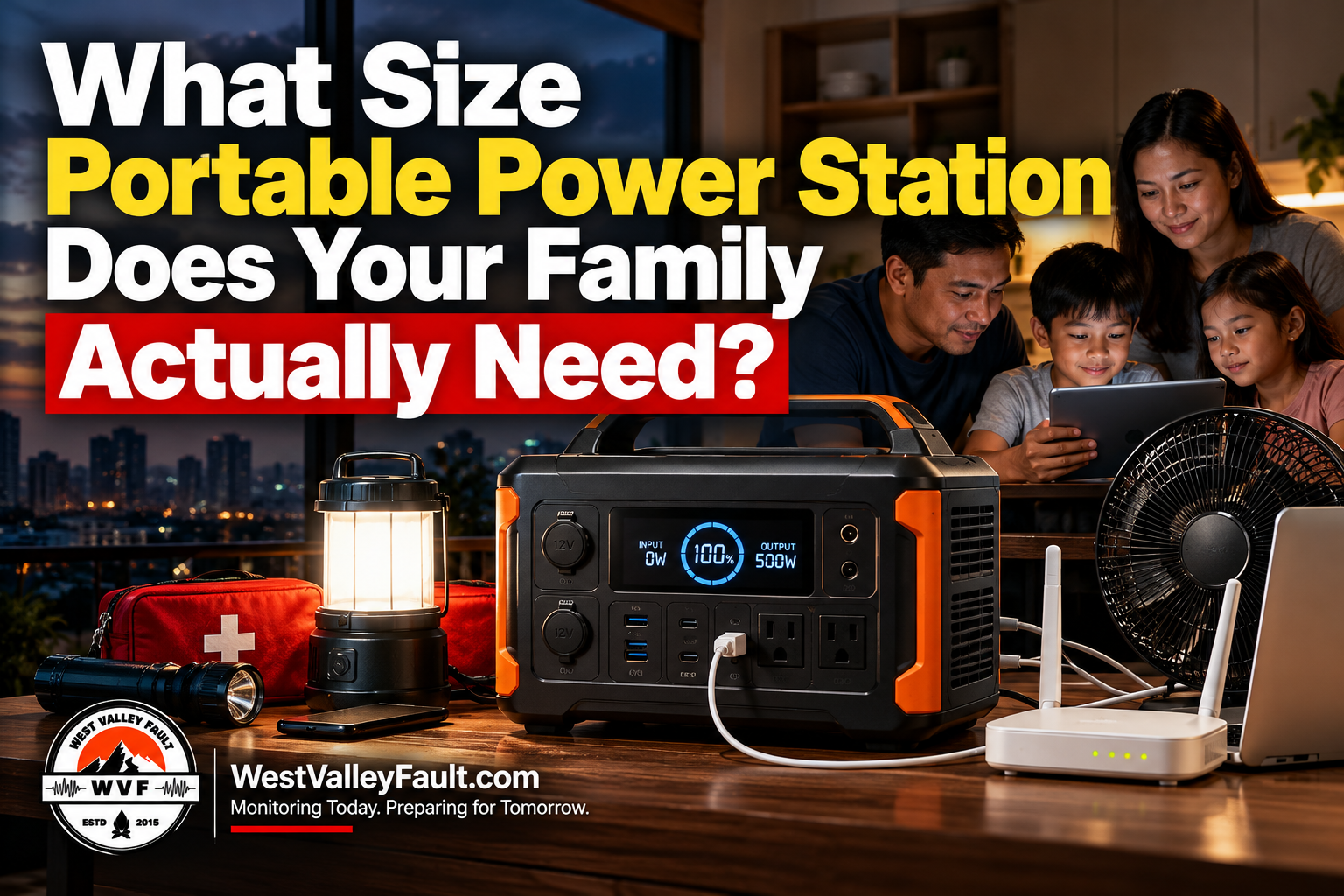
Affiliate disclosure and testing note: This article contains affiliate links. WestValleyFault.com may earn a commission from qualifying purchases at no additional cost to you. We have not hands-on tested the products mentioned here. The sizing guidance below is based on verified manufacturer specifications, official Philippine power-system information, and practical household load planning.
A portable power station should not be chosen by the size of your house.
It should be chosen by a much simpler question:
What does your family actually need to keep running when the power goes out?
From phones and lights to fans and refrigeration, different households need different amounts of backup energy. Start by listing the devices your family must keep running.
Quick Answer: Start With Your Essential Devices

These are starting points, not universal rules. The right number depends on your own devices, how long you expect to use them, and whether you can recharge the power station during the outage.
You Only Need to Understand Two Numbers
Watts (W) tell you how much power a device needs while it is running.
Watt-hours (Wh) tell you how much energy the power station stores.
Think of watt-hours as the size of the tank and watts as how fast you can draw from it.
A large battery can still fail to run an appliance if the power station’s output is too low. At the same time, a unit with enough output may still run out quickly if its battery capacity is small.
For Philippine use, also verify that the exact regional model you are buying is appropriate for local household equipment. The Philippine Distribution Code specifies a nominal grid frequency of 60Hz, so voltage, frequency and outlet configuration should be checked before purchase. (Department of Energy)
A Simple Way to Estimate the Capacity You Need
You do not need complicated calculations.
For each essential device:
device wattage × hours of use = approximate watt-hours needed
Then add the devices together and leave some extra room for conversion losses, changing usage and a reserve.
Example: One Family’s One-Day Emergency Load
| Device | Example use | Approx. energy |
|---|---|---|
| Four smartphone charges | One charge each | 60Wh |
| Two 5W LED lights | 5 hours | 50Wh |
| 10W router | 6 hours | 60Wh |
| 60W stand fan | 6 hours | 360Wh |
| 5W radio | 4 hours | 20Wh |
| Illustrative total | 550Wh |
That 550Wh is the planned device energy use before losses and reserve. For illustration, if usable delivered energy were 80% of the labeled battery capacity, the theoretical minimum would be 550 ÷ 0.80 = about 688Wh, before adding a further contingency margin. A roughly 800–1,000Wh class is therefore worth comparing for this particular load. The real answer depends on whether devices use AC or DC, the power station’s usable capacity, inverter efficiency, standby consumption and the reserve you want. A 768Wh model may be adequate if you shorten some run times, but should not be promised to cover all these example loads with a generous reserve.
The actual wattage printed on your own fan, router and chargers matters more than the examples above.
A router also helps only if your internet provider or telecommunications network is still operating.
200–400Wh: Basic Communication Backup
This range is most appropriate when your priority is keeping small devices alive rather than operating household appliances.
Think:

- one or two phones;
- LED lights;
- a radio;
- a router for limited periods;
- occasional laptop or tablet charging.
BLUETTI Elite 10 Mini Portable Power Station, 128Wh
For a person living alone, a small household, or a condo resident expecting relatively short outages, this may be enough.
The advantage is portability. Smaller units are easier to store, move and recharge. The tradeoff is that a fan, laptop or several family devices can use the available capacity quickly.
500–800Wh: The Family Emergency Middle Ground
For many households, this is the most useful category to examine first.
It can provide enough stored energy for multiple phones, lights, a router, a laptop and a fan when usage is rationed rather than continuous.
Our earlier Survival Tips guide used the BLUETTI AC70 as an example in this class. BLUETTI Philippines lists it at 768Wh capacity and 1,000W rated AC output, with LiFePO₄ battery chemistry and up to 500W solar input.

If you want to see how that 768Wh capacity translates into an actual emergency-use plan, read our related guide: When the Power Goes Out After an Earthquake: Is the BLUETTI AC70 Enough for Your Family?
1,000–1,500Wh: When You Need More Time or More Devices
This range becomes more relevant when your family needs longer fan use, several work devices, more lighting, or the possibility of supporting a refrigerator.

But refrigerator backup should never be sized from battery capacity alone.
Bluetti P-AC70P 1000W-2000W/864WH
A refrigerator may use modest power while running but require much more for a brief moment when its compressor starts. Check the refrigerator’s actual running and startup requirements against the power station’s continuous and surge output before relying on it.
This capacity class can also make sense for work-from-home households where keeping multiple laptops, communications equipment and fans operating is important.
2,000–4,000Wh+: Serious Household Backup
Once you move into this range, the objective changes. You are no longer simply charging communications devices—you are planning for larger household loads or longer periods between recharging.
A high-capacity example already identified for this Survival Tips series is the EcoFlow DELTA Pro 3. EcoFlow Philippines lists it with a 4,096Wh LFP battery, 4,000W AC output and 8,000W surge output, with up to 2,600W solar input.

This is a very different product from a 700–800Wh portable station. It is designed for much heavier backup use and comes with a correspondingly larger size, weight and cost.
View the EcoFlow DELTA Pro 3 listing on Lazada.
As with any marketplace listing, verify the exact regional model, voltage, outlet configuration, included accessories and local warranty before ordering.
Compare the Right Class Before You Buy
The two products below are examples of different capacity classes, not a head-to-head laboratory test or a complete market ranking. Use them to identify what specifications to compare, then verify the exact Philippine variant, seller, local warranty and current listing.

Shopping options: Check BLUETTI AC70 on Lazada or check EcoFlow DELTA Pro 3 on Lazada.
WVF may receive a commission at no extra cost to you. Pricing and stock are not independently verified here.
One Day or Two Days? This Changes the Answer
Capacity is not just about what you run. It is also about how long you expect to go before you can recharge.
If your essential devices use roughly 600Wh in one day, then a 700–800Wh power station may be a reasonable one-day emergency starting point.
But if you need the same load for a second day without recharging, the requirement roughly doubles.
This is why a recharging plan matters almost as much as battery size.
That recharge may come from:
- restored grid electricity;
- a compatible solar panel;
- a vehicle charging connection;
- or another backup source.
Official Metro Manila earthquake contingency planning includes scenarios in which power and communications disruption could be prolonged. The practical lesson is not that every household needs an enormous battery—it is that no portable battery should be treated as an unlimited source of electricity. (NDRRMC Metro Manila Earthquake Contingency Plan)
Do Not Oversize Just Because You Can

A larger battery gives you more runtime, but it also usually means:
- higher cost;
- more weight;
- more storage space;
- and longer charging time unless the unit supports higher input.
If your entire emergency plan is phones, lights and a radio, buying a 4,000Wh system may be unnecessary.
If your family wants to keep refrigeration, several fans and other larger appliances operating, a 300Wh station will be frustratingly small.
The best size is the smallest system that can safely cover your essential load, desired duration and reserve—with a realistic way to recharge it.
Need to compare emergency lighting, charging accessories, power banks and other essentials alongside a portable power station? Browse the WVF Emergency Preparedness Essentials guide to build an equipment list that fits your actual outage plan. This resource is separate from the individual affiliate product listings above.
Your Five-Minute Sizing Checklist

- List only the devices that really matter during an outage.
- Check the wattage printed on each device.
- Estimate how many hours you will actually use each one.
- Add the watt-hours and leave extra capacity for real-world losses and reserve.
- Check that the power station’s output can handle the devices that will run at the same time.
If a refrigerator, pump, air conditioner or other motor-driven appliance is involved, also check startup or surge requirements.
Backup Power Is Only One Part of the Plan
Electricity can help preserve communication, lighting and basic household functions, but your family still needs a plan for evacuation, contacts, emergency supplies and what to do after strong shaking.
The Big One Emergency Planner helps you organize those decisions before an emergency happens.
Frequently Asked Questions
Is 500Wh enough for an emergency?
Possibly—for short outages and modest loads. Calculate your devices’ combined watt-hours and allow for power losses before deciding.
Is 1,000Wh enough for a household?
For essential-device backup, 1,000Wh can cover considerably more than phones and lights. Whether it is enough depends on how long you need it to last and whether you include refrigeration or other larger loads.
Can a portable power station run a refrigerator?
Yes, if the unit can handle both the refrigerator’s running wattage and compressor startup surge, with enough energy for your target runtime.
Do I need solar panels?
Not necessarily. If outages are normally short and the grid returns reliably, wall charging may be enough. Solar becomes more useful when you want an independent recharging option during longer disruptions.
What size is best for a condo?
For a condo, prioritize the devices you actually need, safe storage and portability. A 500–800Wh unit may be a starting point, not a universal requirement.

Stay Informed. Stay Prepared.
Get WVF’s weekly earthquake and preparedness intelligence, new explainers and Special Reports by email. New subscribers also receive the free Earthquake Preparedness Quick Start Guide.
Email updates and a free welcome guide. Unsubscribe anytime.
The Bottom Line
Compare your planned energy needs with the station’s usable capacity, continuous output and surge rating. Choose a model that covers your essential devices and can be recharged within your outage plan.
Product specifications last verified October 21, 2026. Marketplace prices, bundle contents, regional variants and warranty terms can change. Verify the exact model before purchase.




Leave a Reply