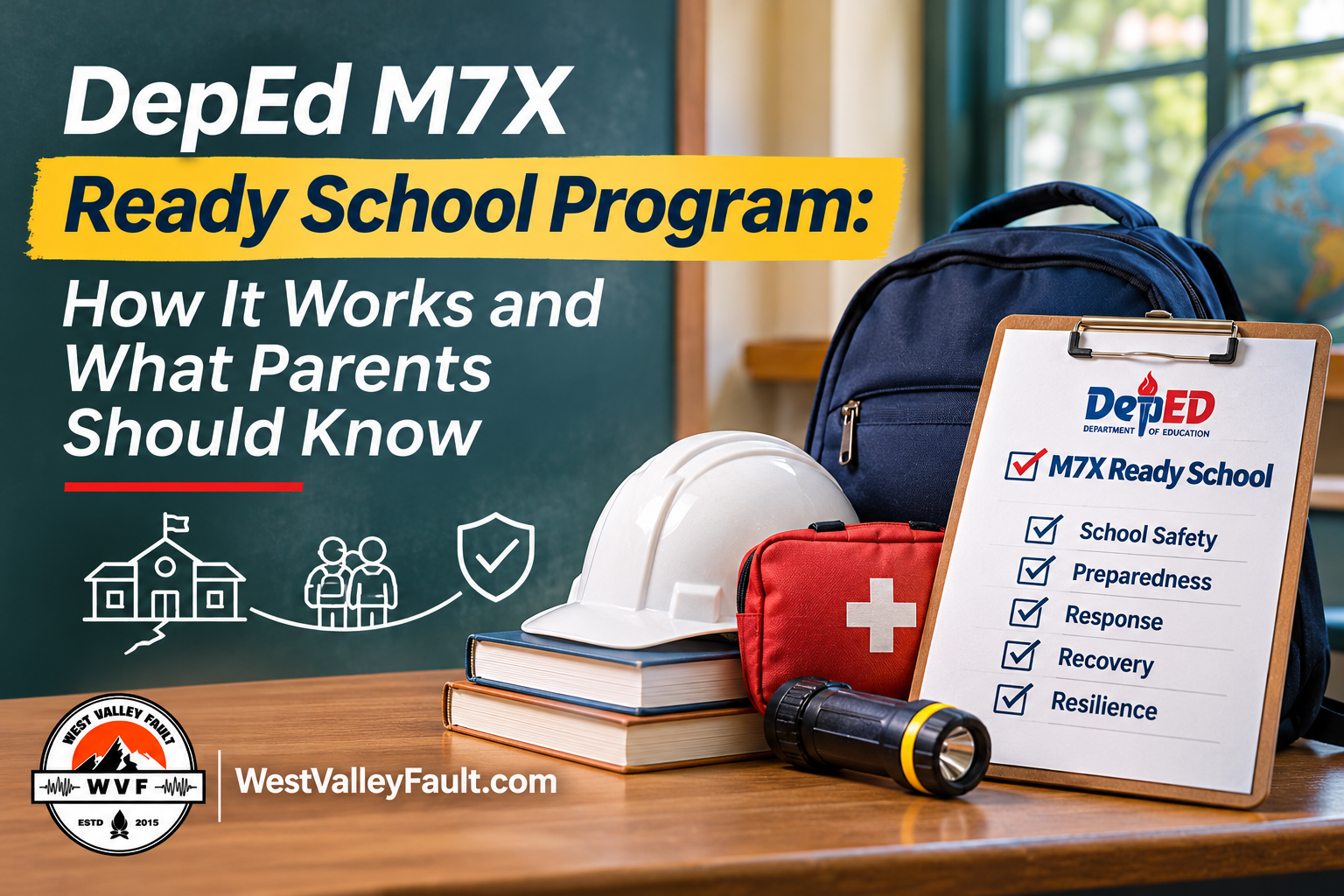
A school may conduct earthquake drills and still have unanswered questions about its classrooms, exits, emergency communications and ability to resume classes after a disaster. DepEd’s M7X Ready School Program seeks to address that broader problem by turning school preparedness into a documented, school-level process rather than an occasional exercise.
Launched on April 30, 2026, it initially targeted public schools in the Greater Metro Manila Area, where the West Valley Fault earthquake scenario is central to disaster planning. The rollout has since included regional orientations, including a Mindanao cluster activity in October. For parents, the important question is not simply whether a school has heard about M7X, but what actions it has taken and what hazards remain.
What is DepEd’s M7X Ready School Program?
The M7X Ready School Program is an earthquake preparedness and school-readiness certification initiative led by DepEd’s Disaster Risk Reduction and Management Service (DRRMS), working with educational facilities specialists and partners. Its purpose is to protect learners and school personnel, reduce potential losses and support learning continuity after a destructive earthquake. DepEd frames the program as a more complete system than a drill alone.
The name is associated with preparations for a magnitude-seven-class earthquake and the ‘Big One’ planning scenario. It should not be read as a forecast of a particular magnitude or date. Scientists cannot predict the exact time of a major West Valley Fault earthquake. School readiness therefore needs to be maintained whether the next disruptive event is tomorrow or years away.
What makes a school M7X ready?

Official regional implementation guidance describes two major parts of the program’s Readiness Index: structural readiness and non-structural readiness. DepEd’s April launch announcement also identifies structural audits, fire inspections, early warning arrangements and DepEd Agile Response Teams, together with first-aid and basic life-support training. These are program requirements and expectations; their presence at any individual school must be verified rather than assumed.
Structural readiness: are the buildings safer?
Structural readiness addresses school buildings and other facilities. It includes professional examination of seismic and fire-safety conditions and corrective actions guided by DepEd’s Safer Learning Facilities framework. Structural engineers, competent inspectors and responsible authorities—not parents reviewing a photograph—must judge whether a building needs repair, retrofitting, restricted use or further investigation. For examples of why professional evaluation and corrective work matter, see WVF’s report on school retrofitting in Manila and Taguig.
This matters because regular drills cannot compensate for serious structural deficiencies. The school community should know whether a professional assessment was conducted, whether defects were documented and what timetable exists to address them. A structure’s appearance, age or the absence of visible cracks is not proof that it will withstand strong shaking.
Non-structural readiness: do people know what to do?
Non-structural measures include securing furnishings and equipment, clearing evacuation paths, practising protective actions and planning student accounting and family reunification. They also include emergency communications, first aid, contingency plans and educational activities. Measures should be accessible to younger learners, students with disabilities and people needing assistance. For a local example of recurring drills and response-team preparations, read WVF’s report on Manila school earthquake drills.
A workable plan addresses failures that a typical drill may not simulate. What if the school gate cannot be used? How will parents learn where their children are? Who may collect a learner when a designated caregiver is unreachable? What if classes cannot resume in the normal building? The value of a readiness program lies in identifying such gaps before they become emergencies.
How does the 100-point M7X scorecard work?

DepEd’s DRRMS online operations center provides an M7X Ready School Scorecard resource and describes how schools can assess preparedness. Reporting on the October 2026 Mindanao cluster orientation calls it a 100-point self-assessment tool to identify readiness gaps and guide improvements. The official scorecard resource is the correct place to consult for current criteria and mechanics.
The score should not be mistaken for a stand-alone engineering certificate. It assesses broader preparedness; some items concern procedures or plans while others concern facilities. This article does not assign invented percentages or point values to individual criteria because a fully verified item-by-item scoring distribution was not available from the source material reviewed. Schools should use the actual DepEd scorecard rather than an unofficial reconstruction.
An M7X Ready Seal is intended for schools meeting the prescribed Readiness Index criteria. But participating in an orientation, entering a self-assessment and receiving certification are not the same event. Neither a high score nor a seal can promise that no building will be damaged or that no injuries will occur.
Which schools are included?
DepEd’s April announcement focused first on public schools in the Greater Metro Manila Area, encompassing the National Capital Region and neighboring parts of Central Luzon and Calabarzon. It set a target for coverage by the end of School Year 2026 and described an intended nationwide expansion to public and private schools by 2028. These are objectives, not verified claims that all schools have already passed.
CALABARZON’s April 2026 implementation memorandum identifies pilot areas along or near the West Valley Fault corridor and requires participating schools to prepare an M7X Action Plan. Regional and division orientations have been organized elsewhere. The October Mindanao orientation demonstrates that the wider rollout is underway, but an orientation should not be confused with completion of physical safety improvements.
WVF separately reported that event in DepEd Brings M7X Ready School Program to Mindanao with 100-Point Readiness Scorecard. This guide explains the program itself rather than repeating that news report.
What happens after an assessment?

The most important stage is what follows the score. DepEd guidance says participating schools should prepare an action plan after orientation, with identified activities implemented during the 2026–2028 period. Higher-risk pilot locations have earlier expectations. Each school may need different measures, from improving communication procedures to arranging professional building investigations.
An assessment should produce identifiable responsibilities, priorities and follow-up. For example, an obstructed stairwell requires prompt corrective action. Unsecured high cabinets need appropriate anchoring. A missing family reunification procedure calls for communication planning and practice. A potentially compromised building requires technical evaluation, not simply a better drill attendance rate.
How PlanSmart supports the program
DepEd also promotes PlanSmart for Safe Schools, a hazard-informed planning platform developed with DOST-PHIVOLCS and the World Bank. Its DRRMS portal says PlanSmart integrates GeoRiskPH hazard information and assists schools in preparing contingency plans. DepEd’s Safer Learning Facilities Guidebook provides complementary guidance on school infrastructure and inclusive, resilient learning spaces.
Maps and digital tools are helpful starting points, but the data must be interpreted for each location. WVF’s guide to hazards surrounding your child’s school explains how families can use official mapping resources. A school still needs accurate information about its facilities, the routes that children actually use and the resources that can realistically be mobilized during an emergency.
Five questions parents should ask their school

- Has the school completed an M7X assessment, and what improvements remain outstanding?
- Have classrooms and other buildings received the appropriate technical inspections?
- Where will students shelter or assemble, and how will children needing assistance be supported?
- How will teachers account for students and contact families if phone networks fail?
- Who may collect a child, and what is the plan if classrooms cannot be reopened immediately?
These are WVF’s recommended questions for families, not a copy of DepEd’s official scorecard. Parents can request explanations from school administrators or the Schools Division Office without expecting the school to release private security details. They should also update the child’s emergency contact and authorized-pickup information.
Families can also ask how the school will report progress. A useful update distinguishes completed actions from projects still awaiting inspection, procurement or funding. It explains who is responsible for outstanding work and when the next review will take place, without disclosing information that would compromise school security or student privacy. A school that has identified a weakness is not necessarily less responsible than one that reports a high score; transparency about its corrective plan matters.
School administrators, meanwhile, should avoid substituting generic announcements for practical instructions. Students and parents need to know where verified messages will appear, what happens if classes are interrupted, and how emergency decisions will be communicated. Those arrangements should be tested, periodically updated and explained in language families understand.

Does M7X certification guarantee a safe school?
No school certification can eliminate earthquake risk. Strong shaking may damage buildings or interrupt access, power, water and communications. A readiness seal indicates compliance with a program’s criteria at a particular stage, not a guarantee of performance under every possible earthquake. The quality of inspections, maintenance, corrective actions, emergency training and the ability to adjust during a real event all matter.
The program is nevertheless useful if it directs attention to real weaknesses and makes follow-up more accountable. Its success should be measured in safer facilities, better-prepared school communities and credible learning-continuity arrangements—not only the number of schools attending launch events.
Frequently asked questions
Is M7X only for Metro Manila?
The initial focus was the Greater Metro Manila Area, but DepEd has announced wider national expansion and conducted orientations elsewhere.
Does the 100-point scorecard certify structural safety?
No. The self-assessment covers preparedness broadly. Building safety requires appropriate professional examination and action where deficiencies are found.
Does M7X mean a magnitude 7 earthquake is imminent?
No. It describes a preparedness scenario and does not predict when a major earthquake will happen.
Where can schools find the official scorecard?
DepEd’s Disaster Risk Reduction and Management Service Virtual Operations Center provides the M7X Ready School Scorecard resource and related program materials.
SCHOOL READINESS STARTS WITH FAMILY READINESS
What Parents Can Prepare While Schools Improve Earthquake Readiness
DepEd’s M7X program focuses on what schools can assess and improve. Parents and caregivers have a complementary role: agree on emergency contacts, authorized school pickups, reunification arrangements and what to do if classes are suspended or communication networks fail. A household plan should be coordinated with—not substituted for—the school’s official procedures.
Put Your Family’s School-Emergency Plan in Writing

Use the Big One Emergency Planner to organize family contact details, meeting points, your child’s authorized pickup arrangements, emergency supplies and alternative communication steps. Confirm school-specific procedures directly with administrators, and keep your household information updated as those procedures change.
Prepare for an Interrupted School Day
Parents can review age-appropriate emergency essentials and household supplies—including water, first aid, lighting, communication backups and go-bags—using WVF’s Emergency Preparedness Essentials guide. Follow school rules on what students may bring; do not assume personal supplies replace a school’s own emergency resources.
Need to plan for power and communication interruptions at home? Read When the Power Goes Out After an Earthquake for a practical household backup-power comparison.
START FREE
Want a Simple Starting Point for Your Family?
Begin with the FREE WVF Earthquake Preparedness Quick Start Guide—a practical starting point for parents and caregivers preparing at home.

Subscribe to WVF’s earthquake intelligence, preparedness updates and Special Reports, and receive the Quick Start Guide as your welcome gift. Use it alongside your child’s school emergency instructions, especially its communication, evacuation and reunification arrangements.
Recommended Further Reading
- DepEd Brings M7X Ready School Program to Mindanao — How the M7X rollout and readiness scorecard were introduced to the Mindanao cluster.
- What Hazards Surround Your Child’s School? — A practical guide to identifying and discussing hazards affecting school communities.
- Manila Mandates Monthly School Earthquake Drills — Local implementation of recurring drills and disaster response teams.
- DPWH School Retrofitting in Manila and Taguig — Why strengthening school infrastructure is distinct from emergency drills.
- DepEd Reports 391 Disaster-Resilient Learning Continuity Spaces — How continuity facilities contribute to education after disasters.
Sources and further reading
- DepEd: M7X program launch, April 30, 2026
- DepEd DRRMS: M7X Scorecard, PlanSmart and learning resources
- DepEd CALABARZON: FY 2026 implementation guidelines
- Philippine Information Agency: School earthquake-readiness certification
- SunStar: Mindanao cluster rollout, October 2026




Leave a Reply