
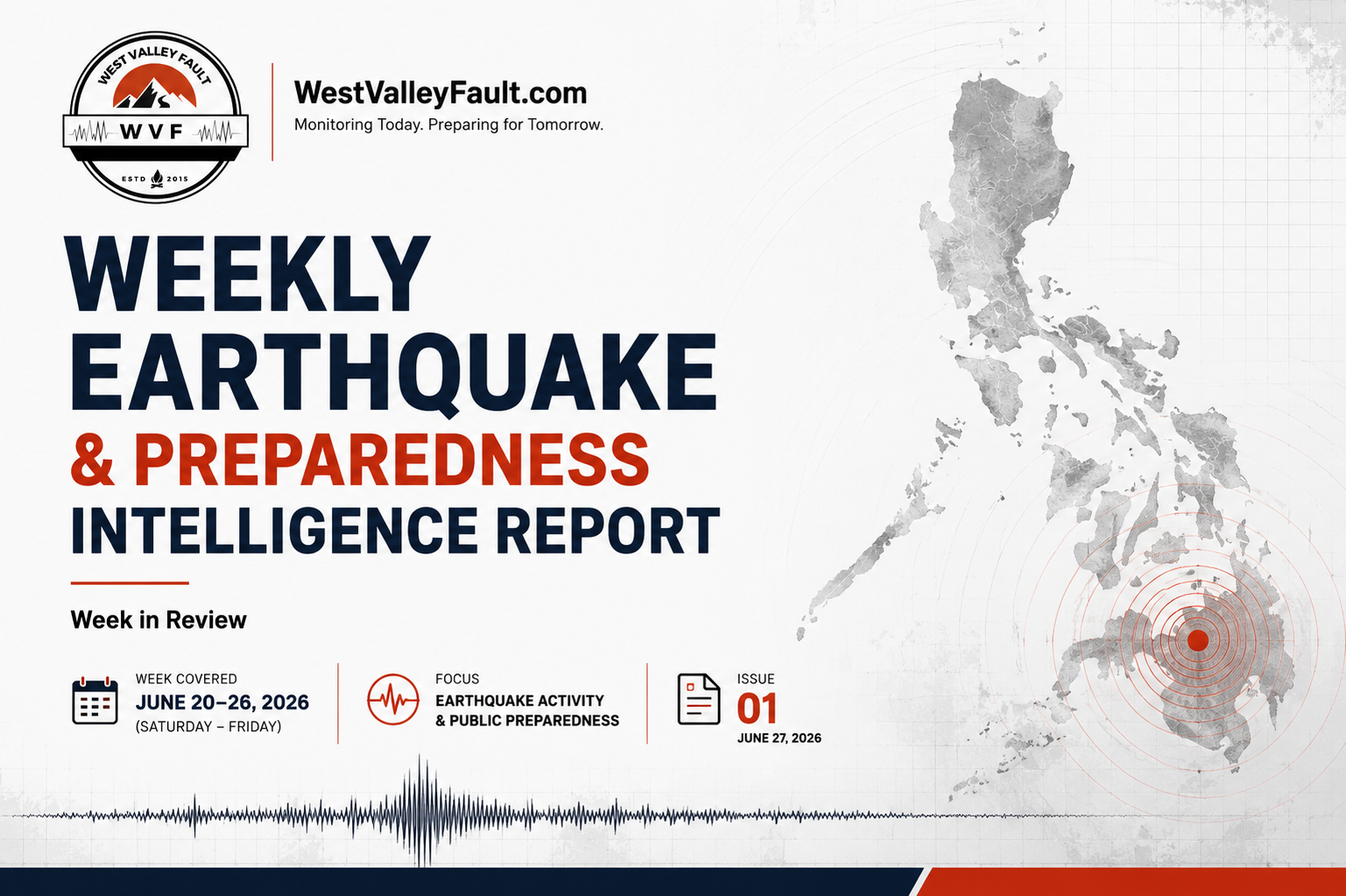
Week of June 20–26, 2026
Focus: Earthquake Activity & Public Preparedness
Issue #001
Executive Summary
This week was defined less by major earthquake events and more by a nationwide push to strengthen disaster preparedness. Government agencies, local governments, emergency responders, and communities carried out training, drills, and resilience initiatives designed to improve readiness before future disasters occur.
From nationwide earthquake drills and workforce preparedness programs to investments in early warning systems and emergency communications, this week’s developments demonstrate a continued shift toward proactive disaster risk reduction. While PHIVOLCS continued monitoring the offshore Sarangani earthquake sequence, equal attention was given to improving the systems, infrastructure, and people responsible for protecting communities when disasters strike.

FEATURED STORY
Nationwide Earthquake Preparedness Gains Momentum Across the Philippines
Sources: Department of the Interior and Local Government (DILG), Philippine Information Agency (PIA), PHIVOLCS
One clear theme emerged this week: preparedness.
Across multiple regions, government agencies intensified efforts to improve earthquake readiness through drills, technical training, public awareness campaigns, and investments in disaster response capabilities. Rather than responding to a disaster after it occurs, these initiatives focused on strengthening the country’s ability to act before and during emergencies.
The Department of the Interior and Local Government (DILG), together with the National Police Commission (NAPOLCOM), led the Second Quarter Nationwide Simultaneous Earthquake Drill, encouraging government agencies and local government units to test emergency procedures, evaluate evacuation plans, and strengthen interagency coordination.
At the local level, Vigan City assessed the earthquake preparedness of its workforce through participation in the nationwide drill, emphasizing that employee readiness is an important part of maintaining government services during emergencies.
Preparedness efforts also extended into homes and communities. Disaster officials urged families to conduct regular earthquake drills so that household members become familiar with protective actions, evacuation procedures, and emergency communication plans before an actual earthquake occurs.
Meanwhile, municipal Disaster Risk Reduction and Management (DRRM) officers in Lanao del Sur completed specialized training on early warning and hazard monitoring systems. Participants received instruction on technologies including PhilSensors, tsunami early warning systems, and the Disaster Resilience through Enhanced and Adaptive Monitoring Solutions (DREAMS) platform.
Emergency response capability was another major focus. The Bureau of Fire Protection (BFP) called on local government units to strengthen post-earthquake Urban Search and Rescue (USAR) capabilities by ensuring responders receive specialized training and are equipped for rubble search operations following major earthquakes.
Although these developments occurred independently across different parts of the country, together they illustrate a broader national commitment to strengthening preparedness through planning, training, technology, and coordination.
Why It Matters
Preparedness is built long before disasters occur.
Modern disaster resilience depends not only on scientific monitoring and warning systems, but also on well-trained responders, coordinated institutions, resilient infrastructure, and informed communities. This week’s developments show that many of these building blocks are continuing to improve across the Philippines.

TOP DEVELOPMENTS
1.Offshore Sarangani Earthquake Monitoring Continues
Source: PHIVOLCS
PHIVOLCS continued monitoring the offshore Sarangani earthquake sequence through aftershock observations, field assessments, and public information releases.
Why It Matters
Continued scientific monitoring helps authorities better understand fault behavior while providing updated information that supports emergency planning and public safety.
2. National Fiber Backbone Expansion Advances in Mindanao
Source: Philippine Information Agency
Expansion of the National Fiber Backbone is expected to improve digital connectivity and communications infrastructure across Mindanao.
Why It Matters
Reliable communications are essential during disasters. Stronger digital infrastructure can improve emergency coordination, dissemination of warnings, continuity of government operations, and post-disaster response.
3. PHIVOLCS Strengthens Preparedness Through Strategic Partnerships
Source: PHIVOLCS
PHIVOLCS continued preparedness outreach through partnerships with organizations such as Philippine Airlines, promoting earthquake awareness among personnel responsible for critical transportation services.
Why It Matters
Preparedness across transportation networks contributes to more resilient emergency response and faster recovery following major disasters.

As awareness of earthquake hazards continues to grow, proximity to the West Valley Fault is becoming an increasingly important factor in property valuation across Metro Manila and surrounding provinces.
GOVERNMENT PREPAREDNESS
National
• DILG and NAPOLCOM conducted the Second Quarter Nationwide Simultaneous Earthquake Drill to evaluate government preparedness.
Source: DILG
Vigan City, Ilocos Sur
• Vigan City strengthened workforce earthquake preparedness through participation in the nationwide drill.
Source: Philippine Information Agency
San Jose, Occidental Mindoro
• Families were encouraged to conduct regular household earthquake drills to improve preparedness at home.
Source: Philippine Information Agency
Masbate City
• BFP urged local government units to strengthen post-earthquake rubble search and rescue capabilities through specialized responder training.
Source: Philippine Information Agency – Disaster Information Service
Lanao del Sur
• Lanao del Sur DRRM officers completed specialized training on early warning and hazard monitoring systems.
Source: Philippine Information Agency
Ilagan City, Isabela
- The provincial government of Isabela intensified its disaster preparedness and response initiatives after the Philippine Institute of Volcanology and Seismology (PHIVOLCS) identified three active faults traversing the province.
Source: Philippine Information Agency
RESEARCH & MONITORING
Sarangani
• PHIVOLCS continued monitoring the offshore Sarangani earthquake sequence and aftershock activity.
Source: PHIVOLCS
• Hazard assessments and public advisories remained ongoing in affected areas.
Source: PHIVOLCS
Bolinao, Pangasinan
• PHIVOLCS continues to monitor the offshore Bolinao swarm and provide updates to the public.
Source: Manila Bulletin
EARTHQUAKE ACTIVITY THIS WEEK
Most Significant Event
| Date (PST) | Latitude | Longitude | Depth (km) | Magnitude | Location |
|---|---|---|---|---|---|
| 24 June 2026 – 10:04 AM | 16.58 | 118.94 | 14 | 5.1 | 104 km N 78° W of Bolinao (Pangasinan) |
| 26 June 2026 – 05:17 AM | 09.87 | 127.01 | 18 | 5.1 | 095 km N 84° E of General Luna (Surigao del Norte) |
| 26 June 2026 – 07:34 PM | 04.62 | 125.24 | 10 | 6.6 | 090 km S 12° W of Balut Island (Municipality of Sarangani), Davao Occidental |
Overall Assessment
No new nationally significant damaging earthquake occurred during the reporting period.
Source: PHIVOLCS Earthquake Bulletin
COMMUNITY PREPAREDNESS
Community preparedness efforts this week emphasized practical readiness through household drills, workforce preparedness, responder training, and improvements in early warning systems.
Collectively, these initiatives reinforce the importance of building a culture of preparedness before disasters occur.
THIS WEEK IN NUMBERS
5
Major preparedness initiatives featured
1
Nationwide earthquake drill
1
Regional early warning system training program
1
National communications infrastructure initiative supporting disaster resilience
Ongoing
PHIVOLCS monitoring of the offshore Sarangani earthquake sequence
PREPAREDNESS SPOTLIGHT
Building a Culture of Preparedness
Preparedness is most effective when it becomes routine rather than reactive.
Regular household drills, trained responders, resilient communications, effective early warning systems, and coordinated government planning all contribute to reducing disaster impacts when major earthquakes occur.
THE BIGGER PICTURE
This week’s developments demonstrate that earthquake resilience extends far beyond monitoring seismic activity.
Preparedness involves strengthening institutions, investing in technology, improving communications infrastructure, training emergency responders, and encouraging families to prepare before disasters occur.
Although these initiatives often receive less public attention than major earthquakes themselves, they represent some of the country’s most important long-term investments in disaster risk reduction.
30-SECOND TAKEAWAY
• Nationwide preparedness activities expanded across multiple government agencies.
• Local governments strengthened training, drills, and emergency response capabilities.
• Investments in communications and early warning systems continue to improve disaster resilience.
• PHIVOLCS maintained monitoring of the offshore Sarangani earthquake sequence.
• Preparedness remains the country’s strongest defense against future earthquake disasters.
Preparedness starts at home

Take the next step in your preparedness journey.
Download the FREE West Valley Fault™ Quick Start Guide and begin building your family’s emergency plan today.
REFERENCES & FURTHER READING
Official Sources
- Department of the Interior and Local Government (DILG)
- PHIVOLCS
- Department of Science and Technology (DOST)
- Office of Civil Defense (OCD)
- National Disaster Risk Reduction and Management Council (NDRRMC)
Government Publications
- Philippine Information Agency
- Philippine Information Agency – Disaster Information Service
Additional Reading
- PHIVOLCS advisories and earthquake bulletins
- DILG Nationwide Simultaneous Earthquake Drill updates
- Disaster preparedness publications from participating agencies




Leave a Reply