
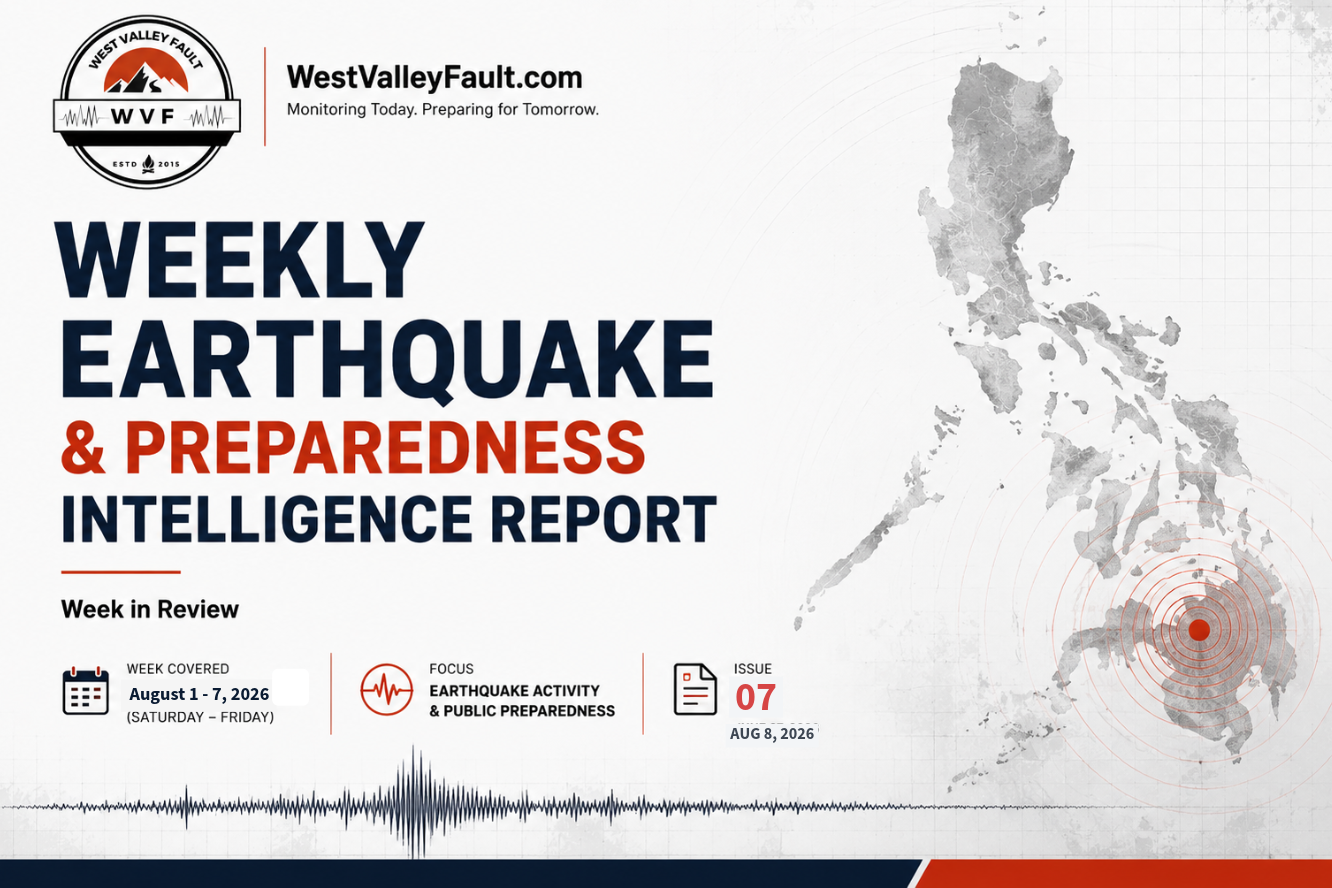
Week of Aug 1 – 7, 2026
Focus: Earthquake Activity & Public Preparedness
Issue #007
Executive Summary
Philippine disaster preparedness this week reflected a continuing shift from awareness toward the systems that determine whether communities can withstand and respond to major hazards. Legislative efforts to overhaul the country’s building regulations remained in focus, while Davao Oriental officials called for the assessment and retrofitting of public buildings to improve their ability to withstand strong earthquakes. At the same time, a proposed $500-million domestic subsea fiber-optic network introduced another dimension to resilience: communications infrastructure that could also serve as a continuous sensing system for earthquakes and tsunamis.
Preparedness efforts were also visible at the local and community levels. DOST-PHIVOLCS strengthened tsunami preparedness initiatives in Borongan, while private-sector programs continued to promote disaster readiness and more inclusive approaches to emergency preparedness. Together, these developments underscore that resilience depends on several systems working together — sound regulations, safer structures, effective monitoring, capable local governments, and communities that know how to respond.
The week’s seismic activity provided an immediate reminder of why those investments matter. PHIVOLCS recorded four earthquakes of Magnitude 5.0 or greater during the August 1–7 reporting period, led by a shallow Magnitude 6.4 earthquake located southwest of Balut Island, Davao Occidental, on August 5. Three other M5+ earthquakes were recorded during the remainder of the week, including a Magnitude 5.4 event near Mamburao, Occidental Mindoro. The earthquake monitor alone does not establish that the events near Davao Occidental were related, and this report makes no such inference.
Taken collectively, this week’s developments point to a broader preparedness lesson: earthquake resilience is not created by any single project or policy. It comes from strengthening the entire chain — from the rules governing buildings and the infrastructure monitoring hazards to the institutions and communities expected to act when a disaster occurs.
Before you read further — do you know your property’s actual risk?

Download the free Home Buyer’s Earthquake Risk Guide to check your specific location against active faults, liquefaction zones, and building safety factors. It takes five minutes and doesn’t require a subscription.
Small disclaimer: This checklist is an educational screening tool—not an official hazard assessment or guarantee of safety.
30-Second Takeaway
- Lawmakers renewed calls to overhaul Philippine building regulations, keeping structural safety and stronger construction standards on the national agenda.
- Davao Oriental officials urged municipalities to assess and retrofit public buildings to improve their ability to withstand strong earthquakes.
- A proposed $500-million domestic subsea fiber network could also function as an earthquake and tsunami sensing system, linking communications infrastructure with disaster monitoring.
- DOST-PHIVOLCS strengthened tsunami preparedness efforts in Borongan, reinforcing local readiness for coastal hazards.
- Community and private-sector initiatives continued promoting disaster preparedness, including more inclusive approaches to emergency readiness.
- PHIVOLCS recorded four M5.0+ earthquakes during the week, led by a shallow M6.4 earthquake southwest of Balut Island, Davao Occidental.

Which cities could face the greatest consequences if the West Valley Fault generates a major earthquake? This Special Report examines the communities exposed to severe ground shaking, surface rupture, liquefaction and other earthquake hazards.
Top Developments
Senate Urged to Advance Overhaul of Philippine Building Regulations

Lawmakers renewed calls for the Senate to act on proposed legislation seeking an overhaul of the country’s building regulations. The initiative keeps structural safety and modernization of construction requirements on the national agenda, extending a broader policy discussion in recent weeks over whether existing standards are sufficient for the Philippines’ exposure to earthquakes and other hazards.
The renewed push is particularly relevant because resilient construction depends not only on improved materials and engineering practices but also on the regulatory framework governing how buildings are designed, approved, constructed, and maintained.
Preparedness Implications
Updating building regulations can strengthen the institutional foundation for earthquake resilience. However, the eventual preparedness impact will depend on the final provisions of the legislation and, if enacted, how effectively new requirements are implemented and enforced.
Source: Malaya Business Insight
$500-Million Subsea Cable Could Double as Earthquake and Tsunami Sensor Network

The Philippines’ three largest broadband providers — PLDT, Globe Telecom and Converge ICT Solutions — are proposing a consortium to build a $500-million domestic submarine fiber-optic cable that would serve both telecommunications and disaster-monitoring functions.
According to the Department of Information and Communications Technology, the planned network would incorporate technology capable of detecting seismic movement, potentially allowing the cable to contribute real-time data for earthquake and tsunami monitoring. The proposed system would extend from Batanes through major portions of the Philippine archipelago, with a targeted completion period of 24 months following approval.
Six government agencies are expected to have roles in the initiative, including DOST through PHIVOLCS for earthquake and tsunami warning applications.
Preparedness Implications
The proposal illustrates how major infrastructure can potentially serve more than one resilience function. If implemented and successfully integrated into the country’s established monitoring systems, the cable could provide an additional stream of seismic information while simultaneously strengthening national telecommunications connectivity.
The system remains a proposal, however, and should not yet be regarded as part of the country’s operational earthquake or tsunami warning network.
Source: Manila Bulletin
Davao Oriental Pushes Assessment and Retrofitting of Public Buildings

Davao Oriental Governor Niño Sotero Uy Jr. urged municipal officials to assess public buildings and identify structures that may require retrofitting to improve their ability to withstand strong earthquakes.
The initiative shifts attention from future construction to another important resilience challenge: the condition of buildings that are already standing. Structural assessment can help local governments identify vulnerabilities before an earthquake exposes them under real-world conditions.
Preparedness Implications
Assessing existing public buildings is an important first step toward determining where structural improvements may be necessary. Retrofitting vulnerable structures can reduce physical risk, but effective implementation requires engineering assessment, prioritization, funding, and appropriate technical standards.
For earthquake-prone communities, resilience is therefore not only about constructing safer new buildings. It also requires understanding and addressing vulnerabilities within the existing building stock.
Source: SunStar

This special report examines why building performance, code enforcement, structural assessments, and engineering decisions—not earthquake magnitude alone—will determine the true impact of the next major earthquake.
Government Preparedness
Eastern Samar
• DOST-PHIVOLCS Strengthens Tsunami Preparedness in Borongan
DOST-PHIVOLCS continued efforts to strengthen tsunami preparedness in Borongan City, Eastern Samar, bringing national scientific and hazard expertise into local disaster-readiness efforts.
For coastal communities, tsunami preparedness requires more than awareness that a hazard exists. Local authorities and residents must be able to translate hazard information into practical preparedness and emergency-response actions. Initiatives connecting PHIVOLCS expertise with local preparedness therefore help close the gap between national hazard science and community-level readiness.
The development also reinforces an important principle of disaster-risk reduction: scientific monitoring has its greatest public value when hazard information can be understood and acted upon by the communities exposed to the threat.
Source: Philippine Information Agency
Check whether your home may have visible structural-safety concerns, Is Your Home Fault-Line Ready? A Structural Integrity Checklist for Metro Manila Homeowners.
Davao Oriental
• Davao Oriental Moves Toward Assessment and Retrofitting of Public Buildings
Davao Oriental’s call for municipal governments to assess public buildings and identify structures requiring retrofitting represents a more infrastructure-focused form of local government preparedness.
Rather than waiting until an earthquake reveals structural weaknesses, the initiative places emphasis on identifying potential vulnerabilities beforehand and determining where corrective measures may be necessary.
For the full discussion and preparedness implications, refer to Top Developments: “Davao Oriental Pushes Assessment and Retrofitting of Public Buildings.”
Source: SunStar
Research & Monitoring
• Proposed Subsea Fiber Network Could Add a New Layer of Seismic Monitoring
A proposed $500-million domestic submarine fiber-optic network could eventually provide the Philippines with an additional source of real-time information on earthquakes and tsunamis.
According to the Department of Information and Communications Technology, the planned cable would incorporate sensing technology capable of detecting seismic movement along the network. DOST, through PHIVOLCS, is among the government agencies expected to participate in the initiative for earthquake and tsunami warning applications.
Because much of the Philippines’ seismic activity occurs offshore, infrastructure capable of detecting movement across an extensive undersea network could potentially supplement existing monitoring capabilities. Its actual contribution, however, will depend on the system’s eventual design, deployment and integration with established scientific monitoring and warning systems.
The project remains under development and should not be interpreted as an operational addition to the PHIVOLCS monitoring network at this stage.
For the broader infrastructure discussion, refer to Top Developments: “$500-Million Subsea Cable Could Double as Earthquake and Tsunami Sensor Network.”
Source: Manila Bulletin
Infrastructure & Policy
• Building-Code Reform Remains on the Legislative Agenda
The renewed call for Senate action on legislation seeking to overhaul Philippine building regulations keeps structural safety at the center of the country’s disaster-resilience policy discussion.
Building regulations form one of the principal mechanisms through which engineering and safety requirements are translated into actual construction practice. Modernizing those rules can therefore have long-term implications for earthquake resilience, particularly as cities continue to expand and existing structures age.
For the full discussion, refer to Top Developments: “Senate Urged to Advance Overhaul of Philippine Building Regulations.”
Source: Malaya Business Insight
• Davao Oriental Turns Attention to Existing Public Buildings
Davao Oriental’s call for municipalities to assess and potentially retrofit public buildings highlights the other side of structural resilience: improving buildings that already exist.
While updated regulations can influence future construction, assessment and retrofitting address vulnerabilities within the existing building stock. Together, the two approaches illustrate how earthquake-resilient infrastructure requires attention to both new and existing structures.
For the full discussion, refer to Top Developments: “Davao Oriental Pushes Assessment and Retrofitting of Public Buildings.”
Source: SunStar
Earthquake Activity This Week
PHIVOLCS recorded four earthquakes of Magnitude 5.0 or greater during the August 1–7, 2026 reporting period.
| Date & Time (PHT) | Magnitude | Depth | Location |
|---|---|---|---|
| August 5, 2026 – 12:14 PM | 6.4 | 6 km | 47 km S 55° W of Balut Island, Davao Occidental |
| August 6, 2026 – 12:50 AM | 5.3 | 183 km | 408 km S 28° E of Balut Island, Davao Occidental |
| August 6, 2026 – 5:41 AM | 5.6 | 13 km | 68 km S 11° W of Balut Island, Davao Occidental |
| August 7, 2026 – 10:38 AM | 5.4 | 14 km | 13 km S 57° W of Mamburao, Occidental Mindoro |
Source: PHIVOLCS – Latest Earthquake Information (Earthquake Monitoring System)
Dates and times are in Philippine Standard Time.
Understand what earthquake magnitudes mean in the Philippine context, watch the short explainer here– What Earthquake Magnitudes Mean in the Philippines
Weekly Seismic Note:
The strongest earthquake recorded during the reporting period was the shallow M6.4 event southwest of Balut Island on August 5. Two additional M5+ earthquakes on August 6 were also described by PHIVOLCS relative to Balut Island, while an M5.4 earthquake occurred near Mamburao, Occidental Mindoro, on August 7.
The earthquake monitor establishes the occurrence, location, magnitude and depth of these events, but does not by itself establish that the earthquakes near Davao Occidental were related. Accordingly, this report does not characterize them as an earthquake sequence, swarm or aftershock series without a specific PHIVOLCS assessment.
Sources: PHIVOLCS
Community Preparedness
• Pasay City
SM Cares Promotes Inclusive Emergency Preparedness
SM Cares brought attention to inclusive disaster readiness through an emergency preparedness forum designed to broaden participation in preparedness efforts.
The initiative reinforces an important preparedness principle: emergency planning must account for the different needs and capabilities of people within a community. Inclusive preparedness helps ensure that resilience efforts are not limited to those who can respond independently during an emergency.
This community-focused work complements the week’s broader developments in building safety, government preparedness and hazard monitoring by emphasizing that effective disaster resilience ultimately depends on people being prepared to act.
Source: Malaya Business Insight
This Week in Numbers
| Number | What It Represents |
|---|---|
| 4 | Earthquakes of Magnitude 5.0 or greater recorded by PHIVOLCS during August 1–7 |
| M6.4 | Strongest earthquake recorded during the reporting period |
| $500 million | Estimated cost of the proposed domestic submarine fiber-optic network |
| 3 | Broadband providers involved in the proposed cable consortium — PLDT, Globe and Converge |
| 24 months | Targeted completion period for the cable system following approval |
| 6 | Government agencies identified as participants in the proposed multi-purpose cable initiative |
Blog Highlight of the Week

High-Rise Earthquake Evacuation, Part 1: Before BPO Workers Enter the Stairwell
When an earthquake stops, thousands of workers inside high-rise offices may instinctively head toward the stairs. But an immediate mass evacuation can introduce new dangers if stairwells, exits, façades and surrounding areas have not been assessed. Part 1 of this WestValleyFault.com series examines the critical decisions that should occur before BPO employees leave their floors and enter the evacuation system.
Read the full Special Report: https://westvalleyfault.com/2026/07/30/high-rise-earthquake-evacuation-bpo-workers-part-1/
Check our latest Special Reports for deeper insights into earthquake hazards, preparedness, and resilience in the Philippines, and return next week for the next edition of the WestValleyFault.com Weekly Earthquake & Preparedness Intelligence Report.
Turn Earthquake Awareness into a Family Plan
Knowing what happened this week is only the beginning. Make sure your household knows what to do, where to meet, who to contact and what to prepare before the next emergency.

✔ Family emergency plans
✔ Emergency contact pages
✔ Go-bag planning
✔ Home preparedness checklists
✔ Document inventory
✔ Designed specifically for Filipino households
Explore the WestValleyFault™ Family Emergency Planner
Not ready for the full planner?

Start with the free WestValleyFault™ Earthquake Preparedness Quick Start Guide.
The free West Valley Fault Earthquake Quick Start Guide walks you through the essential first steps for preparing your family, home and emergency supplies for a major earthquake.
Recommended Further Reading
- How the Big One Could Affect Makati
- Earthquake Preparedness for Businesses and Industries
- High-Rise Earthquake Evacuation, Part 1: Before BPO Workers Enter the Stairwell
- Cities Most at Risk If the Big One Strikes the Philippines
- Preparing for the Big One: Essential Earthquake Survival Kit for Filipinos
References
Top Developments
- Malaya Business Insight
- “Villafuertes urge Senate to pass bill seeking building code overhaul”
- https://malaya.com.ph/news/national-news/villafuertes-urge-senate-to-pass-bill-seeking-building-code-overhaul/
- Manila Bulletin
- “Top telcos join forces on $500-million archipelagic submarine cable backbone—DICT”
- https://mb.com.ph/2026/08/03/top-telcos-join-forces-on-500-million-archipelagic-submarine-cable-backbonedict
- SunStar
- “Davao Oriental guv urges retrofitting of public buildings amid quake threat”
- https://www.sunstar.com.ph/davao/davao-oriental-guv-urges-retrofitting-of-public-buildings-amid-quake-threat
Government Preparedness
- Philippine Information Agency
- “DOST-PHIVOLCS strengthens Borongan’s tsunami preparedness”
- https://pia.gov.ph/news/dost-phivolcs-strengthens-borongans-tsunami-preparedness/
- SunStar
- “Davao Oriental guv urges retrofitting of public buildings amid quake threat”
- https://www.sunstar.com.ph/davao/davao-oriental-guv-urges-retrofitting-of-public-buildings-amid-quake-threat
Research & Monitoring
- Manila Bulletin
- “Top telcos join forces on $500-million archipelagic submarine cable backbone—DICT”
- https://mb.com.ph/2026/08/03/top-telcos-join-forces-on-500-million-archipelagic-submarine-cable-backbonedict
Infrastructure & Policy
- Malaya Business Insight
- “Villafuertes urge Senate to pass bill seeking building code overhaul”
- https://malaya.com.ph/news/national-news/villafuertes-urge-senate-to-pass-bill-seeking-building-code-overhaul/
- SunStar
- “Davao Oriental guv urges retrofitting of public buildings amid quake threat”
- https://www.sunstar.com.ph/davao/davao-oriental-guv-urges-retrofitting-of-public-buildings-amid-quake-threat
- Manila Bulletin
- “Top telcos join forces on $500-million archipelagic submarine cable backbone—DICT”
- https://mb.com.ph/2026/08/03/top-telcos-join-forces-on-500-million-archipelagic-submarine-cable-backbonedict
Community Preparedness
- Malaya Business Insight
“Emergency preparedness forum: SM Cares hosts largest gathering for inclusive preparedness”
https://malaya.com.ph/business/marketing-board/emergency-preparedness-forum-sm-cares-hosts-largest-gathering-for-inclusive-preparedness/
Earthquake Activity This Week
- DOST–Philippine Institute of Volcanology and Seismology (PHIVOLCS)
“Earthquake Information — PHIVOLCS Earthquake Monitor”
https://earthquake.phivolcs.dost.gov.ph/
Data used: PHIVOLCS earthquake-monitor dataset supplied for the August 1–7, 2026 reporting period.




Leave a Reply