
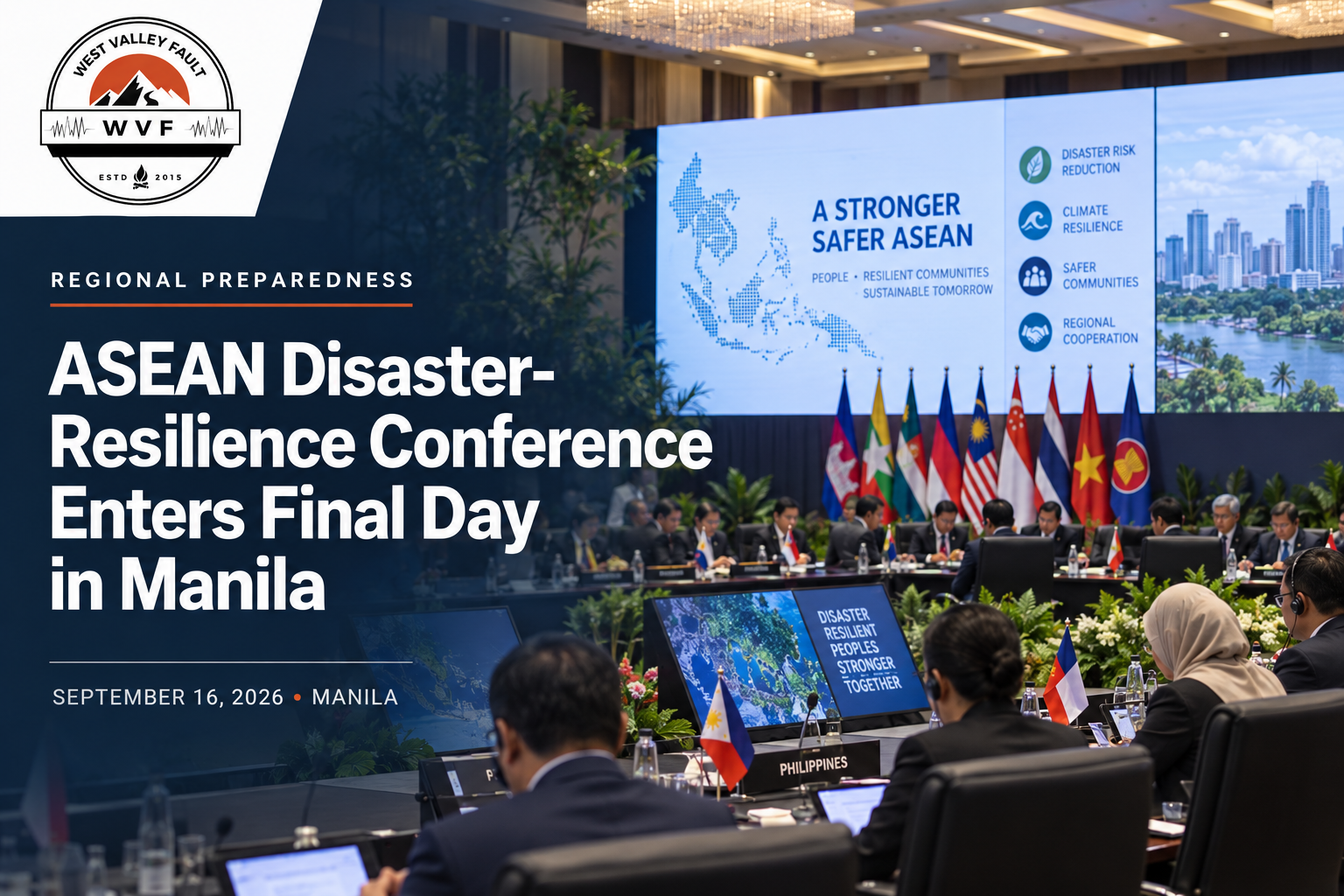
Disaster-management leaders from across Southeast Asia enter the second and final day of a regional resilience conference in Manila on September 16, with discussions expected to shape cooperation on early warning, preparedness, recovery and disaster-risk financing.
MANILA, Philippines — Disaster-management ministers and senior officials from across Southeast Asia enter the second and final day of the ASEAN Ministerial Conference on Disaster Resilience in Manila on Wednesday, September 16, 2026. Hosted by the Philippine Office of Civil Defense under the country’s 2026 ASEAN chairship, the two-day meeting is expected to conclude with new regional commitments on disaster preparedness, early warning, recovery and resilience.
The conference opened on September 15 with sessions covering risk knowledge, early-warning systems, anticipatory action, institutional preparedness and the implementation of resilience measures at the local level. The second day turns to recovery readiness, disaster-risk financing, community resilience, private-sector participation and ASEAN’s longer-term resilience agenda beyond 2030.
Southeast Asia faces overlapping hazards that include earthquakes, typhoons, floods and droughts. Rapid urbanization, environmental pressures and vulnerable infrastructure can compound their effects, making cooperation between national agencies, local governments, communities and businesses increasingly important.
Regional risk review and Manila declaration
Organizers said the conference would feature the launch of the ASEAN Risk Monitor and Disaster Management Review, a regional knowledge product intended to provide governments and disaster-management agencies with current perspectives on risk and disaster management across ASEAN.
The meeting is also expected to conclude with a proposed Manila Declaration on Advancing ASEAN’s Disaster Resilience. The declaration could help direct regional cooperation through 2030 and beyond, although its practical effect will depend on the final commitments, implementation mechanisms and resources adopted by participating governments.
For the Philippines, the conference is relevant to continuing efforts to strengthen early-warning systems, institutional readiness, resilient recovery and the capacity of local governments to turn hazard information into operational plans. Related national work includes the training of more than 2,300 DPWH engineers in seismic retrofitting and the use of preparedness frameworks such as Operation L!STO.
The conference does not indicate an increased probability of an earthquake. Its significance lies in improving the policies, information systems, financing and institutional capabilities needed before hazards become disasters.
WestValleyFault.com will review the final Manila Declaration and the regional risk monitor for commitments that could directly affect Philippine earthquake preparedness and local-government action.
This developing report reflects official information available before the conference’s final documents were released. It will be updated when formal outcomes become publicly available.
Sources: ASEAN 2026 official announcement and Philippine Information Agency.
Stay Prepared with WVF
For continuing earthquake and disaster preparedness news content, join the WestValleyFault.com email list.

As a welcome gift, you’ll also receive our FREE Earthquake Quick Start Guide.
- ✔ Weekly Earthquake Intelligence Report
- ✔ Exclusive Special Reports
- ✔ Practical preparedness tips
- ✔ FREE Earthquake Quick Start Guide
Recommended Reading
- Earthquake hazard maps and preparedness resources
- More Than 2,300 DPWH Engineers Trained in Seismic Retrofitting of Public Buildings
- Philippines Earthquake Preparedness Report: September 5–11, 2026
- What Is Operation L!STO?
- Japan and ASEAN Forge Stronger Ties for Disaster Resilience
UPDATE — September 16, 2026
ASEAN disaster-management leaders formally adopted the Manila Declaration and an accompanying Leaders’ Statement as the ASEAN Ministerial Conference on Disaster Resilience concluded in Manila on September 16.
The adoption moves the declaration from a proposed conference outcome to a formal regional commitment. However, the complete declaration text—and any provisions specifically addressing earthquakes, funding, implementation deadlines or responsibilities for Philippine local governments—was not yet available through the strongest accessible official sources at the time of this update.
WestValleyFault.com will review the declaration and the ASEAN Risk Monitor once their full texts become publicly available, focusing on commitments affecting Philippine early-warning systems, local preparedness, emergency communications, civil-defense coordination and disaster-risk financing.
Sources: Office of Civil Defense Philippines closing-day update and Philippine Information Agency report.




Leave a Reply