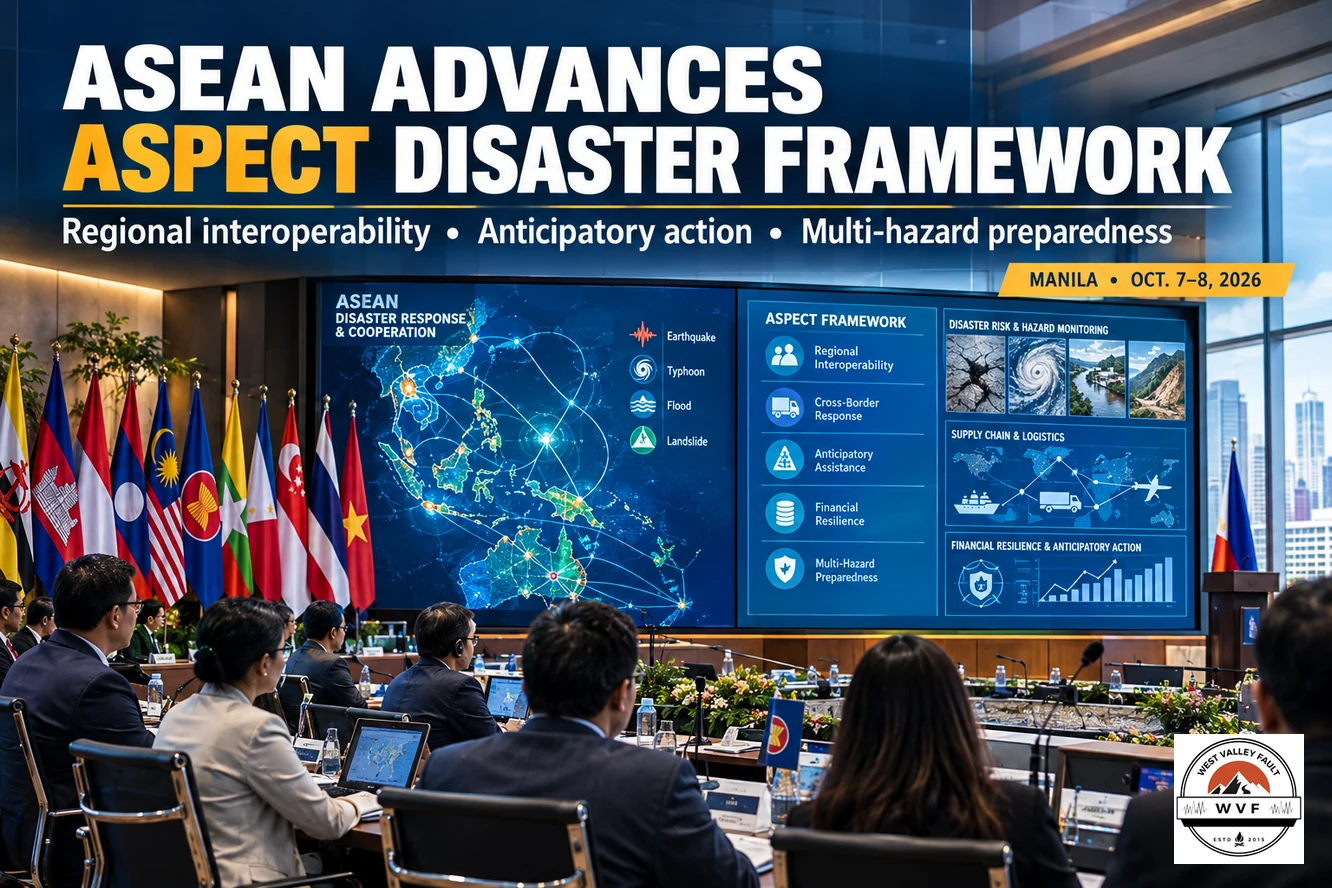
MANILA — The Philippines hosted a high-level ASEAN forum in Manila on October 7–8, 2026 to advance the proposed ASEAN Strategic Protocol for Emergency and Comprehensive Transformation (ASPECT) Framework, a regional disaster-management initiative intended to improve how ASEAN countries coordinate before and during major emergencies.
The Department of Social Welfare and Development opened the forum on October 7 at the Diamond Hotel in Malate, Manila. DSWD said the proposed framework seeks to strengthen regional interoperability, cross-border facilitation, anticipatory approaches, financial resilience, multi-hazard preparedness, and community-based and protection-centered response.
The Philippine Information Agency published a follow-up report on October 9, describing ASPECT as a framework that would build on existing ASEAN disaster-management mechanisms, including the ASEAN Agreement on Disaster Management and Emergency Response (AADMER).
The discussions follow other recent regional disaster-resilience initiatives hosted in Manila. WVF previously covered the ASEAN Disaster-Resilience Conference in Manila and the policy question of how regional commitments translate into disaster-ready infrastructure and implementation.
ASPECT is designed around faster, more coordinated regional action
DSWD said the two-day forum brought together representatives of the ASEAN Committee on Disaster Management, the Senior Officials Meeting on Social Welfare and Development, development partners and technical experts.
The framework under discussion is intended to improve how ASEAN mechanisms work together when disasters cross borders or overwhelm national systems. Its stated areas of focus include faster cross-border facilitation, anticipatory assistance, stronger financial resilience and better coordination between social-protection and disaster-response systems.
On the second day of the forum, DSWD Secretary Rex Gatchalian emphasized anticipatory action as a way to help vulnerable communities before disaster impacts escalate. That regional direction parallels developments inside the Philippines, where WVF has tracked NDRRMC rules for pre-disaster evacuation, infrastructure protection and anticipatory funding.
Why this matters for earthquake preparedness
Large earthquakes can create response demands that extend beyond a single jurisdiction, especially when transport, communications, logistics or medical capacity are disrupted. A functioning regional framework could help ASEAN members coordinate assistance, financing, logistics and technical support more quickly during a major earthquake or other cross-border emergency.
For the Philippines, the practical value would depend on whether ASPECT eventually produces clear operational procedures, financing arrangements and interoperable response mechanisms rather than remaining only at the policy level.
Regional coordination is especially relevant when national systems need outside support for mass-casualty response and logistics. WVF recently reported on the Philippines–Japan mass-casualty and aeromedical disaster exercise, which tested another form of cross-border emergency cooperation.
The DRRM Innovations Gallery was an exhibit, not operational deployment
The forum also included a Disaster Risk Reduction and Management Innovations Gallery featuring technologies, partnerships and initiatives related to risk-informed action, preparedness, response, social protection, resilient livelihoods and recovery.
The gallery demonstrated approaches and capabilities, but its presence does not establish that any displayed technology or program has been funded, deployed or adopted operationally by ASEAN members.
ASPECT remains a proposed framework
ASPECT remains under development. The October forum did not establish it as an adopted binding protocol, nor did the government reports announce a funded implementation program, deployment timetable or earthquake-specific operational package.
Any formal adoption, implementation roadmap, financing mechanism or operational protocol that follows should therefore be treated as a separate development requiring its own verification.
Stay Informed. Stay Prepared.
Get continuing earthquake intelligence, preparedness updates, Special Reports, and the WestValleyFault.com Weekly Earthquake & Preparedness Intelligence Report delivered to your inbox.

As a welcome gift, you’ll also receive the FREE WVF Earthquake Preparedness Quick Start Guide with practical first steps every household can take before a major earthquake.
Enter your email below to join the WVF email list. Unsubscribe anytime.
Recommended Further Reading
- ASEAN Disaster-Resilience Conference Enters Final Day in Manila
- After ASEAN Disaster Resilience Conference, Philippines Faces Test of Strengthening Disaster-Ready Infrastructure
- NDRRMC Activates Rules for Pre-Disaster Evacuation, Infrastructure Protection and Anticipatory Funding
- Philippines and Japan Launch Mass-Casualty and Aeromedical Disaster Exercise
Sources
- DSWD — ASEAN High-Level Forum on ASPECT Framework
- Philippine Information Agency — ASEAN ASPECT Framework and DRRM Innovations Gallery




Leave a Reply