
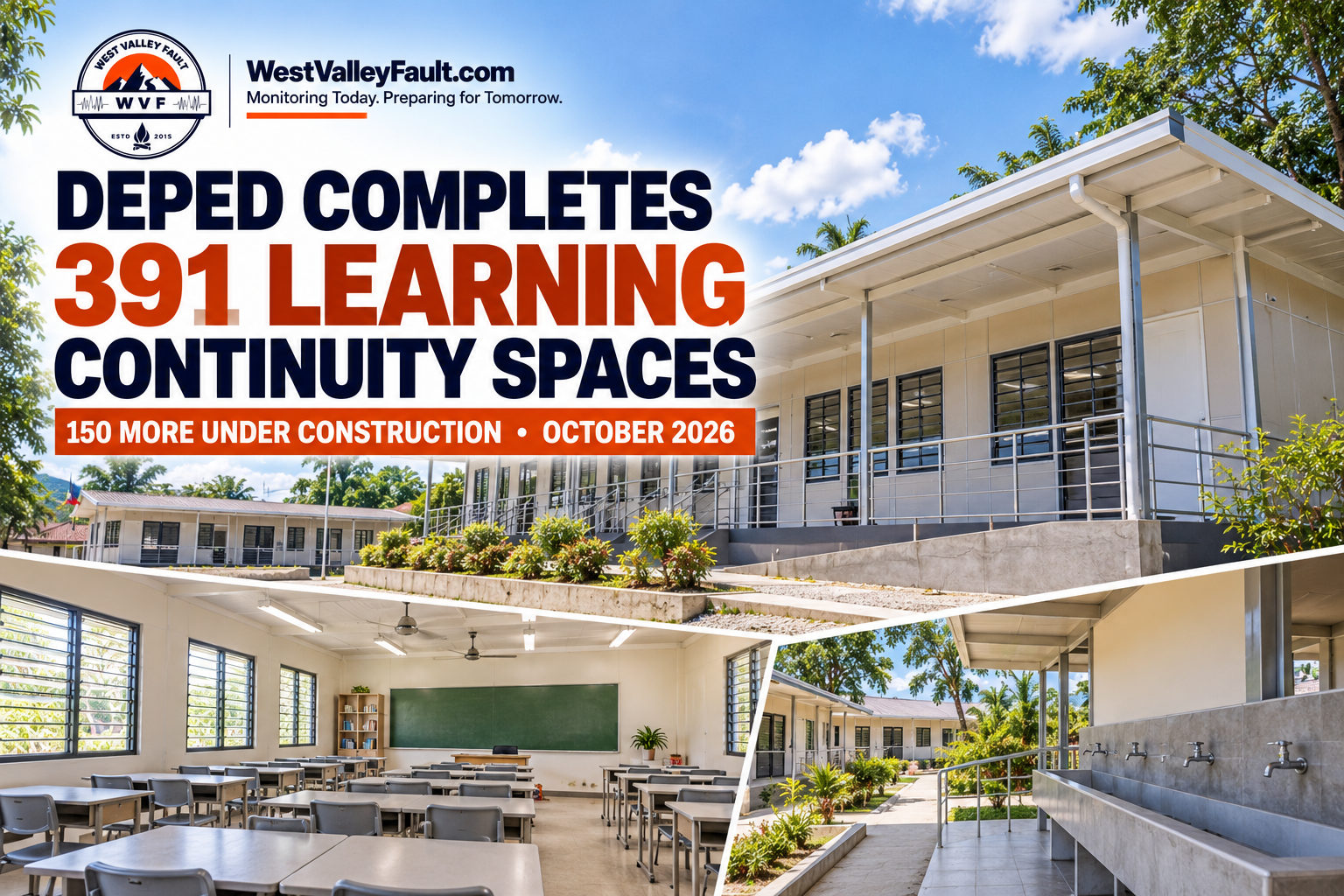
MANILA — The Department of Education (DepEd) reported that 391 modular Learning Continuity Space (LCS) school buildings have been completed as of its October 23, 2026 announcement, with 150 additional units under construction. The program aims to provide classrooms more quickly while incorporating disaster-resilience features.
An ASTIG report citing DepEd’s announcement says the first two phases cover 878 planned LCS units. A separate Daily Tribune report published October 23 also reports the same completion and construction figures.

What the modular structures provide
Each LCS structure contains two to five classrooms, depending on the layout. The reported facilities include three toilets, water, sanitation and hygiene provisions, and rainwater-storage or harvesting features. DepEd says these structures can be installed in four to eight weeks, are designed for winds of up to 250 km/h, and follow earthquake-design standards applicable to highly seismic areas.
These are stated design specifications. The reports do not provide an independent structural test or post-installation performance audit for each completed unit.
Reported rollout status
| Program measure | Reported figure |
|---|---|
| LCS buildings completed | 391 |
| Buildings under construction | 150 |
| Units planned across first two phases | 878 |
| Classrooms per unit | 2–5 |
| Installation target per unit | 4–8 weeks |
| Stated wind resistance | Up to 250 km/h |
The 391 completed figure refers to school buildings or LCS units, not necessarily 391 individual classrooms; each modular unit may hold several classrooms. The program figures do not establish how many pupils are now using the completed units, their per-unit costs, or the construction-completion dates of the 150 ongoing units.
DepEd previously announced ₱3.5 billion for the LCS program in fiscal year 2026. The October 23 completion figures should not be treated as verification that the entire allocation has been spent.
Named school recipients
Reports identify early handovers at Kalawakan Elementary School in Bulacan, Buli Elementary School in Quezon and Magwawa Integrated School in Davao del Norte. Other named installations include schools in Zambales, Davao de Oro, Bohol, Nueva Ecija, Pampanga and Pangasinan. These are selected reported sites rather than an exhaustive verified inventory of all 391 units.
Why it matters to WestValleyFault.com
The LCS design includes earthquake-resilience requirements, making the rollout relevant to the safety of school buildings and the continuity of classes after damaging earthquakes. Fast installation can support the restoration of learning spaces, while actual seismic safety depends on appropriate siting, engineering compliance, installation quality and ongoing maintenance.
WVF has separately examined hazards surrounding school campuses and retrofitting bids for existing public school buildings. Those issues are distinct from constructing new modular spaces.
Stay Informed. Stay Prepared.
Get continuing earthquake intelligence, preparedness updates, Special Reports, and the WestValleyFault.com Weekly Earthquake & Preparedness Intelligence Report delivered to your inbox.

As a welcome gift, you’ll also receive the FREE WVF Earthquake Preparedness Quick Start Guide with practical first steps every household can take before a major earthquake.
Enter your email below to join the WVF email list. Unsubscribe anytime.
Recommended Further Reading
- What Hazards Surround Your Child’s School?
- DepEd Brings M7X Ready School Program to Mindanao
- DepEd Pushes Major Funding Boost for Disaster-Ready Schools
- DPWH Opens ‘Big One’ Retrofitting Bids for Manila and Taguig Schools
- The First 72 Hours After the Big One
Sources
- ASTIG — DepEd built 391 disaster-resistant school buildings in weeks
- Daily Tribune — DepEd completes 391 disaster-resilient school buildings (October 23, 2026)
- DepEd — Disaster-resilient classroom construction and LCS funding (April 14, 2026)




Leave a Reply