
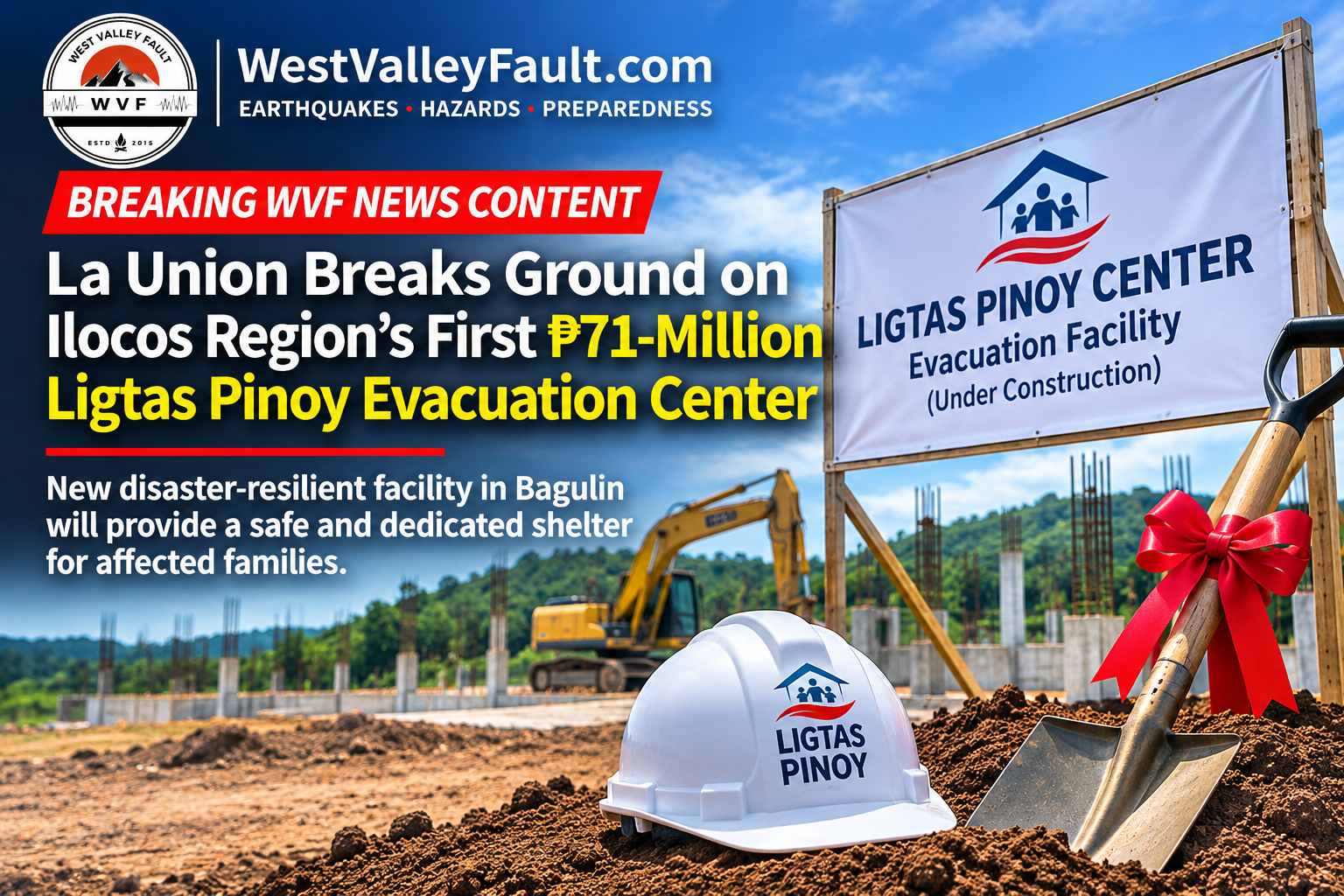
BAGULIN, La Union — The Office of Civil Defense and partner agencies broke ground on the Ilocos Region’s first Ligtas Pinoy Center in Barangay Suyo on November 10, 2026. The planned evacuation facility is intended to shelter people displaced by natural hazards while reducing reliance on public school classrooms during emergencies, according to a November 11 Philippine Information Agency report.
The Department of Public Works and Highways allocated more than ₱71 million under the 2026 national budget for the facility. Separate reporting identifies a ₱71.64-million project cost and a target completion year of 2027. The groundbreaking marks the start of the project, not the opening of a completed shelter.
A purpose-built evacuation center
The project falls under Republic Act No. 12076, the Ligtas Pinoy Centers Act, signed in December 2024. The facility is planned to include sleeping quarters, a healthcare station, sanitation facilities and designated spaces for pets and livestock, according to local government and news reports.

Officials describe the design as intended to withstand strong typhoons and earthquakes. That is a design objective, not an independently verified performance result: no completed construction, structural inspection or operational readiness certification is established by the groundbreaking reports.
Why Bagulin was prioritized
Bagulin faces typhoon, heavy-rainfall, flooding and landslide hazards. The project was selected under a prioritization process considering hazard exposure, vulnerability, coping capacity, disaster frequency and local preparedness. The local government has described prior evacuations to a municipal covered court after flooding.
OCD Administrator Undersecretary Harold Cabreros said purpose-built evacuation centers can help protect displaced families and prevent school disruptions. The Bagulin project is one of 18 Ligtas Pinoy Center projects approved nationwide in 2026, according to contemporaneous reporting.
Why this matters for earthquake preparedness
An evacuation center can support recovery after a damaging earthquake, but shelter location, safe access routes, structural engineering, sanitation and ongoing management all matter. Residents should continue following local government evacuation instructions and should not assume that a planned facility is available before completion and formal opening.
Related WVF coverage examines safety assessment gaps in evacuation buildings and local earthquake evacuation planning in Angeles City.
Stay Informed. Stay Prepared.
Get continuing earthquake intelligence, preparedness updates, Special Reports, and the WestValleyFault.com Weekly Earthquake & Preparedness Intelligence Report delivered to your inbox.

As a welcome gift, you’ll also receive the FREE WVF Earthquake Preparedness Quick Start Guide with practical first steps every household can take before a major earthquake.
Enter your email below to join the WVF email list. Unsubscribe anytime.
Recommended Further Reading
Explore five related WVF reports on evacuation safety, disaster-resilient facilities, local preparedness and response planning.
- PHIVOLCS Flags Safety-Assessment Gap for Tsunami Evacuation Buildings — Why shelter designation must be supported by appropriate safety assessment.
- Angeles City Advances Earthquake and Evacuation Plans — How local government planning connects warnings, routes and response.
- DepEd Reports 391 Disaster-Resilient Learning Continuity Spaces — Why keeping schools functional matters during emergencies.
- Government Approves Disaster Recovery Aid for 306 LGUs — The role of funding in local disaster recovery.
- NDRRMC Rules for Pre-Disaster Evacuation and Anticipatory Action — How local officials can act before hazards cause widespread harm.
Sources
- Philippine Information Agency, November 11, 2026
- Daily Tribune, November 11, 2026
- Provincial Government of La Union, July 8, 2026




Leave a Reply