Remote work is changing something more fundamental than where people open their laptops. It is changing where some people can choose to live.
For Filipinos, the familiar terms are work-from-home employees, online workers, freelancers, virtual assistants, and professionals working for clients or companies elsewhere. Internationally, workers who can move from place to place while keeping the same remote job are often called digital nomads.
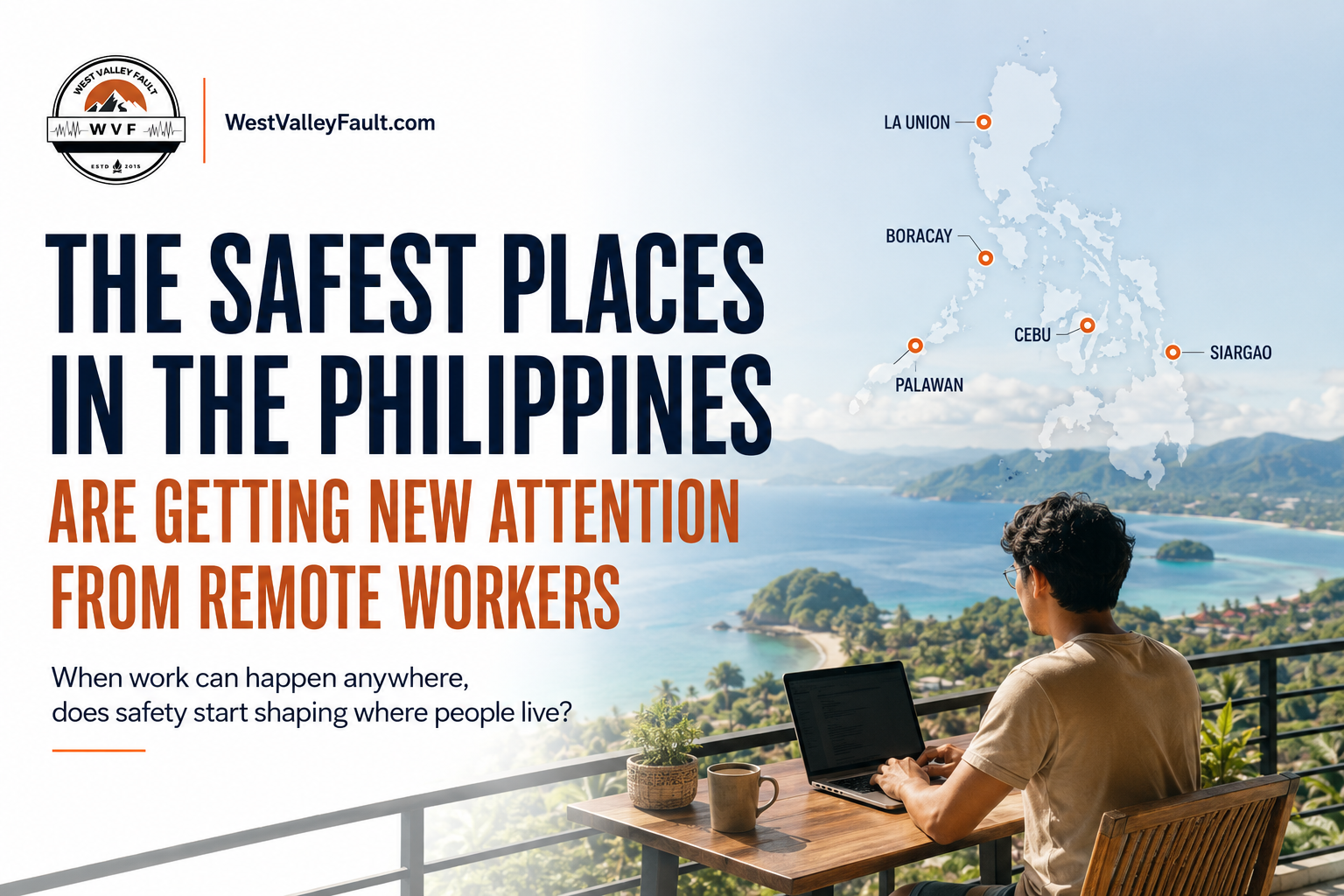
That population is becoming more visible in the Philippines. Boracay, Siargao, Cebu, Palawan and La Union are already being identified as popular “workation” destinations, while coworking and coliving communities have emerged in places such as Siargao and El Nido.
The growth is significant enough that the Philippine government formally authorized a Digital Nomad Visa in April 2025. Executive Order No. 86 did not describe a market that had to be invented. It cited the Philippines’ 2023 ranking as the world’s seventh-fastest-growing remote-work hub as part of the rationale for creating the visa framework.
But this trend raises a question that has received far less attention:
When workers are free to choose where they live, does safety begin to influence that choice?
Remote Work Has Turned Location into a Choice

For a conventional employee, the location of the job often determines the location of the home.
Remote work weakens that connection.
A Filipino virtual assistant working for a US client may not need to live in Metro Manila. A software developer working for a foreign company may be able to spend several months in another province. A foreign remote worker may choose the Philippines as a temporary base while continuing to earn abroad.
These groups are not identical.
The Philippine Digital Nomad Visa applies to eligible foreign nationals working remotely for overseas employers or clients. Filipino remote workers do not need that visa.
But they share one important characteristic: their income can be less dependent on where they physically live.
The appetite for remote work is also familiar locally. In early 2024, Jobstreet by SEEK reported that “work from home” was the most-searched keyword on its Philippine platform.
Once work is no longer tied to a particular office, location becomes another decision.
Cost, internet reliability, housing, lifestyle, and access to airports matter.
So does safety.

A Remote-Work Map Is Already Taking Shape

The Department of Tourism has identified Boracay, Siargao, Cebu, Palawan and La Union as popular Philippine workation destinations.
There are also signs of communities forming around this behavior rather than isolated travelers simply carrying laptops on vacation.
Siargao now has dedicated coworking and coliving businesses built around remote professionals and digital nomads. In El Nido, operators have developed longer-stay workation programs and coworking facilities aimed specifically at people who need to remain productive while living on the island.
Organized workation retreats have also been held or marketed in Siargao, El Nido, La Union and other Philippine destinations.
This does not establish a mass migration in the traditional demographic sense. There is no comprehensive national dataset showing how many remote workers have permanently relocated from one Philippine city or province to another.
What it does show is a recognizable pattern:
A growing class of workers is treating Philippine destinations not simply as places to visit, but as places from which they can continue working.
That distinction matters.
Safety Is Already Part of How Remote Workers Choose

A 2024 study published in Worldwide Hospitality and Tourism Themes examined the role of safety in digital nomads’ destination choices.
Its central finding was clear: safety plays a significant role in destination preference.
That does not mean remote workers are all studying fault maps before signing a lease.
Safety is usually broader than geology. It may include crime, political stability, healthcare, transport, infrastructure, and exposure to natural hazards.
Destination platforms used by remote workers also allow users to consider characteristics such as natural-disaster and earthquake risk alongside cost, climate and quality of life.
This is important because relocation decisions are not based only on technical hazard assessments.
People make choices from reputation, previous experience, news coverage, recommendations, online communities and what they remember about past disasters.
A location can develop a reputation for being safer even when the complete hazard picture is more complicated.
That is where the remote-work trend becomes particularly relevant to this site’s mission.
What Happens When People Can Actually Choose a “Safer” Place?

Read: Discover the Safest Places in the Philippines
WestValleyFault.com has previously examined the question many readers ask when considering relocation:
Which parts of the Philippines face relatively lower earthquake risk?
That question takes on new significance when applied to people whose jobs no longer require them to remain in a particular city.
A family may want to leave Metro Manila but be unable to do so because of work.
A remote worker has more flexibility.
If two destinations both offer adequate internet access, housing and the lifestyle a worker wants, perceived safety can become another factor in the decision.
This does not mean that the country’s current remote-work hubs are automatically the Philippines’ geologically safest locations.
In fact, that would be the wrong conclusion.
A destination cannot be declared safe simply because it is far from the West Valley Fault. Earthquake hazard varies according to seismic sources, ground conditions and location, while overall disaster risk also depends on building vulnerability, population exposure, infrastructure and preparedness.
Coastal destinations may face tsunami hazards. Island communities may have different evacuation, healthcare, power and communications limitations.
“Safer,” in this discussion, therefore means relative or perceived safety—not immunity from disaster.
Perceived Safety Can Still Influence Real Behavior

That distinction does not make perception unimportant.
People do not need to possess a geologist’s understanding of a location before its reputation affects their decisions.
A worker may remember that one province rarely appears in earthquake headlines. Another may prefer a less congested city after experiencing a major disaster. Someone else may rely on recommendations from an online remote-work community.
A foreign worker may compare disaster information for several countries before deciding where to spend six months.
The perception may be incomplete.
But the relocation decision is still real.
This is why the growing remote-work population deserves attention in discussions about safer places to live in the Philippines.
For perhaps more workers than before, the question is no longer theoretical.
They have the ability to act on the answer.
Not sure what earthquake risks apply where you live?

Get the free WVF Quick Start Guide for the essential steps every household should know before a major earthquake.
What the Evidence Does—and Does Not—Show

The evidence currently supports several conclusions.
Remote work in the Philippines is growing. The country was already recording substantial growth as a remote-work destination before the Digital Nomad Visa framework was authorized.
Philippine tourism authorities recognize several destinations as workation hubs, and dedicated communities and businesses serving remote workers are already operating in places such as Siargao and El Nido.
Research also supports the conclusion that safety influences digital nomads’ destination preferences.
What has not been established is the final link.
There is currently no strong evidence showing that remote workers are choosing Palawan, Siargao, La Union, Cebu or other Philippine destinations specifically because they have concluded that those places face lower earthquake risk.
That claim would go beyond the available evidence.
The stronger finding is that two trends are now intersecting:
More workers have geographic freedom.
And:
Safety is one of the factors that can influence where location-independent workers choose to live.
Whether earthquake and disaster risk will become a more visible part of that decision in the Philippines is the question worth watching.
A Different Kind of Migration
Remote work has created something the traditional workplace rarely allowed:
the ability to choose a home without first choosing a nearby job.
That freedom is helping turn tourism destinations into temporary—and sometimes longer-term—work bases.
For now, beaches, internet connectivity, affordability and lifestyle remain the most visible reasons remote workers talk about Philippine destinations.
But the research shows that safety belongs in the decision as well.
The Philippines’ remote-work map is already taking shape.
The next question is whether the country’s perceived safety map will increasingly help shape it.
Moving to the Philippines as a remote worker?
Earthquake and disaster exposure is only one part of planning where to live. Remote workers coming from overseas should also consider healthcare and travel protection before relocating.
→ Explore insurance for digital nomads
Affiliate disclosure: WestValleyFault.com may earn a commission if you purchase through this link, at no additional cost to you.
Recommended Further Reading
- Discover the Safest Places in the Philippines: Earthquake-Free Zones
- Preparing for the Big One: Essential Earthquake Survival Kit for Filipinos
- Ideas to Secure Your House Against Earthquakes: Simple Steps for Safety in the Philippines
- Is Your Home Fault-Line Ready? A Structural Integrity Checklist for Metro Manila Homeowners
Knowing the risk is only the beginning.
Turn preparedness into an actual household plan with the WVF Big One Emergency Planner—built to help families organize what to do, what to prepare, and how to respond before an earthquake happens.

✔ Family emergency plans
✔ Emergency contact pages
✔ Go-bag planning
✔ Home preparedness checklists
✔ Document inventory
✔ Designed specifically for Filipino households
A practical planning system for households preparing for a major earthquake.
| Source | Supports |
|---|---|
| Executive Order No. 86, LawPhil | April 24, 2025 Digital Nomad Visa framework; eligibility; up-to-one-year stay; Philippines cited as 7th fastest-growing remote-work hub in 2023. (LawPhil) |
| Department of Tourism / PNA | Boracay, Siargao, Cebu, Palawan and La Union identified as popular workation destinations. (Philippine News Agency) |
| Worldwide Hospitality and Tourism Themes | Safety and secure living conditions matter in digital-nomad destination choice. (Emerald Publishing) |
| Existing WVF safest-places article | Internal context for relative earthquake safety and existing reader interest. (WestValleyFault.com) |







Leave a Reply