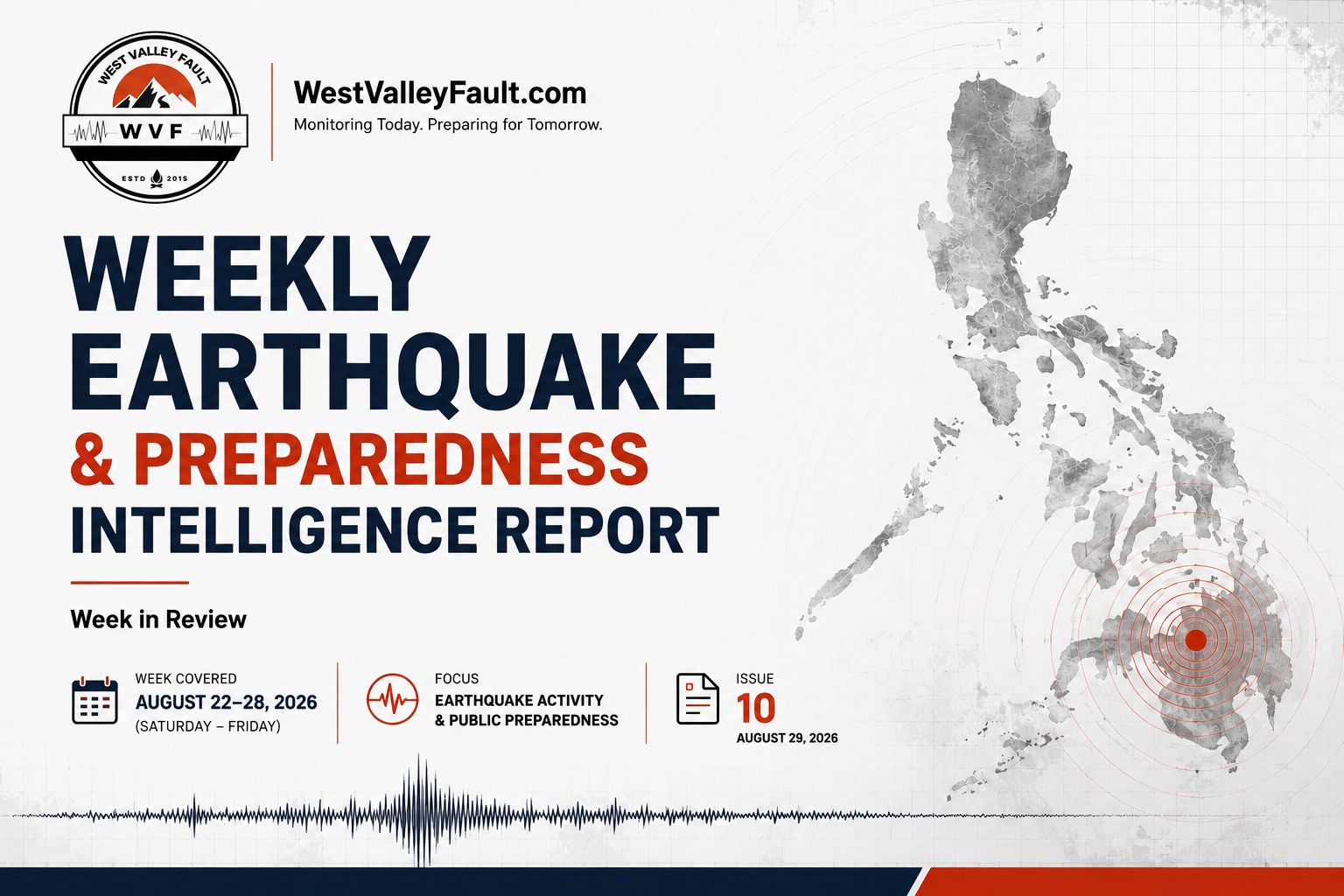
Week of August 22 – 28, 2026
Focus: Earthquake Activity & Public Preparedness
Issue #010
Executive Summary
This week’s earthquake and disaster-preparedness developments centered on a practical challenge: turning hazard information into decisions that schools, local governments, and communities can actually use before and during emergencies.
The Department of Education moved in that direction with the nationwide launch of Project LIGTAS+, an AI-assisted disaster-risk information platform designed to provide schools and local authorities with school-level geohazard information, multi-hazard monitoring, forecasts, automated situation reports, and live incident tracking. Following an earlier pilot, the nationwide rollout represents a broader effort to make hazard information more accessible for operational decisions involving earthquakes, flooding, tropical cyclones, volcanic activity, tsunamis, and other hazards. Recommended actions generated through the system still require field validation and local judgment.
In Baguio City, the local disaster-risk reduction office is urging schools to move away from generic preparedness plans and instead build DRRM arrangements around the hazards they actually face. Schools are being encouraged to identify their priority hazards, map evacuation routes and safe areas, organize school DRRM teams, coordinate with barangays, conduct tabletop exercises and full simulations, and strengthen first-aid and basic life-support capability. The city is also pursuing a proposed ordinance intended to strengthen DRRM requirements for private schools.
The Office of Civil Defense reinforced the same principle from a community perspective: scientific monitoring and hazard information are only useful when they are translated into timely, understandable actions at the local level. LGUs, barangay leaders, disaster officers, and local communicators play a critical role in bridging technical information and the decisions residents must make during emergencies.
Before you read further — do you know your property’s actual risk?

Download the free Home Buyer’s Earthquake Risk Guide to check your specific location against active faults, liquefaction zones, and building safety factors. It takes five minutes and doesn’t require a subscription.
Small disclaimer: This checklist is an educational screening tool—not an official hazard assessment or guarantee of safety.
The supplied PHIVOLCS monitor recorded one earthquake of Magnitude 5.0 or greater during the August 22–28 reporting period: an M5.0 earthquake southeast of Tarragona, Davao Oriental, at a depth of 71 kilometers. The weekly monitor does not establish that the event was part of a swarm, sequence, or developing larger earthquake event.
30-Second Takeaway
- DepEd launched Project LIGTAS+ nationwide, expanding an AI-assisted platform that gives schools and local authorities access to school-level geohazard information, multi-hazard monitoring, forecasts, automated situation reports, and live incident tracking.
- Baguio City is urging schools to tailor DRRM plans to their actual local hazards, including mapped evacuation routes, safe areas, school DRRM teams, barangay coordination, tabletop exercises, and full simulations.
- Baguio is also pursuing a proposed ordinance to strengthen DRRM requirements for private schools; the measure should not yet be treated as enacted.
- The Office of Civil Defense stressed that hazard information only becomes useful when it is translated into timely, understandable community action.
- The supplied PHIVOLCS monitor recorded one M5.0+ earthquake during August 22–28: an M5.0 southeast of Tarragona, Davao Oriental, at a depth of 71 km.
- This week’s Blog Highlight is Approved but Not Yet Enforced, Part 3: DTI Moves Toward Implementation, continuing the examination of how PNS 49:2026 moves from approval toward actual compliance and enforcement.

A new reinforcing-steel standard has already been approved, but full implementation has not yet arrived. For families building homes during the transition, the issue is not just regulatory—it can determine which minimum steel standard becomes permanently embedded inside their house.
Top Developments
DepEd Takes Project LIGTAS+ Nationwide for School-Level Hazard Intelligence

Source: PNA/DepEd Philippines
The Department of Education has launched Project LIGTAS+ nationwide, expanding an AI-assisted disaster-risk information platform that was previously piloted earlier this year. The system is designed to help schools and local authorities make faster, more localized preparedness and response decisions by combining school-level geohazard information, multi-hazard monitoring, forecasts, automated situation reports, live incident tracking, and exposure data.
Project LIGTAS+ supports monitoring and decision-making for hazards including earthquakes, flooding, tropical cyclones, volcanic eruptions, and tsunamis. Rather than relying only on broad regional warnings, the platform is intended to give education officials and local decision-makers more specific information about schools that may be exposed to particular hazards.
The platform does not replace field assessment or local authority. Recommended actions generated through the system still require validation on the ground and appropriate local judgment, an important safeguard when automated tools are used in disaster operations.
Preparedness Implications:
The nationwide rollout represents a shift toward more localized and anticipatory disaster decision-making in the education sector. If consistently maintained and used alongside verified field information, school-level hazard intelligence could help officials identify exposed facilities earlier, prioritize preparedness measures, and make more informed decisions on class suspensions, evacuations, and emergency response. Its effectiveness, however, will depend on data quality, connectivity, staff training, and how well digital recommendations are integrated with actual conditions on the ground.
Source: Philippine News Agency
Baguio Pushes Schools to Build DRRM Plans Around Their Actual Hazards

Baguio City’s Disaster Risk Reduction and Management Office is urging schools to move away from generic preparedness plans and instead design their DRRM arrangements around the specific hazards present in their own locations.
Schools are being encouraged to identify their two priority hazards, map safe areas and evacuation routes, establish school DRRM teams, coordinate with barangays, and regularly test their plans through tabletop exercises and full simulations. The city is also emphasizing first-aid and basic life-support capability as part of school-level readiness.
The approach is intended to make preparedness more operational: not simply having a written plan, but ensuring that staff, students, parents, and local responders understand what actions to take, where to go, and how to coordinate when a hazard occurs.
Baguio is also pursuing a proposed local ordinance to strengthen DRRM requirements for private schools. The measure remains a proposal and should not yet be treated as approved or in force.
Preparedness Implications:
The value of the initiative lies in matching preparedness measures to actual local risk. Hazard-specific planning, mapped evacuation routes, trained school teams, and regular exercises can make emergency procedures more realistic and easier to execute. The proposed ordinance could also create a more consistent preparedness framework for private schools if it is eventually approved and implemented.
Source: Philippine Information Agency

DTI moved toward implementation of PNS 49:2026 in July 2026, but the proposed timetable quickly became the next point of dispute. Part 3 reconstructs the consultation, the April 2027 compliance date, and PISI’s objection to the transition.
Government Preparedness
National
• Department of Education Launched Project LIGTAS+ Nationwide
At the national level, the Department of Education launched Project LIGTAS+ nationwide, expanding an AI-assisted disaster-risk information platform designed to support schools and local authorities with school-level geohazard information, multi-hazard monitoring, forecasts, automated situation reports, live incident tracking, and exposure data. The system is intended to improve the speed and local relevance of preparedness and response decisions, while still requiring field validation and local judgment before recommended actions are carried out.
Source: Philippine News Agency
Check whether your home may have visible structural-safety concerns, Is Your Home Fault-Line Ready? A Structural Integrity Checklist for Metro Manila Homeowners.
Baguio City
• Local DRRM Office Urges Schools to Tailor Preparedness Plans to Actual Hazards They Face
In Baguio City, the local DRRM office is strengthening school preparedness by urging schools to tailor their plans to the hazards they actually face. Schools are being encouraged to identify their two priority hazards, map safe areas and evacuation routes, establish DRRM teams, coordinate with barangays, conduct tabletop exercises and full simulations, and improve first-aid and basic life-support capability. The city is also pursuing a proposed ordinance to strengthen DRRM requirements for private schools, although the measure is not yet enacted.
Source: Philippine Information Agency
Tacloban City
• OCD Calls for Translation of Hazard Information into Community Action
The Office of Civil Defense also emphasized a broader implementation challenge: hazard information from national and regional monitoring systems must be translated into timely, understandable actions at the local level. LGUs, disaster officers, barangay leaders, and local communicators remain critical in turning scientific information into practical preparedness and response measures.
Source: Philippine Information Agency
Research & Monitoring
No standalone scientific research or PHIVOLCS monitoring story was included among this week’s retained sources.
Infrastructure & Policy
This week’s infrastructure and policy developments were centered less on physical construction and more on digital preparedness systems and local regulatory frameworks.
National
At the national level, the Department of Education’s rollout of Project LIGTAS+ represents a new layer of digital disaster-preparedness infrastructure for the education sector. The platform brings together school-level geohazard information, multi-hazard monitoring, forecasts, automated situation reports, exposure data, and live incident tracking to support preparedness and response decisions by schools and local authorities. Its nationwide launch moves the system beyond pilot use and into broader operational deployment, although recommended actions still require field validation and local judgment.
Source: Philippine News Agency
Baguio City
In Baguio City, policymakers are also pursuing a proposed ordinance to strengthen disaster-risk reduction and management requirements for private schools. The measure is intended to improve preparedness standards and coordination between private schools, barangays, and city disaster authorities. Because the ordinance is still being pursued, it should be treated as a proposal rather than an approved or enforceable requirement.
Source: Philippine Information Agency
Earthquake Activity This Week
The supplied PHIVOLCS earthquake monitor recorded one earthquake of Magnitude 5.0 or greater during the August 22–28 reporting period.
| Date and Philippine Time | Magnitude | Depth | PHIVOLCS Location |
|---|---|---|---|
| August 22, 2026 — 2:43 PM | M5.0 | 71 km | 050 km S 46° E of Tarragona, Davao Oriental |
Source: PHIVOLCS – Latest Earthquake Information (Earthquake Monitoring System)
Dates and times are in Philippine Standard Time.
Deeper earthquakes like this week’s M5.0 at 71 km are often less destructive — but shallow ones aren’t. This earthquake safety kit is worth having ready.
Understand what earthquake magnitudes mean in the Philippine context, watch the short explainer here– What Earthquake Magnitudes Mean in the Philippines
Community Preparedness
• Baguio City
In Baguio City, schools are being encouraged to build preparedness plans around the hazards that actually affect their locations. The city’s DRRM office is asking schools to identify their two priority hazards, map safe areas and evacuation routes, establish school DRRM teams, coordinate with barangays, and test their plans through tabletop exercises and full simulations. First-aid and basic life-support capability are also being emphasized as part of school-level readiness.
The approach is intended to move preparedness beyond written compliance. Students, teachers, parents, and school personnel should know where to go, what procedures to follow, and how to coordinate with local authorities when an emergency occurs.
Source: Philippine Information Agency
• Tacloban City
In a separate Philippine Information Agency report, an Office of Civil Defense official emphasized that scientific hazard information must be translated into practical actions that communities can understand and carry out.
The message focused on the role of local governments, DRRM officers, barangay leaders, and communicators in bridging the gap between technical hazard information and community-level decisions. Effective preparedness depends not only on collecting and monitoring hazard data, but also on ensuring that warnings and risk information lead to timely, understandable action.
Source: Philippine Information Agency
For school-level and family-level preparedness, this first-aid kit covers the basics Baguio’s DRRM office recommends.
This Week in Numbers
| Number | What It Represents |
|---|---|
| 5 hazard types | Earthquakes, floods, tropical cyclones, volcanic eruptions, and tsunamis are among the hazards covered by Project LIGTAS+. |
| 2 priority hazards | Number of local hazards Baguio schools are being urged to identify and use as the basis of their DRRM planning. |
| 128 barangays | Baguio barangays reported as having DRRM and contingency plans. |
| 1 proposed ordinance | Baguio measure intended to strengthen DRRM requirements for private schools. |
| 1 | M5.0+ earthquake in the supplied PHIVOLCS monitor. |
| 71 km | Depth of the week’s qualifying M5.0 earthquake southeast of Tarragona, Davao Oriental. |
Special Announcement

Coming Soon: How the Philippines Became the Philippines
WestValleyFault.com is preparing a new short-form micro-series exploring the tectonic forces that shaped the Philippine archipelago. How the Philippines Became the Philippines will trace the story from trenches and colliding plates to faults, volcanoes, mountains, and the complex crust beneath the country. Each installment will break down one part of that geological story in a concise, visual format—building toward a clearer picture of why the Philippines is one of the world’s most geologically dynamic regions.
Watch out for it on our YouTube channel starting next week: https://www.youtube.com/@WestValleyFaultPH
Check our latest Special Reports for deeper insights into earthquake hazards, preparedness, and resilience in the Philippines, and return next week for the next edition of the WestValleyFault.com Weekly Earthquake & Preparedness Intelligence Report.
Turn Earthquake Awareness into a Family Plan
Knowing what happened this week is only the beginning. Make sure your household knows what to do, where to meet, who to contact and what to prepare before the next emergency.

✔ Family emergency plans
✔ Emergency contact pages
✔ Go-bag planning
✔ Home preparedness checklists
✔ Document inventory
✔ Designed specifically for Filipino households
Explore the WestValleyFault™ Family Emergency Planner
Not ready for the full planner?

Start with the free WestValleyFault™ Earthquake Preparedness Quick Start Guide.
The free West Valley Fault Earthquake Quick Start Guide walks you through the essential first steps for preparing your family, home and emergency supplies for a major earthquake.
Recommended Further Reading
- Your House Is Being Built Today. The New Steel Standard Is Still Waiting.
- Approved but Not Yet Enforced, Part 1: Why the Philippines Changed Its Rebar Standard
- Approved but Not Yet Enforced, Part 2: The Campaign to Make PNS 49:2026 Mandatory
- Approved but Not Yet Enforced, Part 3: DTI Moves Toward Implementation
- Cities Most at Risk If the Big One Strikes the Philippines
- Preparing for the Big One: Essential Earthquake Survival Kit for Filipinos
References
Top Developments
- Philippine News Agency — Project LIGTAS+ to speed up decisions, disaster response– Angara — August 26, 2026. PNA article
- Philippine Information Agency — Baguio City DRRMO urges schools to tailor DRRM plans to local hazards — August 25, 2026. PIA article
Government Preparedness
- Philippine News Agency — Project LIGTAS+ to speed up decisions, disaster response– Angara — August 26, 2026. PNA article
- Philippine Information Agency — Baguio City DRRMO urges schools to tailor DRRM plans to local hazards — August 25, 2026. PIA article
- Philippine Information Agency — OCD official calls for translation of hazard information into community action — August 24, 2026. PIA article
Infrastructure & Policy
- Philippine News Agency — Project LIGTAS+ to speed up decisions, disaster response– Angara — August 26, 2026. PNA article
- Philippine Information Agency — Baguio City DRRMO urges schools to tailor DRRM plans to local hazards — August 25, 2026. PIA article
Community Preparedness
- Philippine Information Agency — Baguio City DRRMO urges schools to tailor DRRM plans to local hazards — August 25, 2026. PIA article
- Philippine Information Agency — OCD official calls for translation of hazard information into community action — August 24, 2026. PIA article
Earthquake Activity This Week
- DOST–PHIVOLCS — Earthquake Information No. 3 — 22 August 2026, 2:43:38 PM; Mw 5.0, Tarragona, Davao Oriental — Final bulletin. PHIVOLCS earthquake bulletin
Explore More WVF Weekly Intelligence Reports




Leave a Reply