
Week of July 18 – 24, 2026
Focus: Earthquake Activity & Public Preparedness
Issue #005
Executive Summary
This week’s developments placed the foundations of disaster resilience under renewed scrutiny: the materials used to construct buildings, the laws governing their safety and the financial resources available when disasters occur.
The Philippine Iron and Steel Institute called for the immediate implementation of seismic-steel requirements, highlighting the role of compliant construction materials in earthquake-resistant structures. At the same time, renewed calls for the passage of the New Philippine Building Act brought attention to structural inspections, construction standards and accountability for violations of approved building plans.
Preparedness also advanced beyond construction. The World Bank is reportedly preparing a $1-billion disaster-readiness loan for the Philippines, while government agencies and local partners strengthened technical assessment capabilities through drone operations and REDAS training. DTI and nine organizations also forged an MSME Resilience Pact, addressing the vulnerability of small businesses to permanent closure after disasters.
Together, these developments reinforce one central lesson: resilience is created before an earthquake occurs. Safer materials, enforceable regulations, reliable financing, science-based assessment tools and practical community preparation all influence how well the country withstands and recovers from a major disaster.
Before you read further — do you know your property’s actual risk?

Download the free Home Buyer’s Earthquake Risk Guide to check your specific location against active faults, liquefaction zones, and building safety factors. It takes five minutes and doesn’t require a subscription.
Small disclaimer: This checklist is an educational screening tool—not an official hazard assessment or guarantee of safety.
30-Second Takeaway
- The Philippine Iron and Steel Institute called for the immediate implementation of seismic-steel requirements for safer construction.
- Rep. Romeo Momo urged the President to prioritize the proposed New Philippine Building Act, which includes mandatory structural reviews every 15 years.
- The World Bank is reportedly preparing a $1-billion disaster-readiness loan for the Philippines.
- DOST, the Provincial Government of Ilocos Sur and PHIVOLCS strengthened disaster-assessment capabilities through drone operations and REDAS training.
- DTI and nine partner organizations forged an MSME Resilience Pact as officials warned that 40% of small businesses may never reopen after a major disaster.
- PHIVOLCS listed four earthquakes of magnitude 5.0 or greater during the reporting period, with the strongest registering magnitude 5.6.

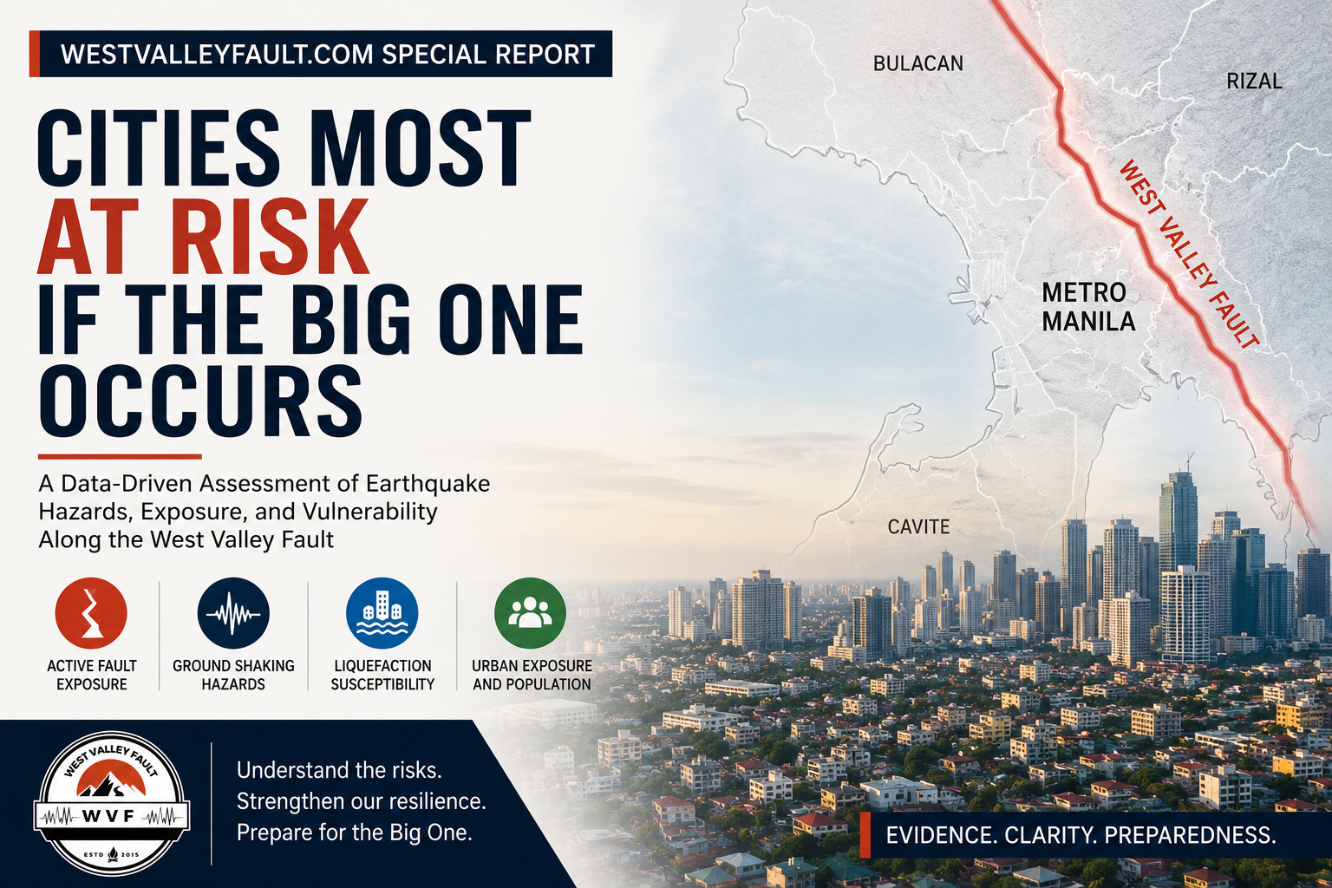
Which cities could face the greatest consequences if the West Valley Fault generates a major earthquake? This Special Report examines the communities exposed to severe ground shaking, surface rupture, liquefaction and other earthquake hazards.
Top Developments
PISI Calls for Immediate Seismic-Steel Implementation

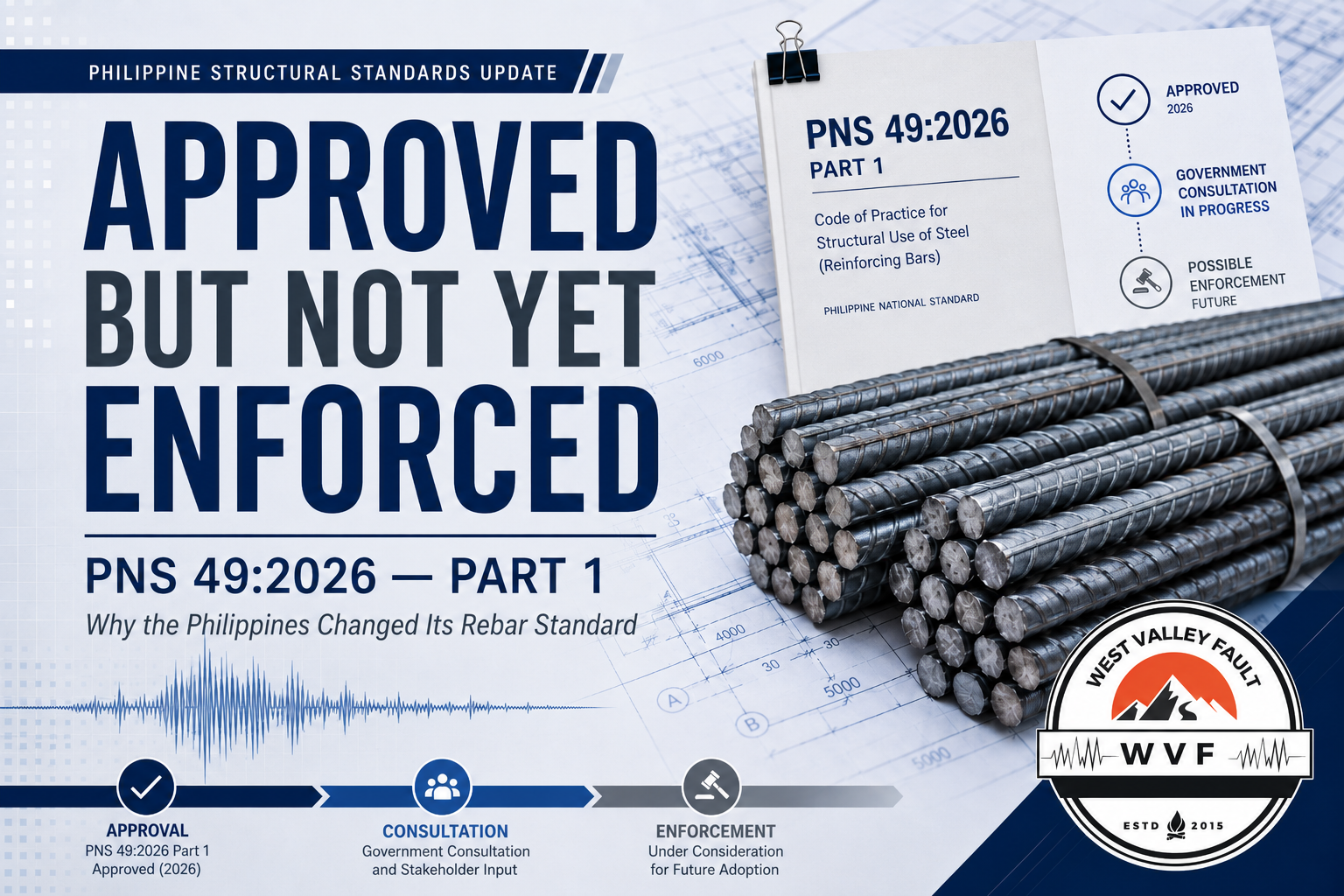
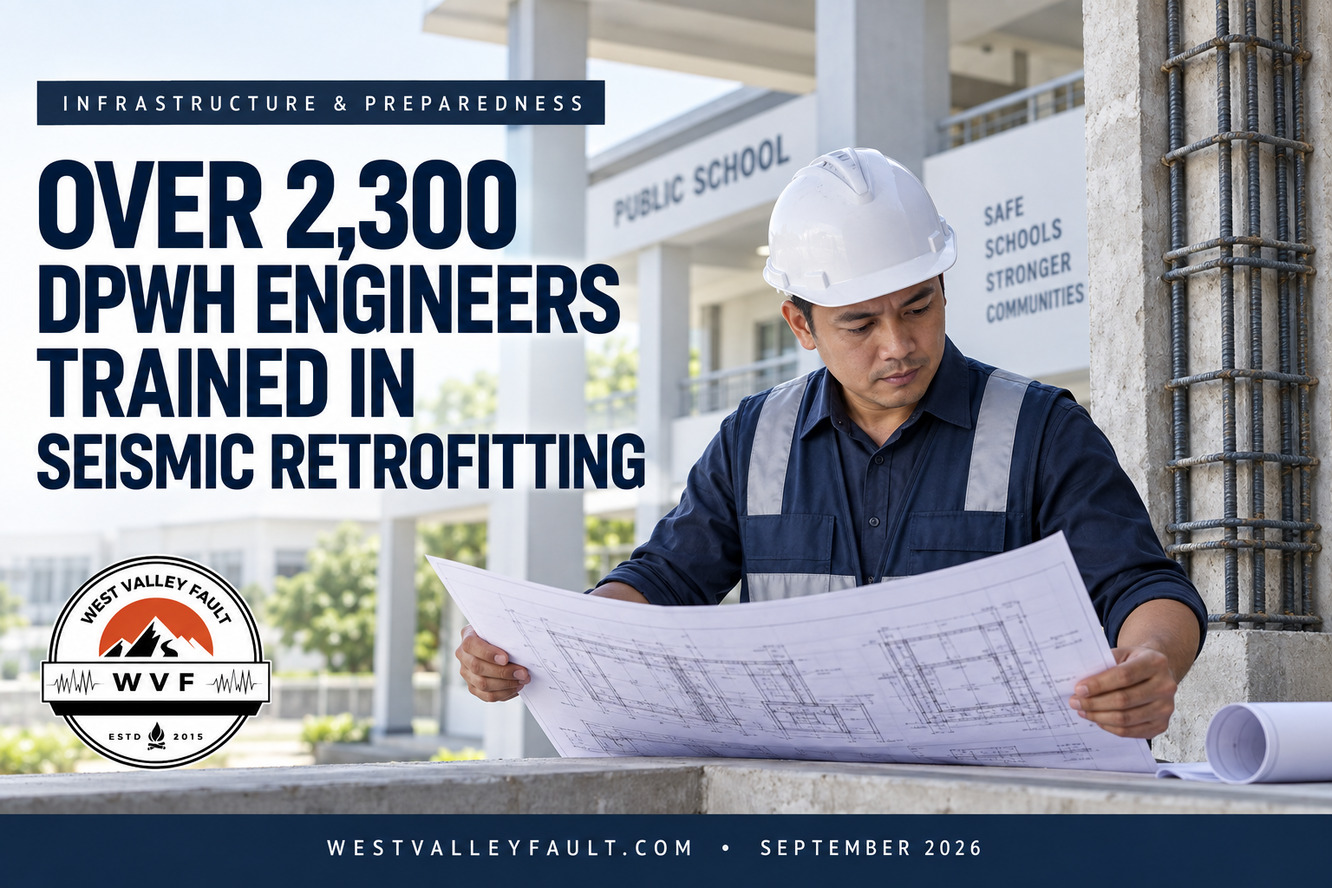
The Philippine Iron and Steel Institute called for the immediate implementation of seismic-steel requirements, placing renewed attention on the materials used in earthquake-resistant construction.
A building may be designed to withstand strong ground shaking, but the effectiveness of that design also depends on whether the materials used during construction meet the required technical specifications. Steel that does not satisfy prescribed standards can weaken the building’s ability to perform as intended during an earthquake.
The proposal is particularly relevant as the country considers broader reforms to its building regulations. Updated laws and engineering designs can improve structural safety, but their protective value depends on consistent material standards, product verification and enforcement throughout the construction process.
Preparedness Implications
Earthquake resilience begins long before a building is occupied. Construction materials must meet the specifications required by approved structural designs, while regulators, engineers, developers and suppliers must ensure that compliant materials are used.
Implementing seismic-steel requirements would strengthen an important part of the construction-safety system. However, effective implementation would also require credible testing, product traceability, market surveillance and consistent enforcement.
Source: Daily Tribune
Proposed New Philippine Building Act Gains Renewed Urgency

Surigao del Sur First District Rep. Romeo Momo called on President Ferdinand Marcos Jr. to identify House Bill 6615, or the proposed New Philippine Building Act, as a priority measure in his forthcoming State of the Nation Address.
The proposal seeks to update the regulatory framework governing the design, construction, inspection and maintenance of buildings in the Philippines. Among the provisions highlighted in the submitted reports is a requirement for structural reviews every 15 years.
The proposed legislation would also standardize requirements involving building design, location, materials and safety measures. Its prohibited acts reportedly include unauthorized deviations from approved plans, construction beyond permitted specifications, noncompliance with structural and safety standards, and violations of permits and regulatory requirements.
Momo connected the urgency of the legislation to recent incidents involving building failures and destructive earthquakes. His appeal reflects growing recognition that earthquake casualties are determined not only by the strength of ground shaking but also by the safety and condition of the structures exposed to it.
Preparedness Implications
A modern building law could strengthen national standards and clarify responsibility for construction and safety violations. Mandatory structural reviews could also help identify deterioration, unauthorized alterations and vulnerabilities in existing buildings before they contribute to a disaster.
Passing a new law, however, would be only the first step. Its effectiveness would depend on implementing regulations, qualified inspectors, reliable records, capable local building offices and consistent enforcement without exemptions or shortcuts.
Sources: Manila Bulletin and Journal News Online
World Bank Prepares $1-Billion Disaster-Readiness Loan for the Philippines

The World Bank is reportedly preparing a $1-billion disaster-readiness loan intended to strengthen the Philippines’ financial capacity to manage major emergencies.
The proposed financing recognizes a recurring challenge in disaster management: governments often require substantial resources immediately after a destructive event, when lives, essential services, infrastructure and local economies are all under pressure.
Pre-arranged disaster financing can provide access to funds more quickly than relying entirely on emergency budget reallocations after an event. It can support urgent government operations while protecting other public programs from sudden funding disruptions.
The size of the proposed loan also reflects the scale of the country’s exposure. Earthquakes, typhoons, volcanic activity and other hazards can affect multiple regions and generate recovery costs extending far beyond immediate rescue and relief.
Preparedness Implications
Financial readiness is an essential part of disaster preparedness. Having access to funds soon after a major emergency can help government agencies and local authorities restore essential services, support affected communities and begin recovery without avoidable financing delays.
Borrowing capacity alone does not guarantee resilience. The effectiveness of the financing will depend on its activation conditions, eligible uses, transparency safeguards and how well it complements investments in prevention, risk reduction and resilient infrastructure.
Source: BusinessWorld

This special report examines why building performance, code enforcement, structural assessments, and engineering decisions—not earthquake magnitude alone—will determine the true impact of the next major earthquake.
Government Preparedness
National
• World Bank Prepares $1-Billion Disaster-Readiness Loan
Refer to Top Developments above.
The proposed financing represents an effort to strengthen the government’s ability to mobilize resources following major disasters. Its value will ultimately depend on how quickly the funds can be accessed, what activities qualify for financing and how the facility complements long-term investments in risk reduction.
Source: BusinessWorld
• DTI and Nine Organizations Forge MSME Resilience Pact
The Department of Trade and Industry and nine partner organizations forged an MSME Resilience Pact aimed at strengthening disaster preparedness and business continuity among micro, small and medium enterprises.
The agreement followed warnings about the vulnerability of smaller businesses after major disasters. DTI cited international data indicating that 40% of MSMEs never reopen following a major disaster, while another 25% cease operations within one year.
These closures can have consequences extending far beyond individual business owners. MSMEs account for 99.63% of registered businesses in the Philippines and provide 65.1% of total employment. When they fail, communities can lose jobs, income, essential services and important parts of their local supply chains.
The pact shifts the focus from recovery alone to continuity planning before disruption occurs. This can include identifying essential business functions, protecting records, establishing backup suppliers, preparing alternative communication arrangements and planning how operations can resume after facilities, utilities or transport networks are affected.
For smaller enterprises with limited savings and restricted access to financing, even a short interruption can become an existential threat. Treating preparedness as a regular business responsibility can therefore protect both livelihoods and local economic stability.
Sources: SunStar Cebu
Ilocos Sur
• DOST, PGIS and PHIVOLCS Strengthen Disaster Assessments Through Drones and REDAS
The Department of Science and Technology, the Provincial Government of Ilocos Sur and PHIVOLCS strengthened local disaster-assessment capabilities through training involving drone operations and the Rapid Earthquake Damage Assessment System, or REDAS.
Drones can provide aerial information about locations that may be difficult or unsafe to inspect from the ground. They can help document physical conditions, identify affected areas and give emergency managers a broader view of damage to communities and infrastructure.
REDAS complements this capability by providing science-based tools that can support earthquake-impact assessment, contingency planning and emergency decision-making. Combining aerial observation with hazard and exposure information can help authorities build a clearer picture of potential and actual disaster impacts.
The initiative demonstrates how scientific tools become more useful when local personnel are trained to apply them. Technology alone does not improve preparedness; agencies and local governments must also develop the people, procedures and institutional capacity needed to turn collected information into operational decisions.
Source: Journal Online
Research & Monitoring
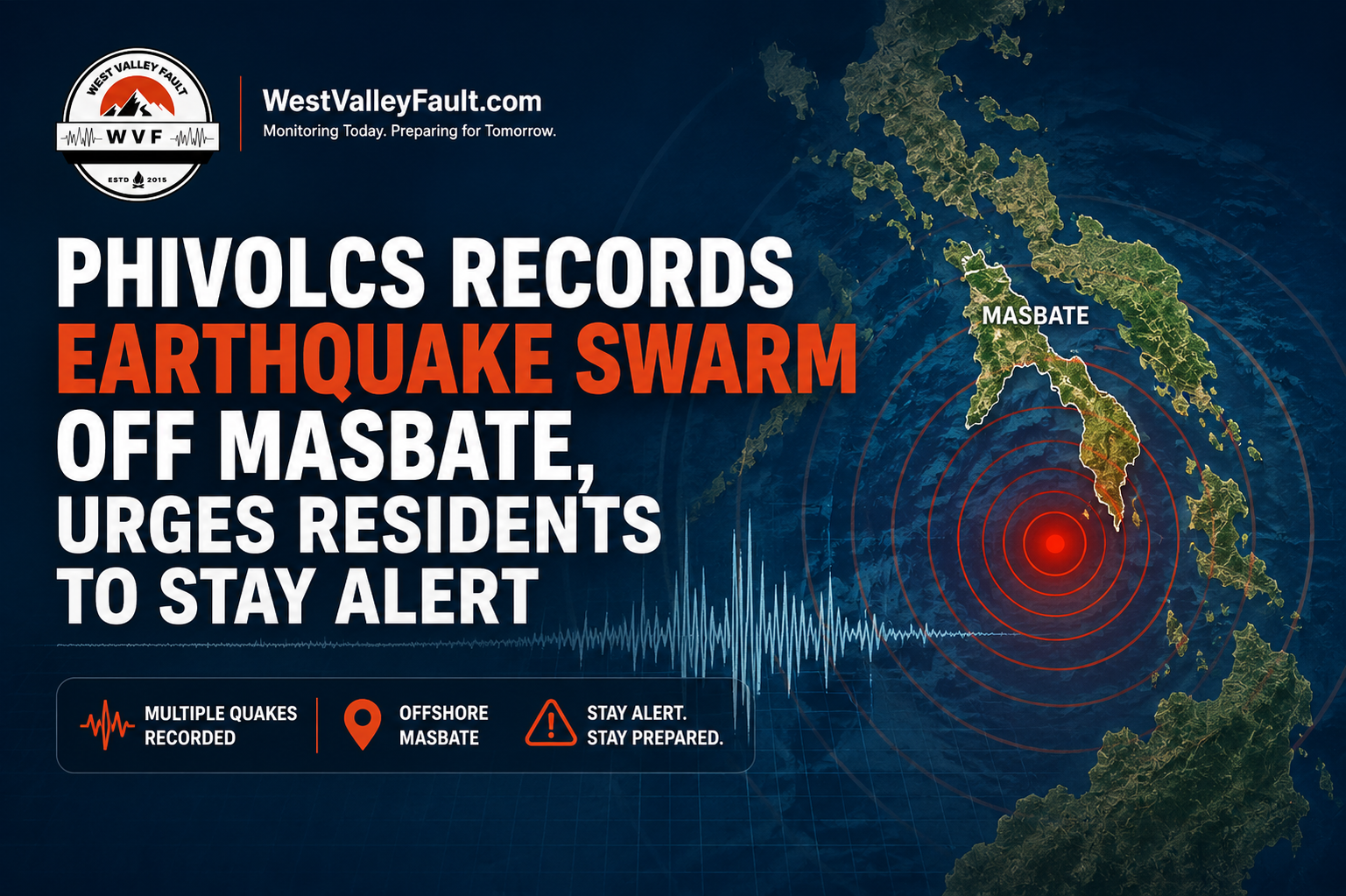
• Earthquake-Swarm Activity Reported Again in Masbate
Renewed earthquake-swarm activity was reported in Masbate during the week, continuing scientific and public attention on the area’s seismic activity.
An earthquake swarm consists of a sequence of earthquakes occurring within a relatively confined area and period without one event clearly dominating the sequence as the mainshock. This differs from the more familiar pattern in which a large earthquake is followed by progressively smaller aftershocks.
The latest Masbate development is included as a monitoring update rather than a Top Development because the swarm was already covered prominently in the previous weekly report.
Earthquake swarms can occur for different geological reasons, and their behavior can vary considerably. Their presence does not provide a reliable basis for declaring that a larger earthquake is imminent. Scientists must examine the locations, depths, magnitudes and progression of the events before drawing conclusions about the sequence.
Public interpretations should therefore remain grounded in PHIVOLCS bulletins and official assessments. The timing of individual earthquakes cannot currently be predicted with scientific reliability, and unrelated seismic events should not be connected without supporting evidence.
Source: Philippine Information Agency
Infrastructure & Policy
• PISI Calls for Immediate Seismic-Steel Implementation
(Refer to Top Developments above.)
The Philippine Iron and Steel Institute’s proposal places attention on the implementation of seismic-steel requirements and the role of construction materials in structural safety.
Building regulations establish how structures should be designed and constructed, but compliance must extend to the materials entering the construction site. Steel products must satisfy the specifications assumed by engineers when calculating how a structure should carry loads and respond to strong ground motion.
Implementation therefore involves more than publishing a technical standard. It requires appropriate testing, documentation, product identification, market monitoring and enforcement against noncompliant materials.
The proposal complements the push for a new national building law by addressing a specific part of the construction process: whether the materials used in a structure meet the safety requirements reflected in its approved design.
Source: Daily Tribune
• New Philippine Building Act Proposed as a National Priority
(Refer to Top Developments above.)
House Bill 6615, or the proposed New Philippine Building Act, would update the framework governing building design, construction, inspection and maintenance.
Among the provisions highlighted in the submitted reports are:
- Structural reviews of buildings every 15 years
- Standardization of building design, location, materials and safety measures
- Prohibitions against unauthorized deviations from approved plans
- Prohibitions against building beyond permitted specifications
- Accountability for noncompliance with structural and safety standards
- Penalties for violations of permits and regulatory requirements
The proposal addresses both the technical requirements applied to buildings and the behavior of those responsible for approving, constructing and maintaining them.
Periodic structural reviews are particularly relevant to existing buildings. A structure’s condition can change because of deterioration, corrosion, previous earthquake damage, unauthorized alterations, added loads or changes in how the building is used. A building that complied with requirements when it was constructed may not necessarily remain in the same condition decades later.
The proposed law and the seismic-steel initiative address different but connected layers of building safety. The legislation concerns the broader regulatory system, while the PISI proposal concerns the implementation of specific material requirements. Both depend on credible inspection and consistent enforcement.
Sources: Manila Bulletin and Journal News Online
Earthquake Activity This Week
| Date and time | Magnitude | Depth | Location |
|---|---|---|---|
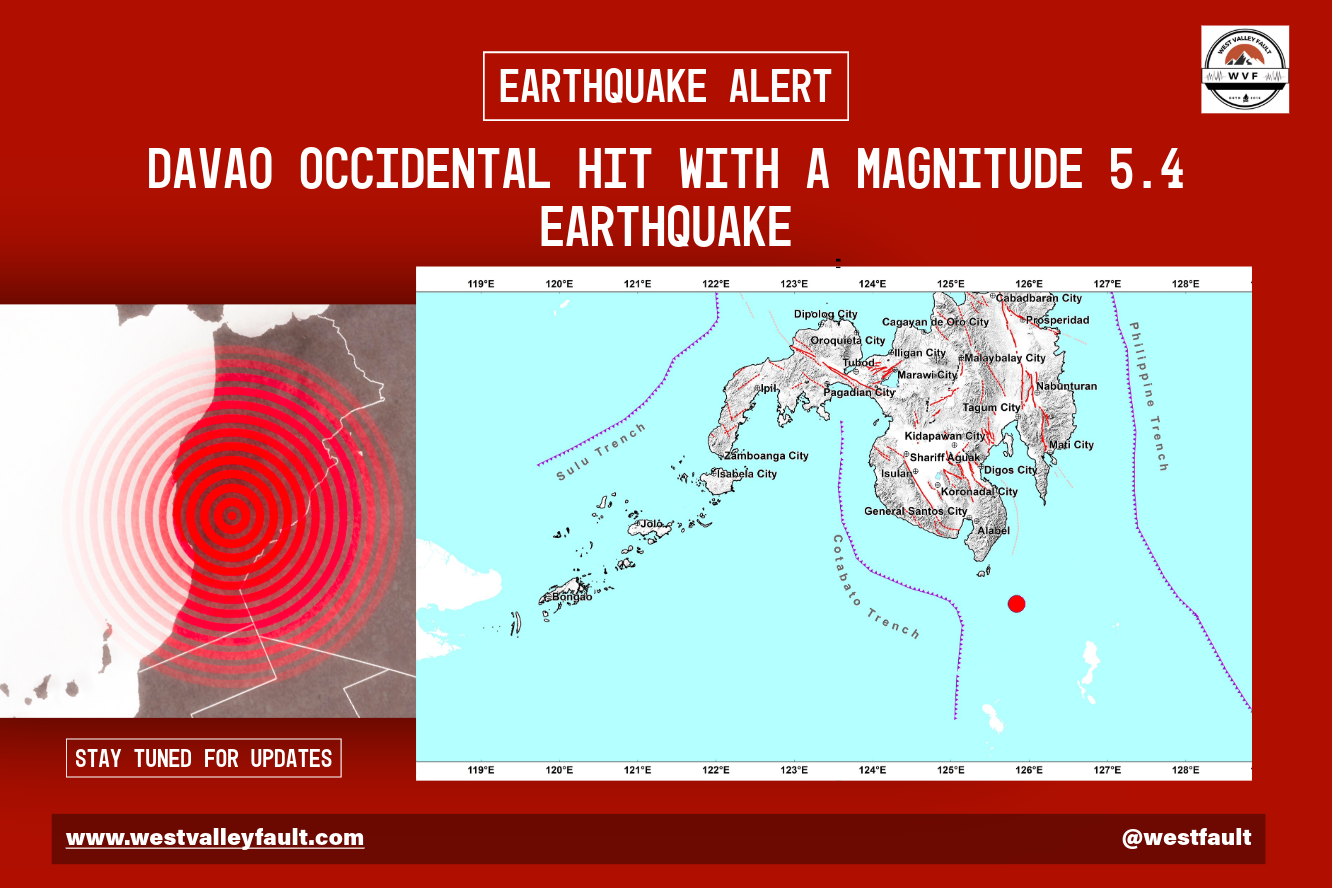
| 18 July 2026, 12:12 a.m. | 5.5 | 17 km | 10 km S 58° W of Balut Island, Davao Occidental |
| 18 July 2026, 10:23 a.m. | 5.6 | 5 km | 129 km S 35° W of Balut Island, Davao Occidental |
| 20 July 2026, 5:40 p.m. | 5.1 | 177 km | 422 km S 26° E of Balut Island, Davao Occidental |
| 22 July 2026, 5:47 p.m. | 5.1 | 19 km | 5 km S 42° E of Balut Island, Davao Occidental |
Source: PHIVOLCS – Latest Earthquake Information (Earthquake Monitoring System)
Dates and times are in Philippine Standard Time.
Weekly Seismic Note:
The four earthquakes varied considerably in depth and distance from Balut Island. The shallowest was the magnitude 5.6 event on 18 July at a depth of 5 kilometers, while the deepest was the magnitude 5.1 event on 20 July at 177 kilometers.
Although PHIVOLCS described all four locations relative to Balut Island, geographic reference alone does not establish that the events were generated by the same geological process. No relationship among the earthquakes should be assumed without an explicit assessment from PHIVOLCS.
The table records only earthquakes of magnitude 5.0 and above in accordance with the Weekly Report’s editorial standard. It does not represent all earthquakes detected in or around the Philippines during the reporting period.
Community Preparedness
• Baguio City
Baguio Strengthens Youth Readiness Following Earthquake Panic
The Baguio City Disaster Risk Reduction and Management Office is strengthening disaster preparedness among young people after 113 high school students reportedly required medical attention because of panic attacks and hyperventilation during a magnitude 4.5 earthquake.
According to the city’s disaster officials, fear spread rapidly among students and triggered a chain reaction of distress. The incident demonstrated that earthquake preparedness requires more than knowing evacuation routes or practising physical response procedures. Students must also learn how to manage fear, follow instructions and make safe decisions under pressure.
Baguio already conducts quarterly earthquake drills, but the city is now placing greater attention on students’ mental and emotional readiness. A Youth Resilience Boot Camp is scheduled for August, with participants expected to receive disaster-management instruction, CPR training and other emergency-response skills.
The city’s wider preparedness activities include a public roadshow and emergency-equipment display, crash-vehicle extrication training, advanced geographic information systems training and recognition of educational-video participants and disaster-response volunteers.
Officials are also studying the use of unannounced earthquake drills to assess how schools and communities respond without advance preparation. Such exercises can reveal whether participants have internalized emergency procedures or are merely following instructions rehearsed for a scheduled event.
Unannounced drills, however, require careful planning. Schools must ensure that students, teachers, parents and emergency personnel understand the exercise framework and that appropriate safeguards are in place, particularly for children who may experience anxiety or have medical and accessibility needs.
The Baguio initiative underscores an often-overlooked part of preparedness: people may understand what they are supposed to do but still struggle to act when fear spreads through a crowd. Building confidence, emotional control and familiarity with emergency procedures can help reduce panic during real earthquakes.
Source: Daily Tribune
This Week in Numbers
| Indicator | Value |
|---|---|
| Earthquakes of magnitude 5.0 or greater listed by PHIVOLCS during the reporting period. | 4 |
| Strongest earthquake recorded | Magnitude 5.6 |
| Earthquake swarm reported in Masbate | 100+ tremors |
| World Bank funding for Disaster Readiness Loan | US$1 billion |
| Proposed interval for mandatory structural reviews under the New Philippine Building Act | 15 years |
| The proportion of MSMEs that reportedly never reopen after a major disaster, based on international data cited by DTI. | 40% |
| The additional proportion of MSMEs that reportedly cease operating within one year after a major disaster. | 25% |
| The number of partner organizations that joined DTI in forging the MSME Resilience Pact. | 9 |
Special Report of the Week
Special Report: Cities Most at Risk If the Big One Strikes the Philippines
Which cities could face the greatest consequences if the West Valley Fault generates a major earthquake? This Special Report examines the communities exposed to severe ground shaking, surface rupture, liquefaction and other earthquake hazards. Rather than relying on a simplistic ranking, it evaluates how hazard exposure interacts with population density, building vulnerability, critical infrastructure and emergency-response capacity. The report explains why proximity to the fault is only one part of understanding a city’s overall earthquake risk.
Read the full Special Report: https://westvalleyfault.com/2026/07/21/cities-most-at-risk-if-the-big-one-occurs/
Check our latest Special Reports for deeper insights into earthquake hazards, preparedness, and resilience in the Philippines, and return next week for the next edition of the WestValleyFault.com Weekly Earthquake & Preparedness Intelligence Report.
Preparation always starts in the family.

Take the next step in your preparedness journey.
Download the FREE West Valley Fault™ Quick Start Guide and begin building your family’s emergency plan today.
Recommended Further Reading
- How the Big One Could Affect Makati
- Earthquake Preparedness for Businesses and Industries
- Discover the Safest Places in the Philippines: Earthquake-Free Zones
- Preparing for the Big One: Essential Earthquake Survival Kit for Filipinos
- Earthquake Swarms Along the Manila Trench and Masbate—and a Psychic’s Warning: Can We Connect the Dots?
References
Top Developments
- Daily Tribune
“PISI Seeks Immediate Seismic Steel Implementation”
https://tribune.net.ph/2026/07/24/pisi-seeks-immediate-seismic-steel-implementation - Manila Bulletin
“Solon Says These Incidents Compel Marcos to Mention New Philippine Building Act in SONA”
https://mb.com.ph/2026/07/21/solon-says-these-incidents-compel-marcos-to-mention-new-philippine-building-act-in-sona - Journal News Online
“Rep. Momo Shares High Hopes for New PH Building Law in Marcos’ SONA”
https://journalnews.com.ph/rep-momo-shares-high-hopes-for-new-ph-building-law-in-marcos-sona/ - BusinessWorld
“WB Readying $1-B Disaster Readiness Loan for PHL”
https://bworldonline.com/economy/2026/07/23/765655/wb-readying-1-b-disaster-readiness-loan-for-phl/
Government Preparedness
- BusinessWorld
“WB Readying $1-B Disaster Readiness Loan for PHL”
https://bworldonline.com/economy/2026/07/23/765655/wb-readying-1-b-disaster-readiness-loan-for-phl/ - Journal Online
“DOST, PGIS, PHIVOLCS Enhances Disaster Preparedness Assessment Through Drone Operations with REDAS Training in Ilocos Sur”
https://journal.com.ph/dost-pgis-phivolcs-enhances-disaster-preparedness-assessment-through-drone-operations-with-redas-training-in-ilocos-sur/ - SunStar Cebu
“DTI, 9 Organizations Forge MSME Resilience Pact”
https://www.sunstar.com.ph/cebu/dti-9-organizations-forge-msme-resilience-pact - SunStar Cebu
“DTI: 40% of MSMEs Fail After Disasters”
https://www.sunstar.com.ph/amp/story/cebu/dti-40-of-msmes-fail-after-disasters
Research & Monitoring
- Philippine Information Agency
“Earthquake Swarm Hits Masbate Anew”
https://pia.gov.ph/news/earthquake-swarm-hits-masbate-anew/
Infrastructure & Policy
- Daily Tribune
“PISI Seeks Immediate Seismic Steel Implementation”
https://tribune.net.ph/2026/07/24/pisi-seeks-immediate-seismic-steel-implementation - Manila Bulletin
“Solon Says These Incidents Compel Marcos to Mention New Philippine Building Act in SONA”
https://mb.com.ph/2026/07/21/solon-says-these-incidents-compel-marcos-to-mention-new-philippine-building-act-in-sona - Journal News Online
“Rep. Momo Shares High Hopes for New PH Building Law in Marcos’ SONA”
https://journalnews.com.ph/rep-momo-shares-high-hopes-for-new-ph-building-law-in-marcos-sona/
Community Preparedness
- Daily Tribune
“Baguio to Launch Youth Resilience Boot Camp After Quake Panic”
https://tribune.net.ph/2026/07/19/baguio-to-launch-youth-resilience-boot-camp-after-quake-panic - Daily Tribune
“Baguio Boosts Youth Disaster Readiness”
https://tribune.net.ph/2026/07/19/baguio-boosts-youth-disaster-readiness
Earthquake Activity This Week
- PHIVOLCS. Latest Earthquake Information.












Leave a Reply