

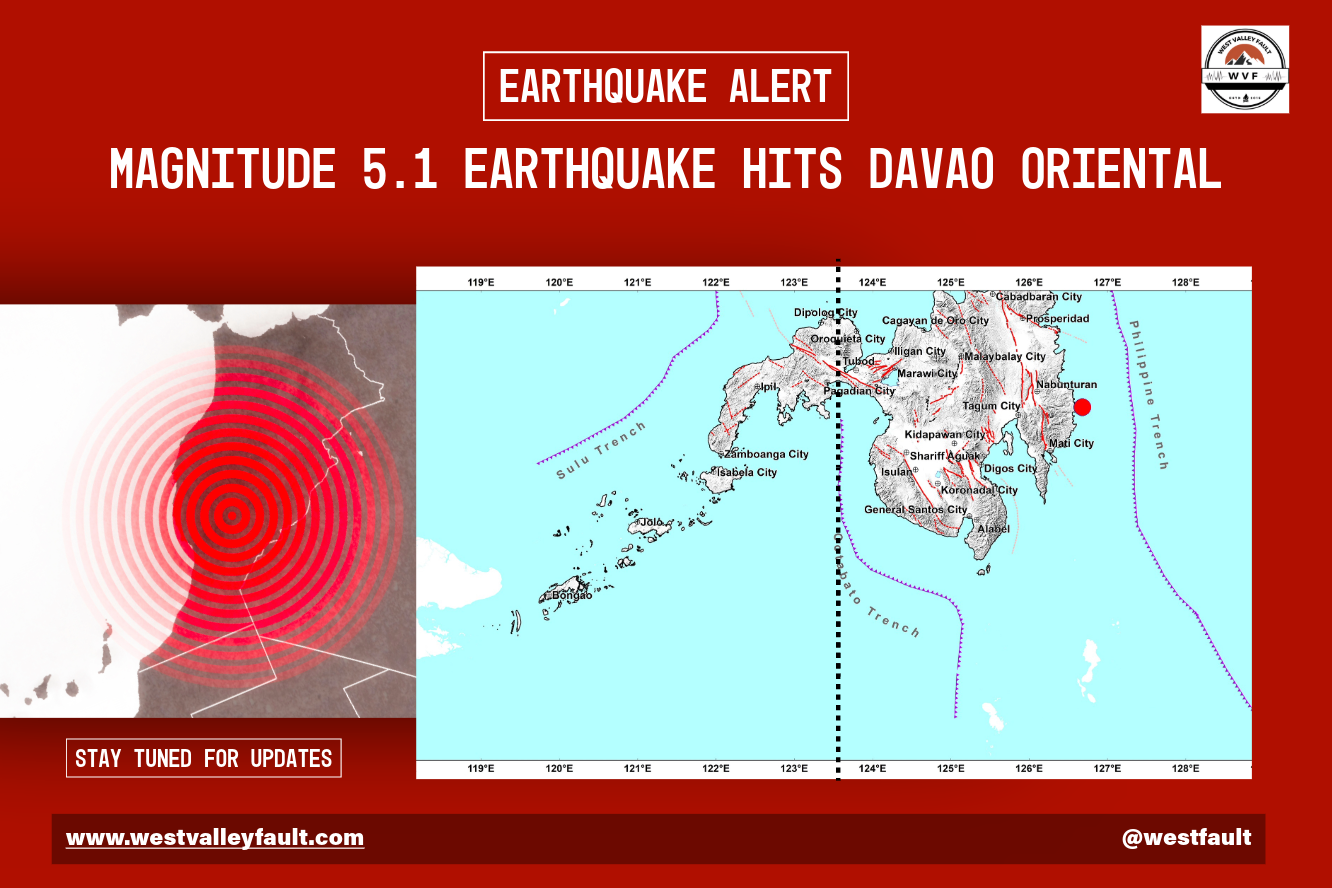
A magnitude 5.8 earthquake was felt by residents of General Luna in Surigao del Norte early Friday morning.
The Philippine Institute of Volcanology and Seismology (PHIVOLCS), determined the epicenter of the earthquake at 94 kilometers northeast of the said municipality.
The tremor was felt at 5:17 a.m. and had a depth of 19 kilometers and was tectonic in origin.
Phivolcs later downgraded the magnitude to 5.1.
The following intensities were reported in these areas:
Intensity III – General Luna, Dapa, and San Isidro, SURIGAO DEL NORTE; Basilisa, Cagdianao,
Dinagat, Libjo, San Jose, and Tubajon, DINAGAT ISLANDS
Intensity II – City of Surigao, SURIGAO DEL NORTE; Loreto, DINAGAT ISLANDS
Intensity I – Tubod, DINAGAT ISLANDS
No damage was reported but aftershocks are expected according to Phivolcs.
AI-Assisted Content Disclosure:
The information below was generated with the assistance of artificial intelligence and is provided for general informational and educational purposes only. While every effort has been made to ensure accuracy and clarity, AI-generated content may contain errors, omissions, or interpretations that do not reflect the latest scientific findings or official guidance.
This content should not be considered a definitive or authoritative source for earthquake-related information. Readers are encouraged to verify important details with official agencies such as PHIVOLCS, the Office of Civil Defense (OCD), and other relevant government or scientific institutions before making decisions or taking action.
Always rely on official advisories during emergencies and disaster situations.
What Does Magnitude 5.1 Mean?
A magnitude 5.1 earthquake is considered moderate. It is generally strong enough to be felt over a wide area and may cause light damage, particularly to older or poorly constructed buildings near the epicenter. Most modern, well-built structures are expected to withstand an earthquake of this size without significant structural damage.
Although a magnitude 5.1 event is far smaller than major earthquakes such as the 1990 Luzon (Mw 7.7) or the 2026 Offshore Sarangani (Mw 7.8) earthquake, it still releases a substantial amount of energy. Because the moment magnitude scale is logarithmic, a magnitude 6.1 earthquake releases roughly 32 times more energy than a magnitude 5.1 event, while a magnitude 7.1 releases about 1,000 times more energy.
Why Did This Earthquake Happen?
According to PHIVOLCS, this earthquake was tectonic in origin, meaning it was caused by the sudden movement of rocks along an active fault beneath the Earth’s surface rather than by volcanic activity.
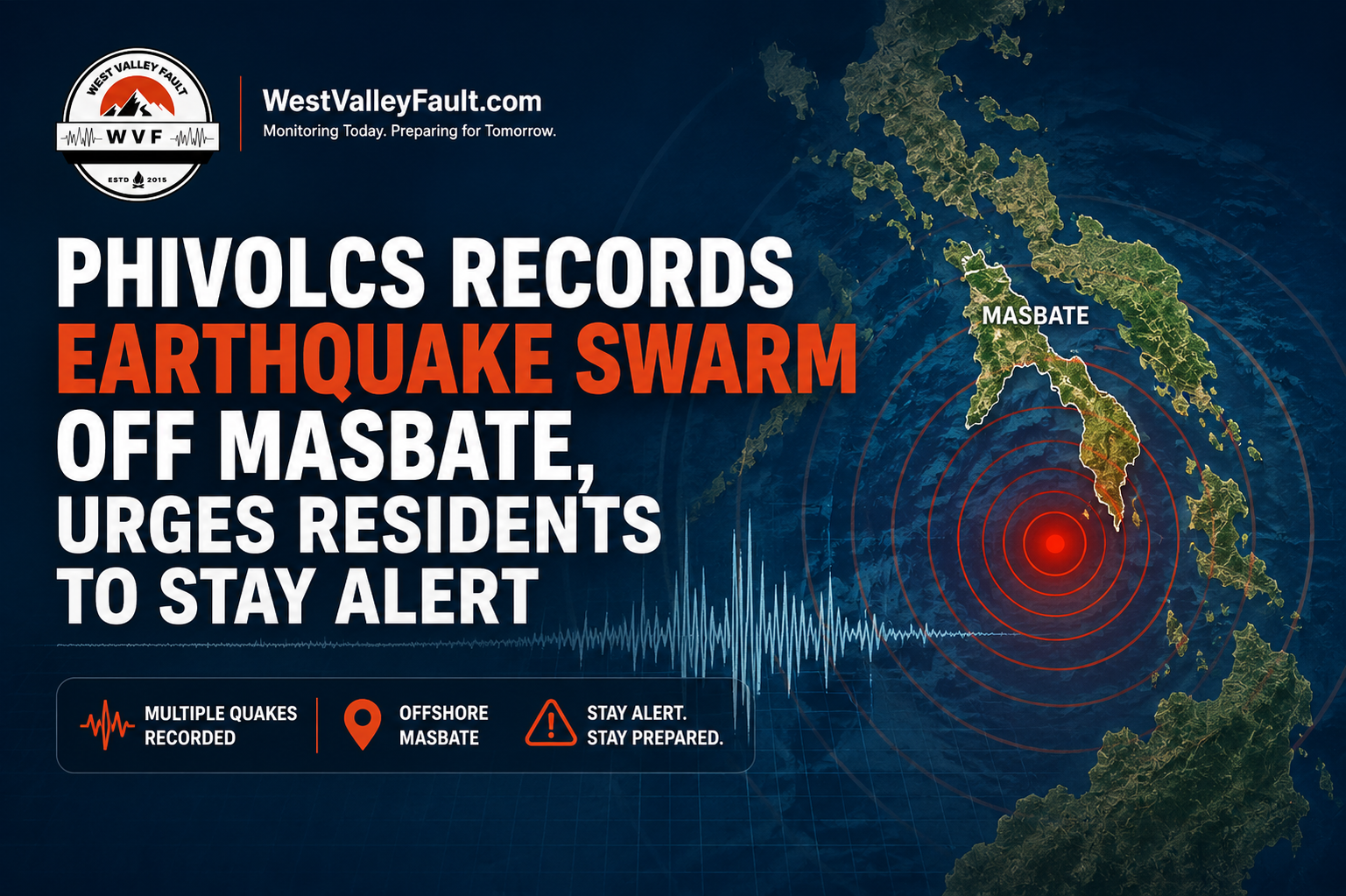
The earthquake occurred near Batuan, Masbate, a region influenced by the complex interaction of the Philippine Fault System and several smaller active faults surrounding Masbate. These faults accommodate the continuous movement of the Philippine Mobile Belt as it is squeezed between the Philippine Sea Plate to the east and the Sunda Plate to the west.
Stress gradually builds up within these faults over many years. When the accumulated stress exceeds the strength of the rocks, the fault suddenly slips, releasing energy in the form of seismic waves that we experience as an earthquake.
Could Aftershocks Occur?
Yes.
Aftershocks are a normal part of the earthquake cycle following a moderate tectonic earthquake. They occur as the Earth’s crust adjusts to the changes in stress caused by the main shock.
For a magnitude 5.1 event, aftershocks are typically:
- Smaller than the main earthquake.
- Most frequent during the first few hours or days.
- Capable of being felt if they occur close to populated areas.
- Able to continue for days or even weeks, although they generally become less frequent over time.
While most aftershocks are weaker, it is not impossible for one to be strong enough to cause additional damage to structures that were already weakened by the initial earthquake.
Could This Trigger Other Earthquakes?
There is no evidence that this earthquake will trigger a larger earthquake elsewhere in the Philippines.
Large earthquakes can slightly redistribute stress within the Earth’s crust, but scientists have found that moderate events such as a magnitude 5.1 generally affect only nearby faults. They do not indicate that “The Big One” or another major earthquake is imminent.
Earthquakes cannot currently be predicted, and a single moderate earthquake should not be interpreted as a warning that a larger event will immediately follow. Instead, it serves as a reminder that the Philippines is an active seismic region where preparedness should always be maintained.
Key Takeaway
This magnitude 5.1 earthquake is a reminder that earthquakes are a normal part of life in the Philippines. While events of this size often result in limited damage, they demonstrate how quickly seismic hazards can occur without warning.
Residents should continue monitoring official updates from PHIVOLCS, remain alert for possible aftershocks, and use every felt earthquake as an opportunity to review family emergency plans and preparedness measures.
Safety Advice
If you experienced this earthquake:
- Be prepared for possible aftershocks.
- Stay away from buildings or walls showing visible cracks or damage.
- Check yourself and others for injuries before re-entering damaged structures.
- Inspect your home for gas leaks, electrical hazards, or other safety concerns.
- Avoid spreading unverified information on social media.
- Follow updates and advisories issued by PHIVOLCS and your local disaster management office.
Remember: Drop, Cover, and Hold On remains the recommended protective action whenever strong ground shaking occurs.
Primary reference: PHIVOLCS Earthquake Bulletin for this event.




















Leave a Reply