
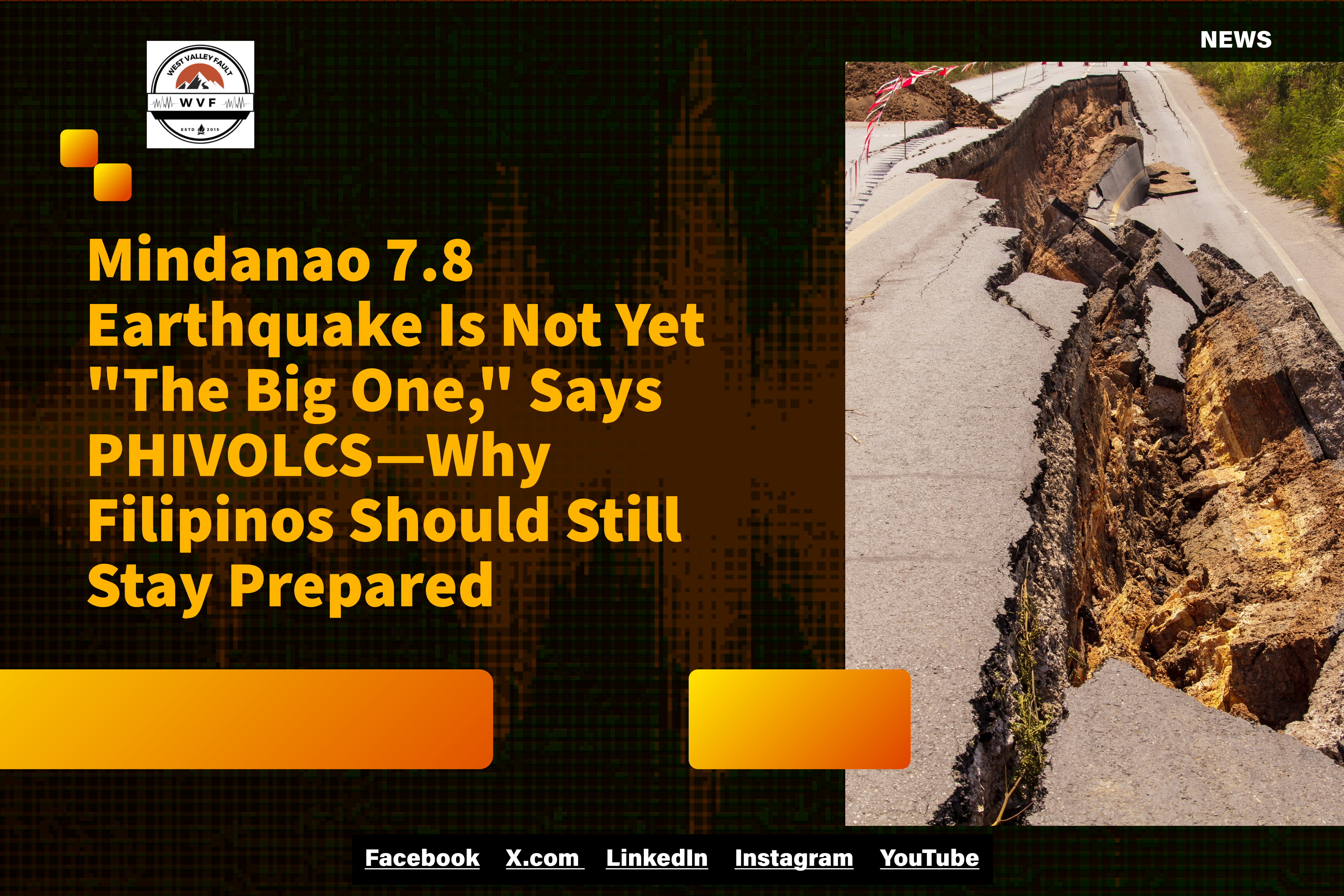
The powerful 7.8-magnitude earthquake that recently shook Mindanao has once again reminded Filipinos that the country sits on one of the world’s most active seismic zones. While the earthquake caused widespread concern and thousands of aftershocks, experts from the Philippine Institute of Volcanology and Seismology (PHIVOLCS) say the event should not yet be classified as “The Big One.”
According to Bhenz Rodriguez, senior science research specialist at PHIVOLCS, “The Big One” refers to the strongest possible earthquake that may occur in a specific area, triggered by a trench or fault.
Why the Mindanao Earthquake Is Different
The recent earthquake originated from the Cotabato Trench and measured magnitude 7.8. Although extremely powerful, scientists explain that it does not represent the maximum earthquake that this trench is capable of producing.
This distinction is important because every active fault system or trench has its own estimated maximum magnitude based on geological studies.
For residents of Metro Manila, the more familiar concern remains the West Valley Fault System.

A magnitude 7.8 earthquake is different from what experts call “The Big One.” Learn why in our complete guide.
Metro Manila’s Own “Big One”
Experts continue to identify the West Valley Fault as one of the country’s most significant earthquake threats.
A complete movement along the fault is projected to generate a magnitude 7.2 earthquake—an event widely referred to as Metro Manila’s version of “The Big One.”
Studies under the Greater Metro Manila Area Risk Assessment Project estimate that such an event could result in:
- Up to 48,000 fatalities
- Approximately $48 billion in economic losses
- Massive damage to homes, businesses, roads, bridges, and public infrastructure
- Long-term disruption of essential services
These projections highlight why disaster preparedness remains a national priority.

Preparedness Starts Before the Ground Shakes
Rodriguez emphasized that earthquake readiness should extend beyond government agencies.
Communities are encouraged to conduct regular earthquake drills while local governments and private property owners should continuously evaluate the structural integrity of buildings and public infrastructure.
More importantly, he stressed that every Filipino family should have its own emergency preparedness plan, including evacuation procedures, emergency supplies, and communication strategies.
Thousands of Aftershocks Continue
The earthquake’s effects are far from over.
Rodriguez explained:
“We can expect aftershocks to continue for two weeks to two months. Over time, the aftershocks will gradually become smaller and less frequent.”
As of 6:00 p.m., PHIVOLCS had already recorded 3,254 aftershocks across 852 locations, with 64 felt earthquakes ranging from magnitude 1.2 to 6.4.
While most aftershocks gradually weaken, some may still be strong enough to damage already weakened structures.

Homes Should Be Inspected Before Reoccupation
Residents whose homes remain standing after the earthquake are advised not to assume that their properties are safe.
PHIVOLCS recommends having structures inspected by qualified structural engineers to identify hidden damage or possible collapse risks.
The same caution applies to people living in landslide-prone communities, where aftershocks may trigger additional hazards even weeks after the main earthquake.
The Takeaway
The Mindanao 7.8 earthquake is a powerful reminder that earthquakes cannot be prevented—but their impact can be reduced through preparation.
Although PHIVOLCS clarifies that this event is not “The Big One,” it serves as another warning that disaster readiness should become part of every Filipino household.
Knowing evacuation procedures, preparing emergency supplies, strengthening homes, and staying informed could make the difference between life and death when the next major earthquake strikes.
Contemplating on how you can get your family prepared?

Take the next step in your preparedness journey.
Download the FREE West Valley Fault™ Quick Start Guide and begin building your family’s emergency plan today.
Related Reading
- The Big One Philippines: What Experts Say About the Next Metro Manila Earthquake.
- Essential Earthquake Survival Kit for Filipinos
- Earthquake Preparedness for Businesses and Industries
- Ideas to Secure Your House Against Earthquakes: Simple Steps for Safety in the Philippines
Source: BusinessWorld




Leave a Reply